








War in Gaza: the victims that no one talks about

According to the United Nations, Gaza’s maternal and newborn healthcare system has been “decimated”.
Select your language
Generated with artificial intelligence.
Listening:
War in Gaza: the victims that no one talks about
In February, Nagham, a 29-year-old living in the Al-Mawasi camp, Khan Younis in southern Gaza Strip was rushed to hospital with bleeding and severe pain. That’s when she learnt she was pregnant.
She is now into her eighth month of pregnancy, which she has described overall as extremely “difficult”.
“The living conditions caused physical and emotional exhaustion, especially after the famine; the stress, the heat, the humidity, and the lack of hygiene,” she tells Swissinfo.
Nagham was unable to attend regular check-ups because the nearest hospital was two hours away and the journey cost more than she could afford. It was only this summer that a humanitarian organisation opened a clinic close to the camp where she could receive medical care. Finding essential vitamins and medication was likewise very difficult and costly.
Recently, she suffered from severe infections and needed antibiotics. Soaring temperatures – an average of 33°C in August in Gaza – combined with extreme humidity made breathing and sleeping difficult.
Nearly three years after the Hamas-led attacks on Israel and the start of Israel’s military campaign in Gaza, more than 73,000 Palestinians have been reported killed according to OCHA, the United Nations Office for the Coordination of Humanitarian Affairs.
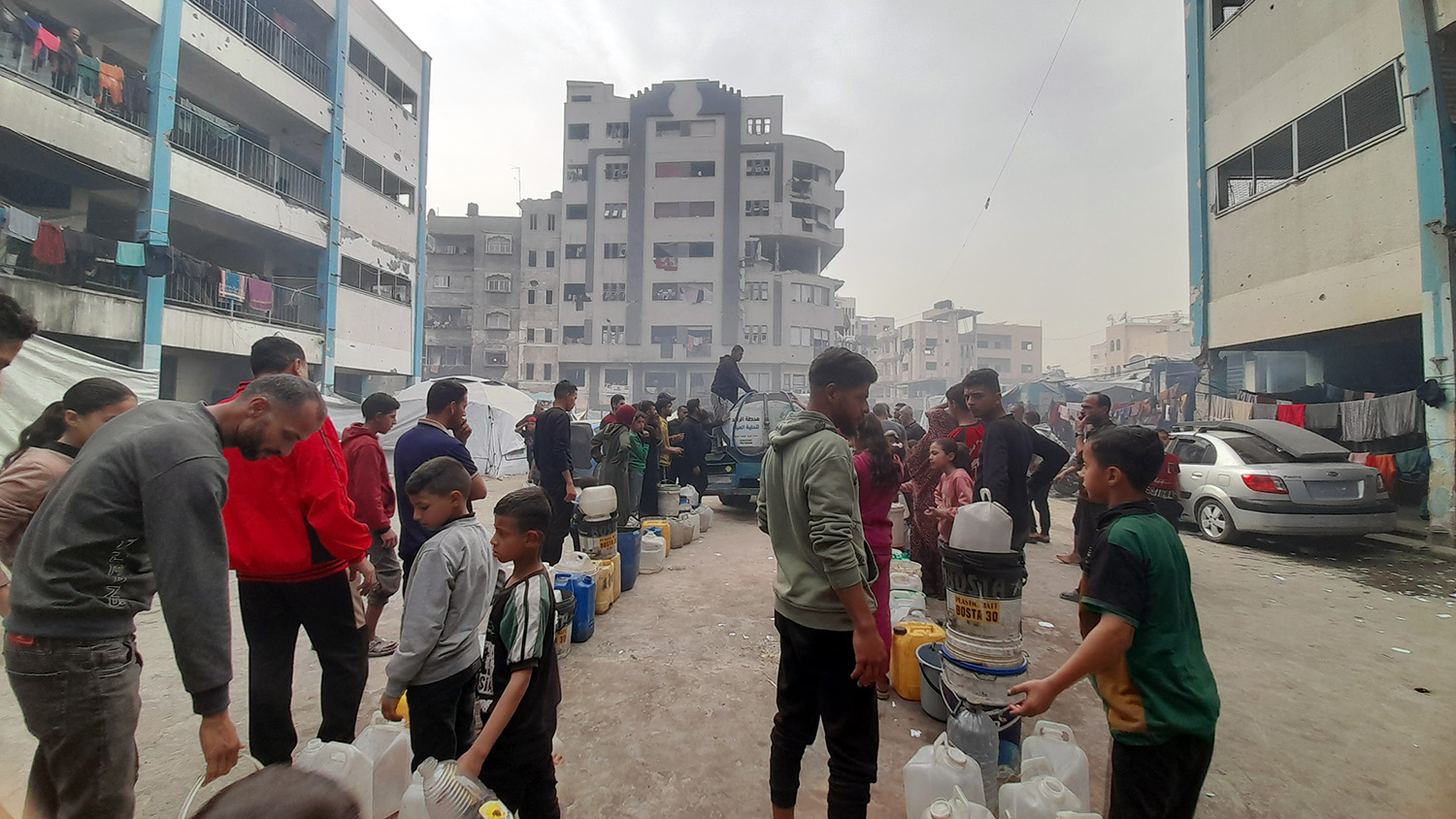
For pregnant and breastfeeding women in Gaza, the war has created particular risks. With much of the healthcare system decimated, access to care remains complicated and expensive. Hygiene conditions are minimal. Women often have no choice but give birth in tents or other makeshift conditions.
According to a study by the London School of Hygiene & Tropical Medicine and Al-Quds University in Gaza City, published by the World Health Organization (WHO) in June 2026, the mortality rate among women who were pregnant on 8 October 2023 was 948 deaths per 100,000 pregnancies. Most died from traumatic injuries.
More
After the ceasefire, survival still defines life in Gaza
Before the war, Gaza’s maternal mortality ratio stood at 30 deaths per 100,000 live births. That compares with 17.9 in the United States and five in Switzerland.
The study’s figures describe a population-level pattern and are not directly comparable with standard maternal mortality rates. They also do not establish the cause of every individual death.
A shattered health system
The broader deterioration of Gaza’s healthcare system has left pregnant women with fewer places to seek treatment.
According to the WHO Israeli attacks over the past three years have reportedly destroyed or damaged almost all hospitals, disrupted medical supplies, and, amid mass displacement and hunger, contributed to sharp increases in maternal mortality, miscarriages, and newborn deaths.
The UN stated in December 2025 that Gaza’s maternal and newborn healthcare system had been “decimated”.
“By the end of 2024, women in Gaza faced a threefold higher risk of dying during childbirth and a threefold higher risk of miscarriage compared with the period before the war,” the OHCHR reported.
Israel’s political and military leaders have consistently said its military’s operations in Gaza are conducted in self-defence, to defeat Hamas and other Palestinian armed groups. They have also insisted that Israeli forces operate in accordance with international law and take all feasible measures to mitigate harm to civilians.
Israel has also said that Hamas is using hospitals in Gaza as shelters and operational bases for its fighters. A UN Commission of Inquiry said Israel had not provided evidence for its broader claim that more than 85% of Gaza’s major medical facilities had been used by Hamas. It did, however, confirm a tunnel and shaft at Al-Shifa hospital and evidence that armed-group members had entered the facility.
Where’s the focus on women?
Since the turn of the century, there has been growing international attention to the specific harms women experience in war. UN Security Council resolution 1325, adopted in 2000, put women’s protection in conflict and participation in peacemaking on the international agenda. International criminal law also addresses sexual violence in war.
Yet reproductive violence receives less global attention, even though international humanitarian law carves out specific protections for pregnant women and infants during armed conflict.

“The war in Gaza illustrates the extent to which violence directed at pregnant, labouring, and breastfeeding women, as well as women struggling to keep their newborn children alive, is completely absent from global political debates about the obligations of parties to armed conflict,” wrote Fionnuala Ní Aoláin, the former UN special rapporteur on counter-terrorism and human rights, in the online publication Just Security in February 2024.
Human rights and medical organisations have pushed to change that. Israel’s military campaign resulted in a 41% decline in births during the first half of 2025 compared with the same period in 2022, according to separate reports published in January 2026 by Physicians for Human Rights and Physicians for Human Rights-Israel (PHRI). The organisations also report significant increases in maternal mortality, miscarriages, neonatal deaths, and premature births.
“The severe and ongoing health and life-threatening risks faced by pregnant and breastfeeding women and their children are the logical consequence of the collapse of the healthcare system, the denial of basic living conditions, and an endless cycle of survival reduced to the absolute minimum necessary to endure,” said Lama Bakri, project leader at the Israeli human rights organisation PHRI.

More
The Board of Peace must address the basic needs of the Palestinian population
These organisations, along with the UN Independent Commission of Inquiry on the Occupied Palestinian Territory, now accuse Israel of deliberately dismantling Gaza’s reproductive healthcare system.
UN investigators and human rights groups say the destruction of reproductive healthcare raises questions under international law. Some argue that violence against pregnant women and children in Gaza could amount to war crimes and crimes against humanity. Those are legal assessments made by the organisations concerned, not final judicial findings.
The UN Commission of Inquiry, for example, concluded in March 2025 that Israeli forces had systematically destroyed maternity wards and reproductive healthcare facilities and had intentionally attacked the Al-Basma fertility clinic in December 2023. These acts have been characterised as reproductive violence and obstetric violence by human rights groups and UN investigators.
In a report to the UN Human Rights Council, the independent UN experts stated that the destruction of maternity wards in Gaza and embryos stored at the fertility clinic could indicate a strategy aimed at preventing births within a particular population group. Under the Genocide Convention, that can constitute genocide if it is carried out with the intent to destroy the group.
Israel categorically rejects the suggestion that it is pursuing a policy intended to prevent Palestinian births and says that no such policy exists. Israel says its objective is to defeat Hamas rather than destroying Palestinians. Hamas led the October 7, 2023 attack that killed 1200 people and does not recognise Israel.
The same commission in September 2025 went further, and said there are reasonable ground to conclude that Israel had committed genocide in Gaza. The commission’s findings were those of a UN investigative body, not a binding judgement by the court. Its findings do not establish genocide occurred. Israel rejected that conclusion.
The commission has not been granted access to Israel or the Palestinian Territories since it was established in 2021. Since the October 2023 attacks, Israel has imposed additional restrictions on the access and activities of other UN bodies and humanitarian personnel.
Deterioration despite ceasefire
Despite the ceasefire that has been in place since October 2025, reproductive health indicators in Gaza have continued to worsen.
Between January and June 2026, 3,958 miscarriages were recorded, according to the OCHA. This represented 208.5 miscarriages per 1,000 live births, a 3.3-fold increase compared with the second half of 2025.
The number of births also declined by 3.2% during the first half of 2026 compared with the same period a year earlier.
Nagham says she sees no change in her access over the past months. “We are still in the same place, in the same tents, under the same hygienic conditions.”
Even when women go to hospitals, they are told that other cases are more urgent.
“There is simply not enough care for pregnant women.”
The WHO reported in early August that there had been 45 attacks on healthcare facilities in Gaza since the beginning of this year.

More
Aid groups say Israeli restrictions leave Gaza without relief despite ceasefire
Edited by Virginie Mangin and Dominique Soguel/livm

In compliance with the JTI standards
More: SWI swissinfo.ch certified by the Journalism Trust Initiative

You can find an overview of ongoing debates with our journalists here . Please join us!
If you want to start a conversation about a topic raised in this article or want to report factual errors, email us at english@swissinfo.ch.