








Aid groups say Israeli restrictions leave Gaza without relief despite ceasefire

Despite a fragile ceasefire that has been in place for nearly nine months, living conditions in Gaza continue to deteriorate. Aid organisations denounce Israeli restrictions on the entry of essential goods, particularly medical supplies.
Select your language
Generated with artificial intelligence.
Listening:
Aid groups say Israeli restrictions leave Gaza without relief despite ceasefire

“For many many, months, the world has been told there is a ceasefire in Gaza. Yet for Palestinian children, this so-called ceasefire has become a cruel and deadly illusion,” said James Elder, spokesperson for UNICEF, during a recent press briefing in Geneva.
“Since the ceasefire was announced in October 2025, 265 Palestinian children have been killed across Gaza,” he added. “That is an absurd and devastating figure. During a period supposedly defined by restraint and protection, a child has been killed, on average, every single day for more than eight months.”
According to figures from Gaza’s Ministry of Health, cited by the UNExternal link, the total number of Gazan casualties during this period stands at 1,053 dead and 3,406 injured.
More
After the ceasefire, survival still defines life in Gaza
Hell on earth
Joan Tubau is head of mission for Médecins Sans Frontières (MSF) in the Occupied Palestinian Territories. “Despite the ceasefire, the humanitarian situation remains extremely critical,” he said. Tubau also lamented the decline in media and political attention, which has shifted toward the war in Iran and its global repercussions.
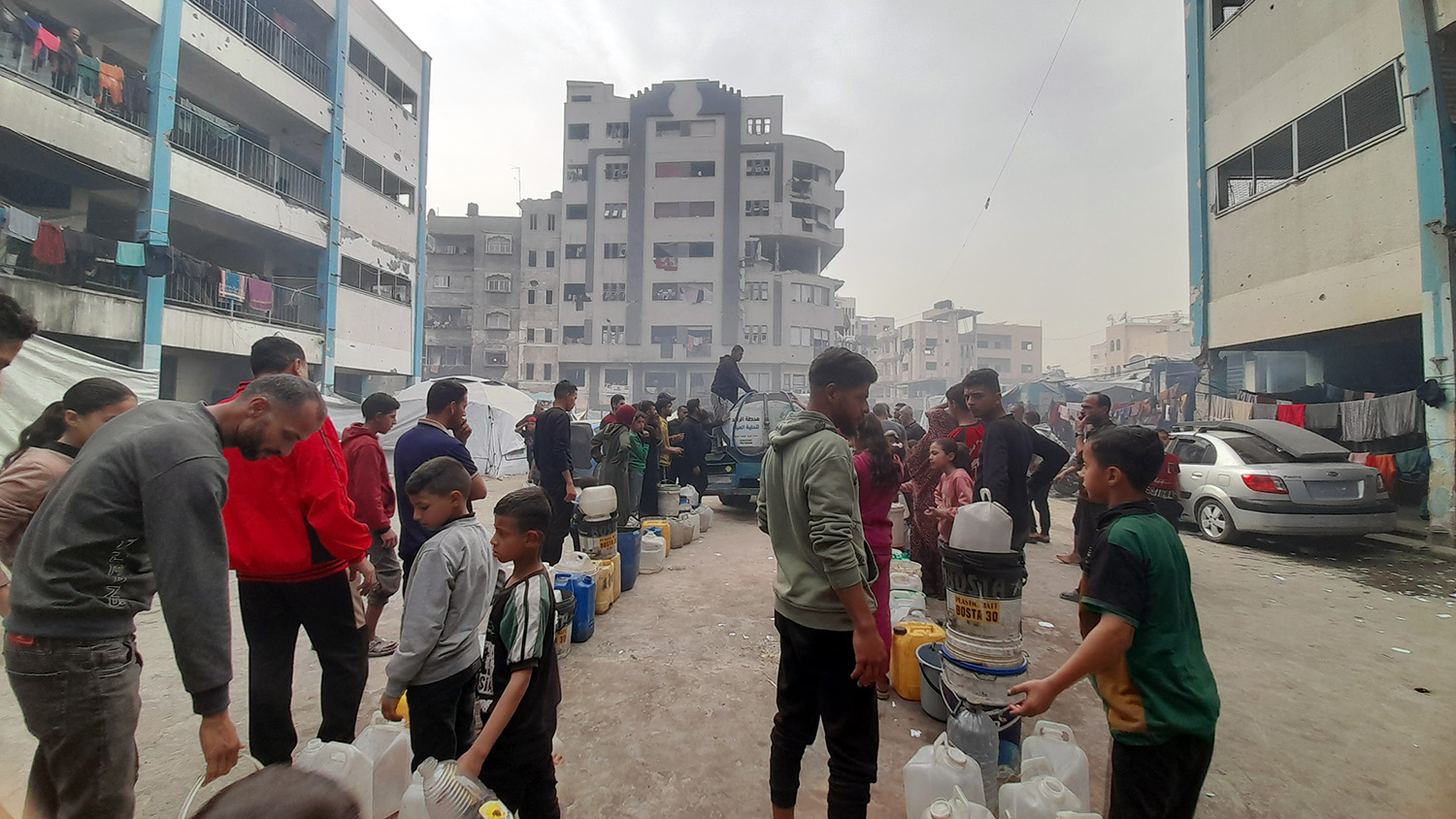
“It is hell on Earth,” he added. “People are living either in tents or in half-destroyed homes, crowded into one-third of what was already one of the most densely populated territories in the world, without adequate access to water or food, and with no effective waste management.” More than two million people in Gaza now live along a narrow coastal strip devastated by two years of war. Although the bombing is less intense than at the height of the conflict, population displacement continues as the Israeli military expands its control over the enclave.

Restrictions on imports
For several weeks, UN agencies and humanitarian organisations based in Geneva have repeatedly warned about Israeli restrictions on the import of certain supplies destined for Gaza.
The restrictions concern what Israeli authorities classify as “dual-use” goods, items they believe could be diverted by Hamas for military purposes. According to humanitarian organizations, this category has gradually expanded to include not only generators, fuel, and motor oil, but also insecticides, tent materials, wheelchairs, and various types of medical equipment.
“It is sometimes very difficult to understand the reasoning behind the prohibition of these goods,” said Tubau. Like many humanitarian workers, he criticised the “arbitrary” and “unpredictable” nature of these restrictions.
MSF is among 37 NGOs whose operations in Gaza were banned by Israel earlier this year. Israel had demanded that the organization provide information about its Palestinian staff, which MSF refused to do on grounds of security and neutrality. MSF continues its work inside Gaza but can no longer send international staff into the enclave or directly import equipment.
>> Several independent UN experts have spoken of genocide in Gaza. Our article explains who makes the decisions, and on what basis:

More
When is a ‘genocide’ really genocide?
Impact on the health system
The consequences have been particularly severe for the health sector, where the hospital system is struggling to recover. According to the World Health Organization (WHO), about half of Gaza’s hospitals are only partially operational, and none function at full capacity.
“One of the key reasons these facilities are not functioning is because they are struggling with critical shortages of medical supplies,” said Dr Reinhilde (Renee) Van de Weerdt, representative for the Occupied Palestinian Territories, during a press conference at the Palais des Nations in Geneva at the end of May.
A prefabricated hospital has been stuck in Jordan for months, while laboratory equipment, reagents, oxygen concentrators, and orthopedic supplies still cannot be delivered, she explained.
“These are the tools we need to save lives, detect diseases, and alert the world to potential epidemics,” she stressed.
The shortages come at a time when medical needs remain acute. According to the UNExternal link, diseases linked to water, sanitation, and hygiene have increased in recent weeks, while treatment for chronic illnesses, trauma injuries, and mental health disorders continues to be severely disrupted.
>> Once the backbone of aid to Gaza, UNRWA is under intense pressure as its future looks increasingly bleak:

More
What is the future of UNRWA?
Israel rejects the allegations
In a document published in JuneExternal link answering frequently asked questions, the Israeli government rejected claims that it is preventing humanitarian supplies from entering Gaza, describing them as “partial, repetitive, and misleading,” and “detached from the reality on the ground.” Israel argues that such claims are circulated “to defame Israel and create a false impression of a humanitarian crisis in the Gaza Strip”.
On medical supplies, the document states that “all requests submitted for the entry of medicines were approved without quantitative restrictions, and their entry into the Gaza Strip is being carried out on an ongoing basis.” Israel instead says the UN and international organizations have coordinated only limited quantities of medical supplies.
Regarding dual-use goods, Israel says it is working with humanitarian organisations “to find and implement approved alternatives or technical replacements that fulfill the exact same civilian medical need without compromising security.”
External Content
Declining funding
While political discussions over the next phase of the peace plan proposed by US President Donald Trump remain stalled, humanitarian organizations are increasingly concerned that funding will dry up.
“We are already seeing some NGOs reduce their water distributions because of funding shortages, even though shortages are severe and summer is beginning,” said Tubau of MSF. “My colleagues and I are very worried about the future. We do not see any light at the end of the tunnel.”
At the end of June, the UN humanitarian response plan for the Occupied Palestinian Territories –estimated at $4 billion – was only 25% fundedExternal link. That level is comparable to funding for crises in Sudan and Haiti, which aid organisations describe as “forgotten” emergencies.
Edited by Samuel Jaberg/livm. Translated from French, sub-edited by Dominique Soguel-dit-Picard/amva

More
Our newsletter on geopolitics

In compliance with the JTI standards
More: SWI swissinfo.ch certified by the Journalism Trust Initiative

You can find an overview of ongoing debates with our journalists here . Please join us!
If you want to start a conversation about a topic raised in this article or want to report factual errors, email us at english@swissinfo.ch.