








After the ceasefire, survival still defines life in Gaza

Nine months after the ceasefire in Gaza, peace remains elusive on the ground. Food queues, water trucks, and torn tents continue to define everyday life as families struggle to meet basic needs. A day spent between displacement camps of Al-Mawasi and Khan Younis in southern Gaza shows that the ceasefire has yet bring about a shift from survival to recovery.

On a morning in mid-June, I left the camp where I live and headed to other camps where friends and relatives had sought shelter. I wanted to check on them, but I was also trying to answer a question that had weighed on me for months: if humanitarian aid is entering the Gaza Strip, why does daily life remain so difficult?
My first stop was to visit my friend, Ahmed, whom I had not seen for weeks. Like so many in Gaza, he and his family are living in a makeshift tent. His mother told me he had gone to the takiya, a community kitchen. She pointed me in the right direction. It took me a few minutes to reach a nearby square crowded with dozens of people holding empty pots.
Ahmed spotted me from a distance. He shared that the family still relies heavily on the hot meals distributed by the takiya. But the community kitchen cannot provide enough meals to meet the needs of everyone in the camp. And so Ahmed, who previously studied English literature at Al-Azhar university, now finds himself queueing for food with hundreds of others.

When distribution begins, the crowd surges forward. Some manage to fill their plates with rice; others leave empty-handed and return to their tents in silence and disappointment. For a moment, I felt a surge of frustration. It was the kind of scene I had expected to disappear after the ceasefire, yet it continues to play out daily.
I asked one of the workers at the takiya why some people could still not get a meal if humanitarian aid is entering Gaza. “The problem is not only the availability of food, but the irregularity of deliveries,” he said. “When supplies are delayed or when the Israeli authorities restrict or slow the entry of goods, the number of meals and their size are reduced.”
Each shipment of food aid passes through a long chain of procedures and restrictions imposed by Israeli authorities at crossing points. Any delay is quickly reflected in the kitchens that thousands of people rely on daily. “On some days we know in advance that we will not be able to feed everyone,” says the kitchen worker.

More
Aid groups say Israeli restrictions leave Gaza without relief despite ceasefire
Seeking water, medicine and shelter
The scale of the need is immense. According to the World Food Programme, around 1.6 million people in Gaza – most of the population – depend on food assistance. The United Nations Office for the Coordination of Humanitarian Affairs reports a continued decline in the capacity to provide hot meals in Gaza, alongside a drop in the number of operational kitchens and persistent difficulties in the regular delivery of supplies. Save the Children warns that 80% of children in Gaza face catastrophic levels of hunger.
Gazans’ reliance on aid extends far beyond food. Later that day, I visited another friend, Yousef, whose lifelong dream was to become an engineer. As we talked, the repeated honking of a water truck echoed through the camp. Without hesitation, he broke off our conversation. “I will be back in a moment,” he said. “I need to fill the water jerrycans before the supply runs out.”
I followed him. Within minutes, dozens of people had gathered around the truck, clutching jerrycans and plastic containers. The urgency with which families rushed to fill containers betrayed their fear of supplies becoming exhausted. I asked one of the workers responsible for water distribution whether scenes like this were common.
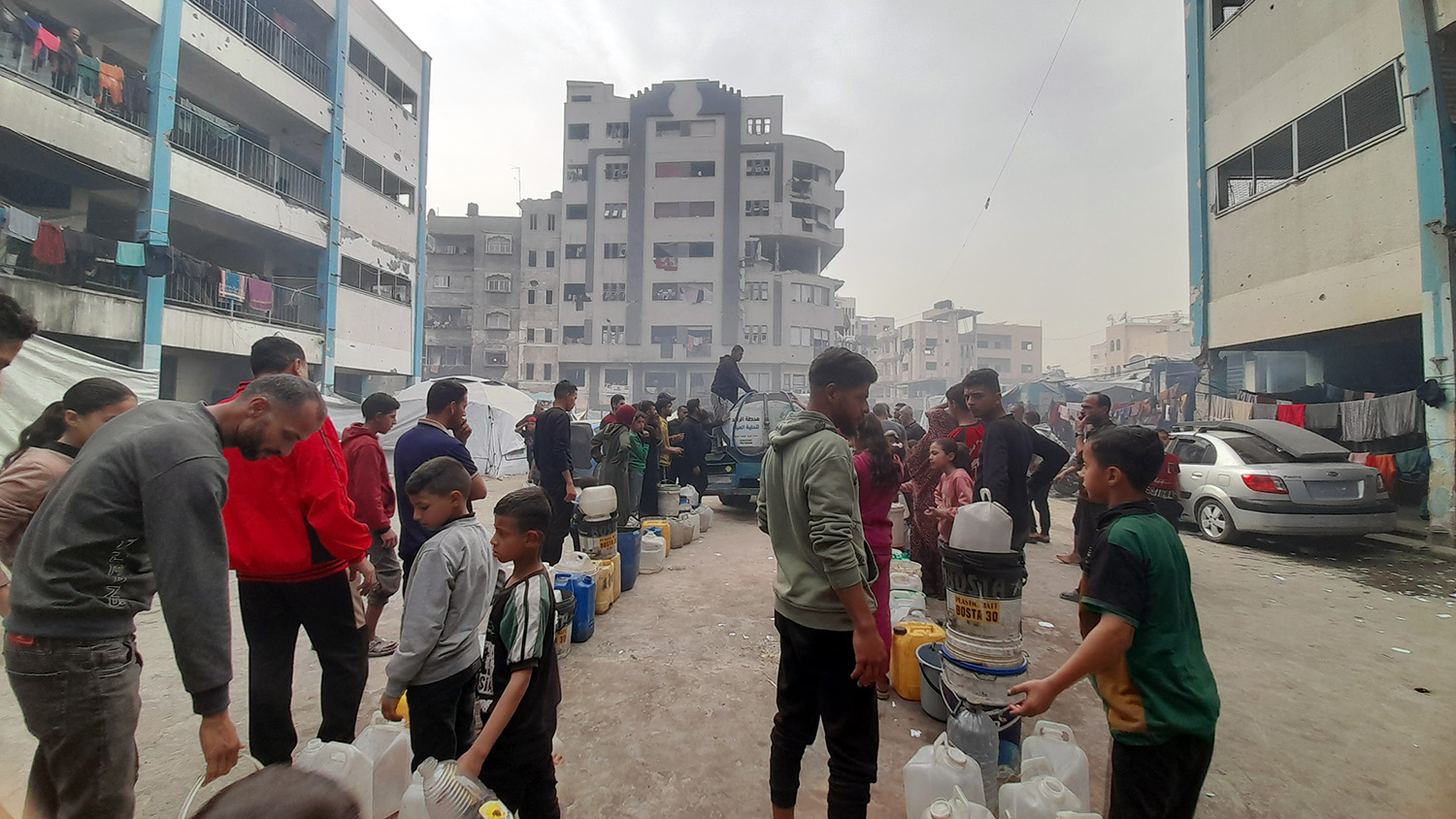
“Yes, this happens every day,” he replied. “Israel destroyed around 90% of the infrastructure during the war, and repairs are still slow due to Israeli restrictions and obstacles on reconstruction efforts. As a result, more than 80% of displaced people rely on water trucks.”
Water is not just essential for drinking. Without enough of it, families cannot cook, wash, bathe or maintain basic hygiene. In recent months,External link health and humanitarian teams have recorded an increase in water- and environment-related diseases, driven by overcrowding, the deterioration of sewage systems, and lack of hygiene supplies.
My next stop was a small medical point serving one of the displacement camps. There I met my 26-year-old friend Khalil, an aspiring barber who had been forced to abandon his training to care for his father after he was wounded in an Israeli strike during the ceasefire. That day, they had come to have the dressings on his father’s leg wound changed.
Inside, patients filled the waiting area as overstretched medical staff struggled to keep pace with demand. I asked one of the healthcare workers what people were seeking most these days. “Medicines,” he replied without hesitation.
He also explained that medicines often become available only briefly, before stocks run out again, forcing patients to search from one facility to the other. Others need specialised care outside Gaza but have spent years waiting for permission to travel. Even when treatment is available elsewhere, access is far from guaranteed.
“We’re a medical point, yet most of the time we can’t find basic medicines or even wound dressings,” says the healthcare worker. “One of our patients has been waiting for hours because we still haven’t been able to find the dressings needed to treat his wound.”
His account reflects a broader crisis. The World Health Organization says Gaza’s healthcare system is in rapid decline. Hospitals face acute shortages of medicines and equipment. The shortages are a result of restrictions imposed by the Israeli authorities on the entry of goods, as well as repeated attacks on health facilities. Doctors and nurses continue to work under immense pressure while enduring many of the same hardships as their patients.
The collective vulnerability of Gazans is most visible in the conditions of shelter itself.
My final stop was to visit Yasser, who has been living with his wife and two children in a tent for more than two years. When I arrived, he was trying to stitch a torn section of the tent roof using worn scraps of fabric. I asked him how many times he had repaired the tent. “I stopped counting,” he replied with a bitter smile.
He pointed to different sections of the roof and walls, “Every part here has been repaired more than once,” he said.
Yasser said his family had hoped the so-called ceasefire would bring in larger quantities of shelter materials and mark the beginning of reconstruction. But nothing has changed for them. They are still stuck in the same tent, in the same camp, where rodents and bugs have also made their home.
“This tent can’t protect us from the summer heat or the insects,” Yasser said. “So we spend hours by the sea, just like thousands of other displaced families.”

By the end of my tour, I understood these are not isolated stories but fragments of a shared reality. In Geneva, the United Nations and humanitarian agencies discuss the mechanics of aid delivery, building plans on the assumption that humanitarian access in Gaza should be stable and continuous. But that assumption collides with reality on the ground.
Israeli restrictions on crossings, shifting security conditions, and infrastructure destroyed during the war continue to shape daily life. Here, aid is measured in a meal delivered after hours of waiting, a water tank arriving at a crowded camp, medicine found after a long search, or a tent that lasts one more day.
Nine months after the ceasefire in Gaza, I am left with a different question. I no longer ask myself whether aid is entering Gaza or not, but whether it is reaching people in a stable and sufficient way for those who depend on it to survive.
Edited by Dominique Soguel/livm/ac
More
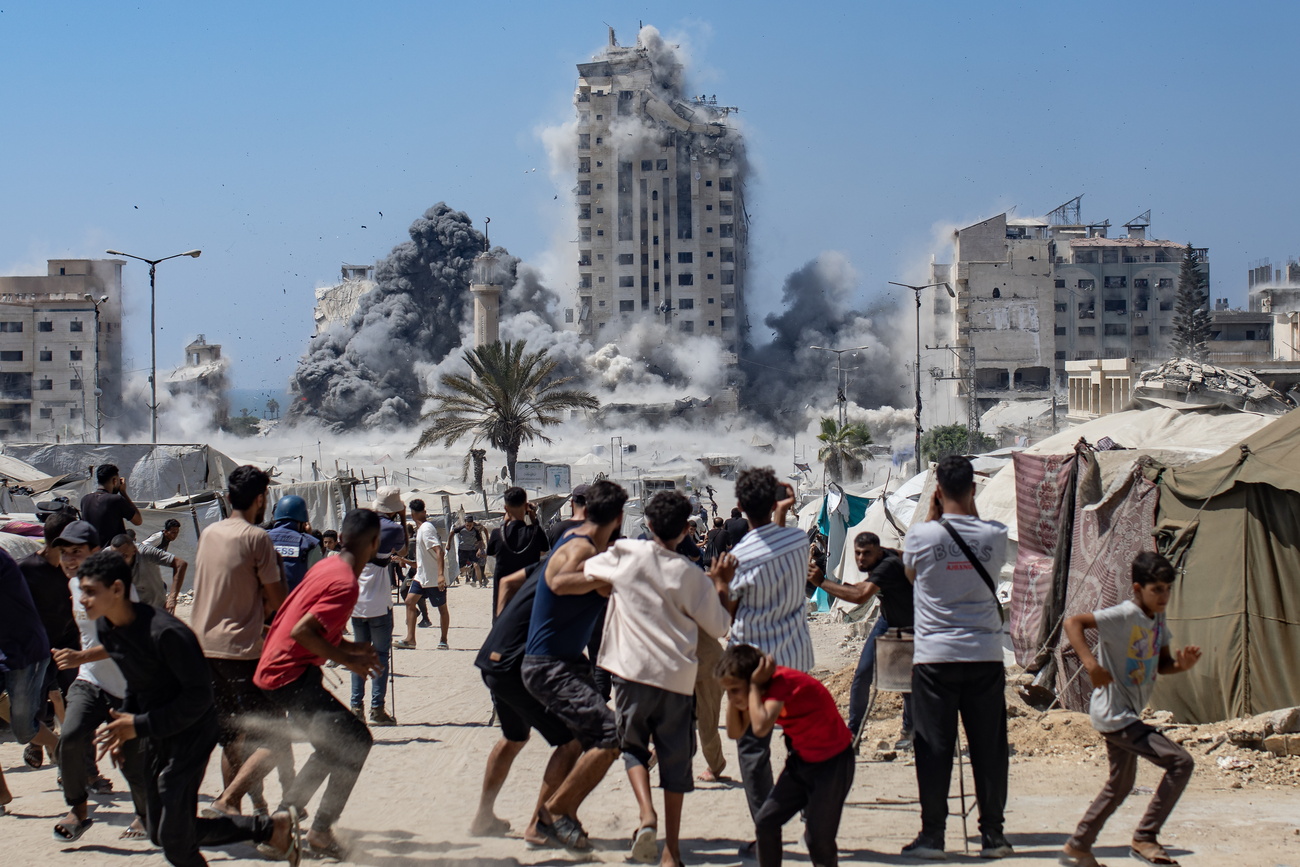
The humanitarian cost of Israel’s war in Gaza
External link
In compliance with the JTI standards
More: SWI swissinfo.ch certified by the Journalism Trust Initiative

You can find an overview of ongoing debates with our journalists here . Please join us!
If you want to start a conversation about a topic raised in this article or want to report factual errors, email us at english@swissinfo.ch.