








Swiss neutrality and food security initiatives suffer hefty defeat

Swiss voters want no big overhaul of neutrality policy: a proposal for a stricter constitutional definition is heading for resounding defeat. An initiative to boost domestic food production has also been soundly rejected. Final results will follow later this afternoon.
Select your language
Generated with artificial intelligence.
Listening:
Swiss neutrality and food security initiatives suffer hefty defeat


Is Switzerland neutral enough? For most citizens, the answer is clearly yes: after polls closed Sunday, projections by the gfs.bern research institute indicated that around 70% are set to reject the “neutrality initiative”, which proposed a strict constitutional definition of it. The extent of the rejection is even heftier than opinion polls had predicted.
Lukas Golder, co-director of gfs.bern, told Swiss public broadcaster SRF on Sunday that voters had not rejected neutrality, but opted for a more “nuanced” version of it – including sanctions, concretely against Russia. A majority clearly believe neutrality should leave “room for manoeuvre to politicians and the government”, rather than being permanently pinned down, he added.
External Content
The initiative, launched by the pro-sovereignty association Pro Schweiz, crystallised debates about neutrality sparked by Russia’s 2022 invasion of Ukraine – and, in particular, Bern’s subsequent mirroring of European Union (EU) sanctions on Moscow.
Claiming this watered down the country’s traditional stance, and served neither Swiss interests nor international peace, the proposal wanted no more such sanctions in future – unless approved by the UN Security Council. Its definition of a “perpetual and armed” neutrality would also have reduced cooperation with military alliances like NATO, except in case of imminent war.
>> Less flexibility, more clarity? Read more about what the neutrality initiative aimed to achieve:
More
Should Swiss neutrality be stricter? Voters will decide
How much cooperation is too much?
On Sunday, Centre Party Senator Marianne Binder-Keller told SRF that the initiative would have led Switzerland into “total isolation” at a time of new security challenges. The result is a signal that the country is “part of the Western, rules-based security architecture, is a partner for cooperation, and participates in sanctions” in cases where international law is breached. Such a stance also serves Swiss security interests, she claimed.
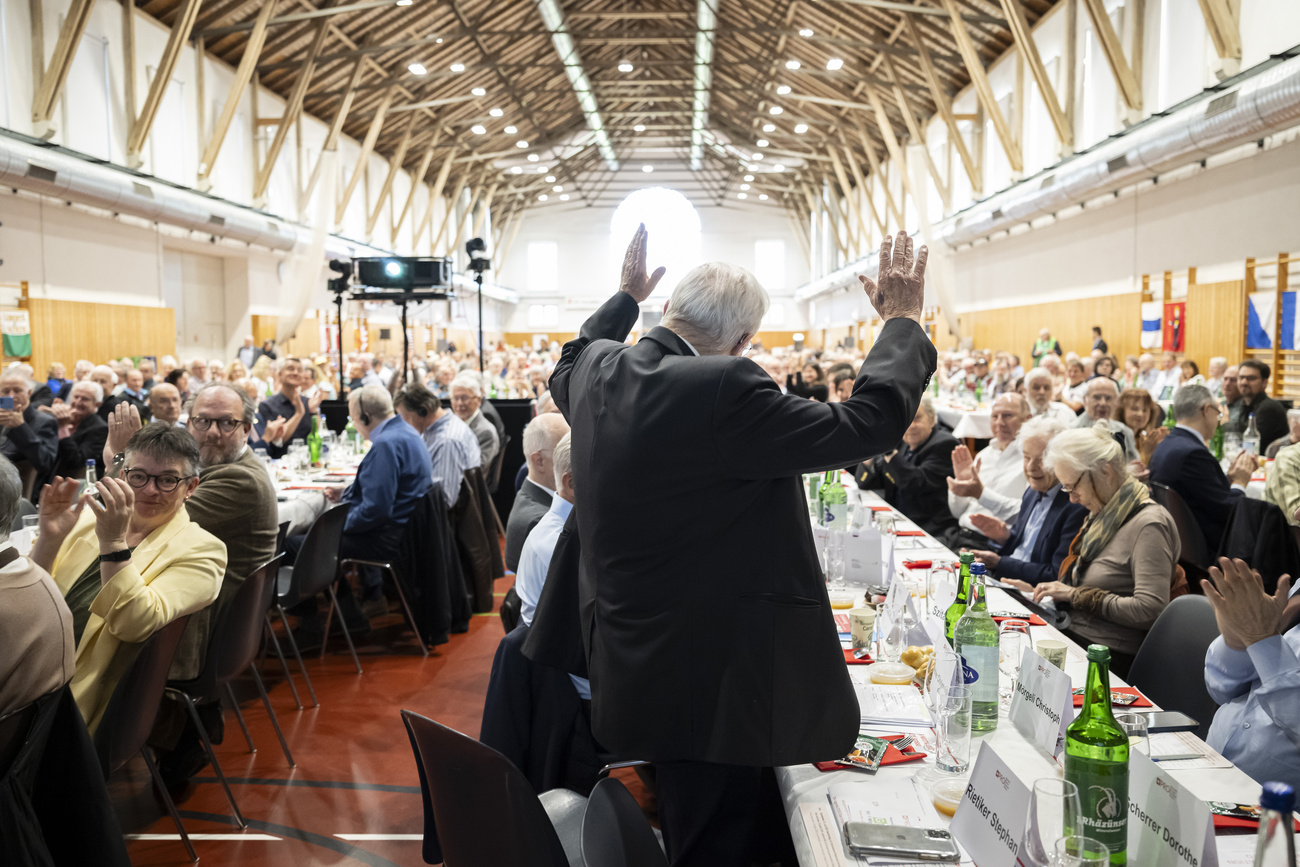
But for Stephan Rietiker, president of Pro Schweiz, the key question is how far such “cooperation” stretches. “Does it mean integration into the military structures of NATO, or does it mean preparations in case of a possible attack?” he told SRF. The initiative would still have allowed room for the latter, he claimed – but it struggled to get this message across.
Indeed, despite ample funding – including from billionaire and former government minister Christoph Blocher – polls early in the campaign made it clear the initiative was fighting an uphill battle. While it had some backers on the pacifist left, just one big political group, the right-wing Swiss People’s Party, was in favour. All other parties and the government rallied around the status quo: a neutrality that respects the Hague ConventionsExternal link while allowing flexible responses to geopolitical changes – including sanctions. They also denied the country had shifted course. “Switzerland was neutral, is neutral, and will remain neutral”, Foreign Minister Ignazio Cassis said several times in the campaign.
The initiative also struggled to attract support with imagery based around a dove and the “give peace a chance” slogan – Switzerland, its argument claimed, could do more good with its diplomatic mediation than with sanctions against warring states. Opponents countered that the initiative was “pro-Putin”, and that ultra-strict neutrality can end up helping the aggressor – an argument helped when the Kremlin itself spoke out in favour of the proposal.
Ultimately, if defeat for the initiative doesn’t mean an end to Swiss neutrality, it doesn’t mean an end to debates about it either. Bern will remain out of conflicts – and out of military alliances – but still faces questions about its place at the heart of a rearming Europe, and how much cooperation it wants with NATO and its neighbours. Swiss voters will soon tackle similar questions: in November, a referendum is scheduled on a proposed easing of the country’s weapons’ export rules.
More

Food security fares even worse
As predicted by the polls, the food security initiative – which aims to boost Switzerland’s self-sufficiency in food production – is also heading for clear rejection. According to latest gfs.bern projections, around 72% of voters came out against it on Sunday, with a very clear “no” vote across the whole country.
Although the issues raised could certainly have garnered majority support, Golder told SRF that the initiative had sought to achieve too much too quickly. For her part, Franziska Herren, who led the initiative, told SRF that “we did nothing wrong”. She added that it had been “surreal”, to say the least, to see how the entire political establishment had opposed the initiative. Herren warned that despite the result the problems relating to water resources and agriculture in the context of climate change still remain as before.
“The public did not want to be deprived of the freedom to choose for themselves what they ate,” said Petra Gössi, a representative of the opposing camp. According to Gössi, a centre-right politician from the Radical Liberal Party, Swiss agricultural policy still remained an issue, but the market also played a part in determining it and condemning meat was not a viable option.
Anne Challandes, vice-president of the powerful Swiss Farmers’ Union, was pleased with the clear result. “This is a show of support for farming families,” she said.

Largely overshadowed by the debates around the neutrality initiative, the proposal failed to gather any steam during the campaign. In theory, it should have received more support from farmers as it aimed to boost Swiss self-sufficiency in food production from 46% to 70% in a decade by promoting the domestic cultivation and consumption of plant-based food. Instead, the farming community perceived it as an existential threat due to fears that it would affect meat and dairy consumption.
With a campaign budget of CHF1.63 million ($1.96 million), the ‘no’ camp comprising associations representing the meat and dairy industries, as well as the Swiss Farmers’ Union, attempted to take the wind out of the sails of the food security initiative (budget CHF720,000) quite early in the campaign. They framed the issue as a “vegan diktat” telling people what they should eat, even though the initiative text does not prescribe a specific diet or call for any restrictions on meat production. To make matters worse, no political party besides the Young Greens backed the initiative and even environmental organisations like Greenpeace and WWF did not endorse it.
>> Switzerland may not be ready for more plant-based fare but other places are:

More
Dutch cities are banning meat advertising – will Switzerland follow?
The result proves that the farming lobby is still a formidable opponent in Swiss politics, especially without the support of the political left and Greens. Like previous attempts to make Swiss farming more sustainable, the food security initiative faced an uphill task to win over voters. Most of all, it had a fatal flaw that sank similar initiatives like the pesticide ban initiative and the drinking water initiative in 2021, as well as the biodiversity initiative of 2024: good intentions but too ambitious.
More


In compliance with the JTI standards
More: SWI swissinfo.ch certified by the Journalism Trust Initiative

You can find an overview of ongoing debates with our journalists here . Please join us!
If you want to start a conversation about a topic raised in this article or want to report factual errors, email us at english@swissinfo.ch.