








Ten years after Brexit, the ‘Swiss model’ just keeps popping up
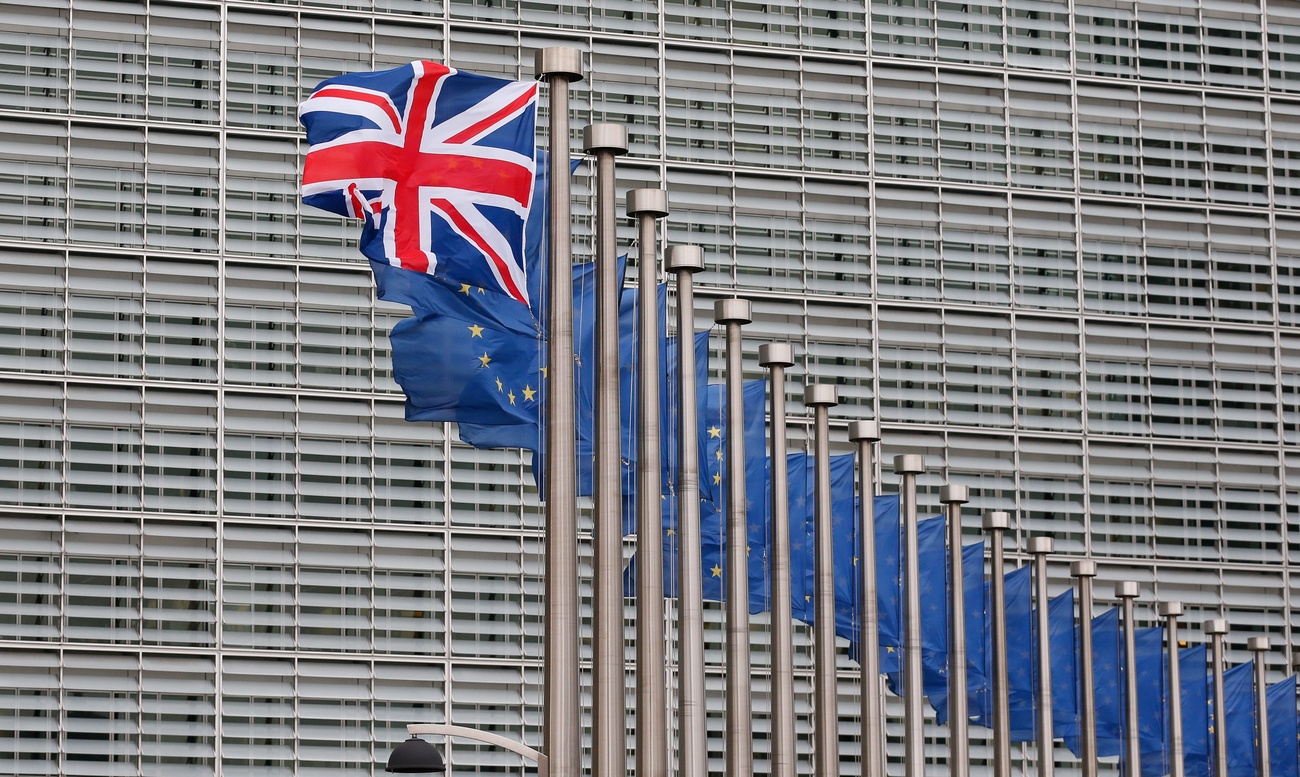
A decade ago, Switzerland was seen by Eurosceptics in Britain as a model for staying free of Brussels. In 2026, pro-Europeans see it as a way to get closer again. We analyse what happened in between.
Select your language
Generated with artificial intelligence.
Listening:
Ten years after Brexit, the ‘Swiss model’ just keeps popping up

In the decade since the United Kingdom voted to leave the European Union (EU), the term “Brexit” has led a lively career. Much more than a foreign policy choice, it became the synonym for the major faultline of British politics, splitting the nation between tribes of “Remainers” and “Leavers”. Abroad, it fed similar debates: Grexit, Frexit, Swexit. More recently, with many Brits unhappy with the course of things, there are rumblings of “Bregret”.
Another term with a busy ten years behind it is the “Swiss model”. This one, by contrast, is not new: Switzerland’s unique way of dealing with the EU has muddled along for decades. But Brexit gave it sudden relevance. Seen from the UK, it was proof – for better or worse – that there is life in Europe beyond Brussels. Switzerland, a non-EU member, manages to trade, interact, and seemingly benefit from its neighbours. Could Britain do the same?
To date, it hasn’t worked out like this. Brexit Britain became, well, Brexit Britain. And yet talk about the Swiss model never really died down. First, it was by right-wing figures like Nigel Farage; ten years on, with the EU and UK aiming to “reset” relations, it’s left-wing strategistsExternal link and Financial Times columnistsExternal link. What’s behind the Swiss model’s enduring post-Brexit appeal – despite the fact that it faces so many challenges of its own?

A model misunderstood?
One half-serious answer is that nobody understands what the Swiss model actually is. Even in Switzerland it’s not always clear. For some, it’s a “customised quasi-membershipExternal link” of the EU; for others, it’s the core of an old struggle to stay free of it. But in a heated context like the Brexit referendum, vagueness can be useful. Switzerland simply looked like it was getting from Europe what the UK always wanted: “maximising economic integration gains and minimising sovereignty losses”, as Sandra Lavenex from the University of Geneva puts it.
But “in the early days there was clearly some misunderstanding of the constraints of the Swiss model”, Lavenex says. Access to the EU’s internal market isn’t free. As part of its web of bilateral treaties, Switzerland takes over large sections of EU law – without having a real say in making it. It also accepts the free movement of people, a clear post-Brexit “red line” for the UK. And despite its image of political stability, EU ties have been a hot political potato for years in Switzerland, not to mention in Brussels itself.
Ten years on, is the understanding better? Right-wing Brexiteers have at least cooled on the Alpine references. Farage once said Switzerland was an “inspiration” for Brexit; he has since likened a Swiss model to a “betrayal” of it (he also seems to have cooled on calls for direct democracy). As for more recent ideas about Swiss-style “dynamic alignment”, Martin Wolf of the Financial Times usually knows what he’s talking about. But does he believe the option would be accepted by the EU – or by “Leavers” in the UK?
Read more: Bern and Brussels have recently found some common ground – but for how long?

More
In Swiss-EU relations, is the era of cordiality over?
A model with something for everyone?
This raises another feature of the Swiss model: it is understood, but selectively. Initially, the sovereignty aspects of it were in vogue: in the heat of a referendum campaign, the idea of a small nation resisting Brussels, à la William Tell, is catchy. But this was mainly “rhetoric, which was instrumental in making a point”, says Giorgio Malet from the Swiss federal technology institute ETH Zurich. “Like support for direct democracy, it quickly dissipated”.
The Swiss option soon got put to other uses. From right-wing ideal, it became a right-wing bogeyman – a warning model used by opponents of any Brexit implementation they deemed too soft. Then-Prime Minister Theresa May’s 2018 Chequers plan, which had some similarities to the Swiss model, caused ructions in the Conservative Party. Two years later, the UK chose a hard Brexit under Boris Johnson. Switzerland, in this context, “is much more integrated than what the UK would have accepted”, Malet says.
And in 2026? With a Europe-friendlier Labour government in London, the Swiss model is seeing another revival – as a sensible economic option for troubled times. Without ditching all red lines, the argument goes, why not be more Swiss and make sectoral quid pro quos with the EU? This could mean concessions on things like the free movement of people. But “political pain” could be offset by “economic gain” via access to European supply chains and markets, the Labour Movement for Europe has writtenExternal link.
Again, some of this could be political positioning, especially with Prime Minister Keir Starmer’s position in the Labour Party being challenged. “Positions on Europe are being used by potential leadership figures to signal something for domestic political reasons”, Anand Menon from the UK in a Changing Europe think-tank told the ObserverExternal link in January. As for the Swiss model, “we are talking to ourselves about something the EU is not necessarily going to give us”, Menon said.
Read more: how does the Swiss model of sectoral deals with the EU work – and what’s at stake in the pending update?

More
The Swiss-EU bilateral treaty updates, explained
A model whose time has come?
Menon is not alone in his scepticism. Whether Switzerland and the UK are comparable is one thing. Another is that since Brexit, the EU has been clear about not wanting another “cherry-picker”: a non-member who manages to benefit from the best bits of the club. It is even fed up with Switzerland doing this: the new package of EU-Swiss deals, currently being debated in Bern, is itself the outcome of a long stand-off about the feasibility of the Swiss model.
For Malet, the most logical moment to have spoken about a Swiss model for the UK was just around the 2016 vote – before the UK locked in its red lines, and before Swiss-EU ties hit rocky times themselves. Overall, Malet reckons, with Britain and Switzerland facing similar dilemmas regarding Europe, the models are useful to compare. “But the starting points and goals are very different.”
At the same time, things are changing in Europe, he adds. War in Ukraine has pushed some states closer to the EU. Among others, Iceland and Norway are mulling membership amid what the latter’s foreign minister cited as a shift from a “benign world” to a “crazy world”. The EU has also become a “bit more flexible” in this geopolitical context, Malet says – which he reckons may also have benefitted Switzerland’s wait-and-see strategy towards the bloc.
Increasingly aware of the economic fallout of Brexit, the UK is trying to get closer to Europe too. It has rejoined the Erasmus+ student exchange. On trade, it is already testing a rather Swiss-sounding “dynamic alignment” approach: following EU rules in certain sectors in order to cut red tape for businesses. Ahead of an EU-UK summit this summer, Britain is “quietly de-Brexiting”, the Economist recently wroteExternal link – with yet another reference to the Swiss model.

A model for confusing times – or a model of confusion?
Whether the EU is open to British wooing is unclear. But a recent surveyExternal link shows that the public mood in the UK is shifting too. Ten years after Brexit, a majority regret it. Only 31% want things to stay as they are with Brussels, while 56% even want to rejoin the EU. Time for a spectacular return to the fold? For the former House of Commons Speaker John Bercow, it’s not impossible – but “extremely unlikely” within the next five years, he recently toldExternal link the Neue Zürcher Zeitung. “In politics, things take time,” he said.
As for other forms of rapprochement, Lavenex from the University of Geneva points to one advantage of the British system of representative democracy. In theory, it could be easier for the UK to make deals now with Brussels on thorny sectoral issues, without the threat of a referendum like in Switzerland. At the same time, with Farage’s Reform UK party polling strongly, the limits of such political bandwidth are clear. In a few short years, everything could be different again.
This raises a last explanation for the recurring talk of the Swiss approach. Models famously offer orientation in a confusing reality. And given the rate of change in UK and European politics in the past decade, it’s hardly surprising so many have popped up – whether Norway, Canada, Turkey, or Switzerland. Currently, as the Swiss model faces its own shifts – a public vote on the new package of bilateral deals could happen next year – it may not be the clearest blueprint. But in uncertain times, even a shaky reference point could be better than none.
Still trying to figure out if the Swiss model really would be a good fit for the UK? Some advice from 2022:

More
Dear Brits, bury the dream of the Swiss model!
Edited by Mark Livingston/gw

In compliance with the JTI standards
More: SWI swissinfo.ch certified by the Journalism Trust Initiative

You can find an overview of ongoing debates with our journalists here . Please join us!
If you want to start a conversation about a topic raised in this article or want to report factual errors, email us at english@swissinfo.ch.