








Gaza: where’s the reconstruction?


The ceasefire in Gaza was agreed more than ten months ago.
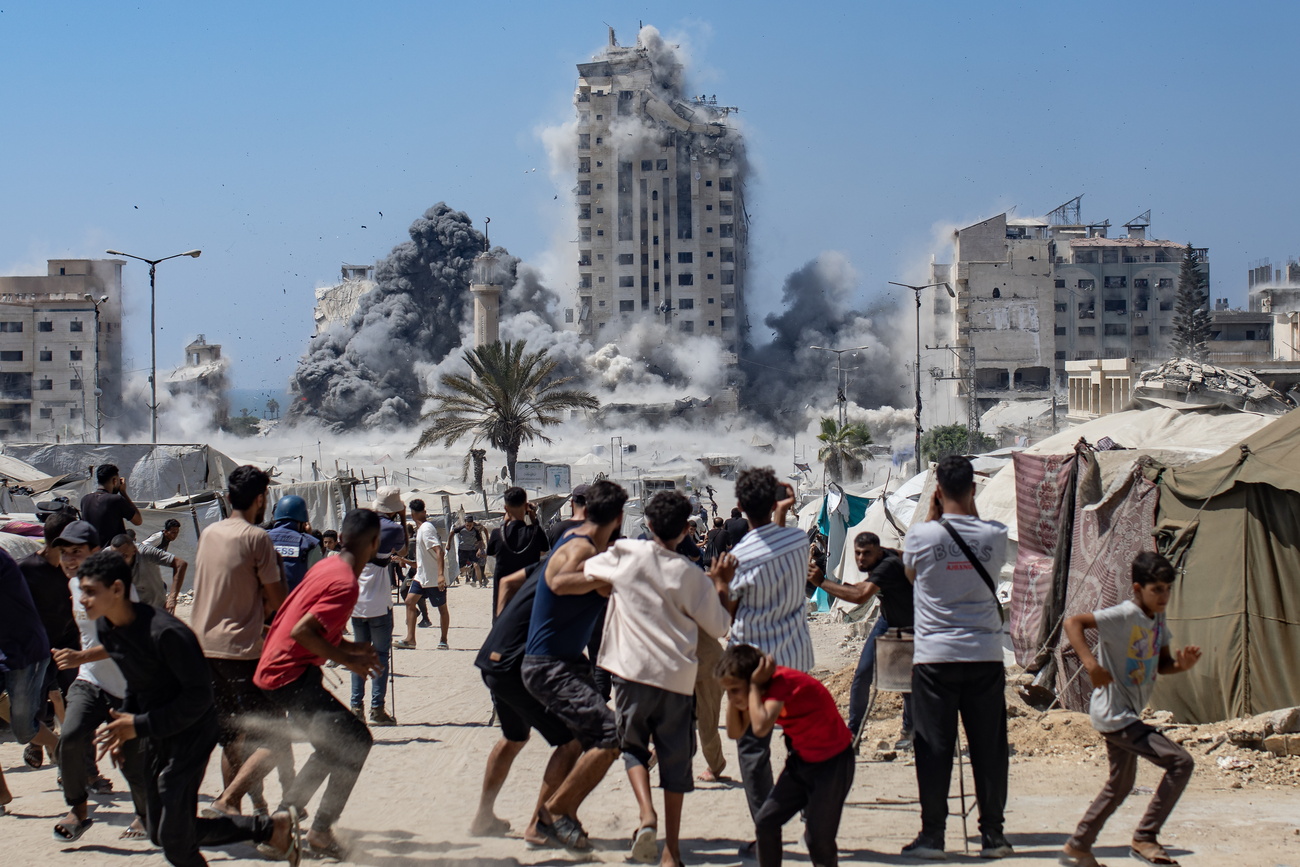
Although there has not been a complete end to violence – bombing continues, though with less intensity here – the situation is, often, calmer than it was a year ago.
But what about all the promises of reconstruction? The shiny, AI generated pictures of a “Riviera of the Middle East”? They remain an elusive fantasy. Here are some cold hard facts: of Gaza’s population of 2.15 million, almost a million are living in tents. The United Nations estimates that 92% of Gaza’s housing units have been destroyed, so those not in tents are primarily living in makeshift shelters or damaged buildings. There are an estimated 60 million tonnes of rubble to clear. Reconstruction, the UN believes, will cost at least $70 billion (CHF57 billion).
So how are people coping? That is the question Inside Geneva tries to answer this week, by talking to two people, one living in Gaza, the other, because of growing restrictions on international aid workers, now mainly in Amman, Jordan.
Mohammed al Aklouk and Jehan Salim work for the Norwegian Refugee Council, which leads the shelter cluster in Gaza. Mohammed, his wife and three children, live themselves in a bomb-damaged building; their own home in Gaza City was destroyed in the first months of the conflict.
Listen to this week’s episode:
More
Gaza’s rebuilding crisis after the ceasefire
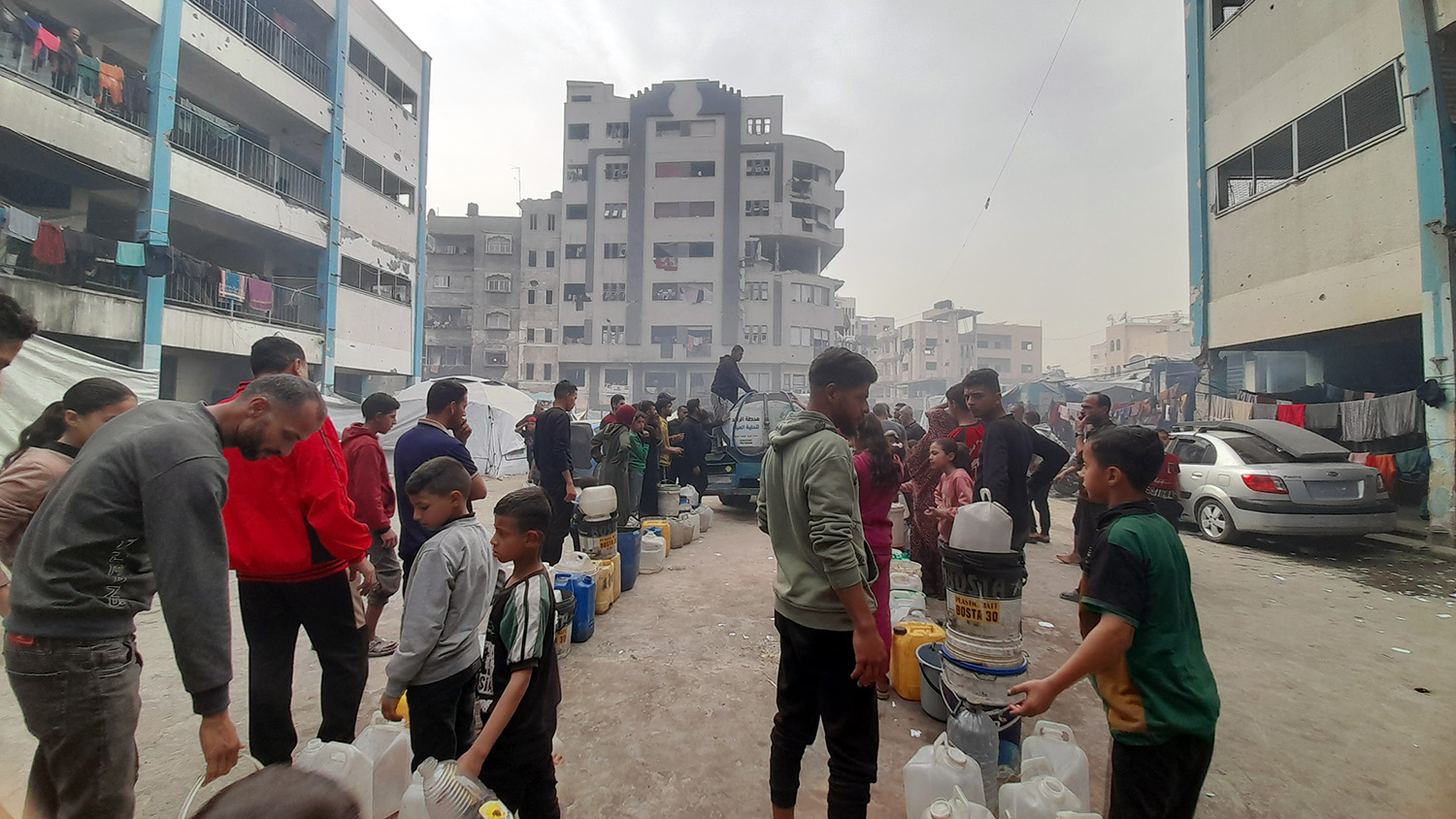
“The shelter situation is extremely challenging,” he tells Inside Geneva. “Around 70% of the whole population in Gaza live in tents or makeshift shelters. It’s a piece of fabric.”
Jehan Salim, originally from Iraq, is in Amman, but is, occasionally, still allowed into Gaza for an assessment. “I worked in Iraq, I worked in Syria, I worked in Afghanistan” she says. “I was in Ukraine before the war and during the war. I’ve seen several wars in my career and through childhood. You can’t compare it to what’s happening in Gaza.”
Rats and snakes
Both are motivated by their desire to provide “dignified living” for the people of Gaza, but the challenges are immense. There is, Mohammed, says, a daily struggle to find clean water, and a nightly battle with vermin. “We have rodents now in the summer: rats. And snakes.”
“There’s no safety, there’s no privacy, there’s no protection” for women and girls, adds Jehan. Large families share tents, or single rooms in damaged buildings. Toilet facilities may be a makeshift cubicle a long walk away, and at night, of course, in darkness.
But since the ceasefire is now almost a year old, why the delay in rebuilding? Israel controls all entry into Gaza, and, until now, has imposed severe restrictions on goods it claims are “dual use”, meaning, they might also be used by Hamas for military purposes. Cement and steel are considered dual use, so too though, often, are wooden planks, and solar lamps.
More
After the ceasefire, survival still defines life in Gaza
When I talk to him, Al Aklouk shares his frustration. When people learn that he works for an aid agency, they think, he says, that “I have magic to solve their problems.”
Unfortunately, he has to disappoint them; he and his family have been displaced seven times since October 2023, and while he considers himself in the “lucky one per cent” to work for an international organisation and to live not in a tent but in a damaged building, he too struggles with daily necessities, and with the continued danger from bomb and drone attacks.
“From the first day of this war, until now,” he says, “each day in the morning when I say goodbye to my wife and my kids, we know there is a chance to not come back again to our home.”
But even with that knowledge, Al Aklouk continues, day after day, to try to bring some relief, however modest, to Gaza’s displaced.
“People seek everything” he tells Inside Geneva. “So they are happy when are allowed a solar lamp. Just one solar lamp. Just to light their tent during the night.”
“We ask for the bare minimum,” says Salim. “The basic materials to build a shelter. Specifically, we’re asking for timber and tarpaulin.”
No end in sight
Israel insists Hamas must disarm completely. On the ground, Israeli forces now control more than half of the Strip, and seem to be extending their presence. And although Hamas did suggest its fighters were ready to disarm, the terms were vague; Israel rejected the offer, and with it the US “15 point plan” for Gaza.
Shuttle diplomacy by President Donald Trump’s envoy and son-in-law Jared Kushner, who has no background in such fraught negotiations, have yielded nothing. And so Gaza remains in a limbo, at the mercy of governments and militaries far wealthier and more powerful than its 2.15 million people.
More
The humanitarian cost of Israel’s war in Gaza
External linkSalim admits that she feels emotional and even guilty that she can, even though now only very occasionally, visit Gaza and then leave again. Gazans themselves cannot leave, the borders are closed. Al Aklouk confesses that if they were to open, there would have to be a “family discussion” about whether to stay or go.
Although his heart is in Gaza, he also wants his children (now aged 14, 13, and 9) to have a chance at a more normal life. His 14 year old daughter asks him often “why we are living in this situation.”
For now though, his focus is on getting more durable housing solutions for thousands of people. If they get that, Al Aklouk says “we can build beautiful Gaza again like before the 7th of October. But we need the the whole world to continue supporting, not forgetting Gaza.”
Listen to the whole discussion on Inside Geneva.
vm

In compliance with the JTI standards
More: SWI swissinfo.ch certified by the Journalism Trust Initiative

You can find an overview of ongoing debates with our journalists here . Please join us!
If you want to start a conversation about a topic raised in this article or want to report factual errors, email us at english@swissinfo.ch.