








Swiss in Hungary: ‘We’ve given ourselves a second chance’

After 54 years in Switzerland, Zoltán Tamassy recently moved to Hungary. On Sunday, the dual national was able to vote locally. He says he supported the winning opposition party Tisza because of "corruption, geopolitics and the economy". A reportage from an eventful election night.
Select your language
Generated with artificial intelligence.
Listening:
Swiss in Hungary: ‘We’ve given ourselves a second chance’

The 81st electoral district in the north of Budapest is bustling. Just like the rest of the country on this warm and sunny spring Sunday.
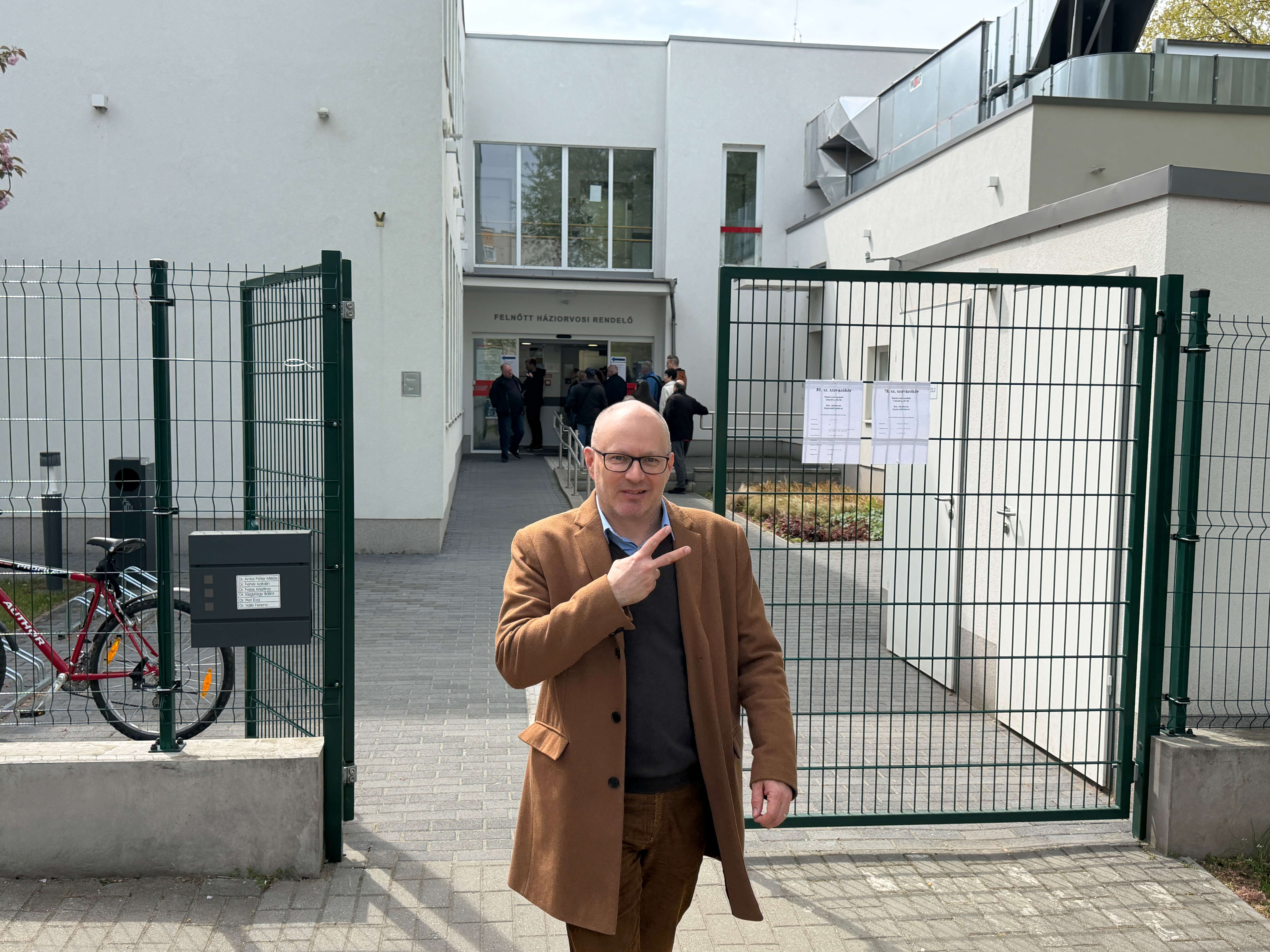
Zoltán Támassy and his wife Orsolya Tamássy-Lénárt are also waiting in the queue outside the school that has been converted into a polling station for the day.
“Everything is different here,” says Zoltán Támassy, 55, a former business journalist. Excited, he checks once again that he has all the necessary documents: his identity card and a certificate of residence.
In Switzerland, where Tamassy was born to a Hungarian father and mother, he voted by post, like almost everyone else.
But now, for the first time, he can have his say in his parents’ homeland. “It feels significant, but I’m also a little nervous,” he says. His father came to Switzerland in 1956 after the suppression of the uprising, his mother in the 1960s. Both have since died, and Tamassy moved to Hungary last autumn.
‘I have chosen, I have decided’
Then, after waiting patiently for 20 minutes, the couple enter the polling station. A stern-looking older man checks the documents. Finally, a lady with an impressive stamp hands him two A4-sized ballot papers: one for the direct election of a district candidate and one with the names of the eligible parties.
Zoltán Tamassy, one of more than 180,000 first-time voters in this election, disappears behind the blue curtain for a minute.
More
How direct democracy became part of Orbán’s ‘illiberal’ toolkit in Hungary
“I have chosen, I have decided,” he declares solemnly as he leaves the school building.
“When we moved from Switzerland to Hungary, I told my wife that I only wanted to live in a democracy,” he says. This is precisely what could no longer be taken for granted in recent years under Prime Minister Viktor Orbán.
The renowned Gothenburg V-Dem Institute has classified the EU and NATO member state Hungary as an “electoral autocracy” since 2020 and even described the country of ten million people as “the worst country for autocratisation in the world” last year.
A country in a state of emergency
Since his election victory in 2010, Orbán and his Fidesz government have always governed with a two-thirds majority, which has enabled him to make far-reaching changes to the constitution.
As if that wasn’t enough, Orbán has used various crises since 2015 to create a permanent state of emergency. He had this extended once again before the elections and it will remain in force until May 13.
Tamassy and his wife, who herself voted for Fidesz in the previous elections in 2022 owing to the tense security situation, therefore feared until the very end that Orbán “could find some excuse to postpone the elections”.
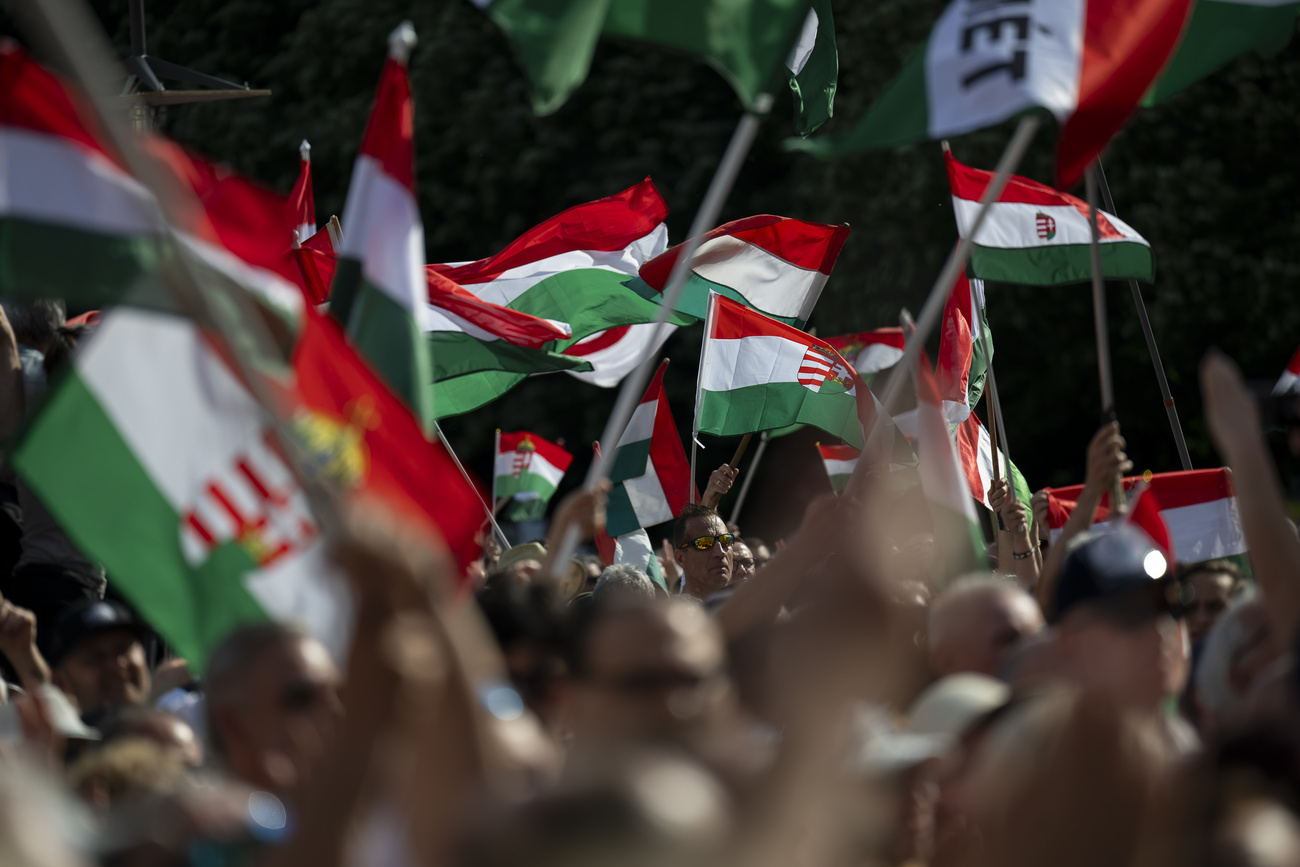
But on this election Sunday, everything fell into place: more people than ever in the country took part in the elections for the 199 seats in the Hungarian parliament. Voter turnout was almost 80%, significantly higher than in any previous election.
Stopover with the in-laws
The next stop is the nearby home of Tamassy’s in-laws: Katalin and Mihály, average middle-class Budapest residents. “We never actually discuss politics – it only creates discord,” Zoltán and Katalin say right at the start of the visit. But an exception is made in view of the curious journalist from Switzerland.
The sprightly pensioners explain in detail why Fidesz and Orbán continue to deserve their trust. They cite historical reasons such as Orbán’s fiery speech in the summer of 1989 against the power of the communists and in favour of the withdrawal of Soviet troops. “You never forget something like that,” Katalin says. The former bookseller then serves up a plum brandy in a conciliatory manner.
Emotional election evening
When the polling stations close at 7pm sharp, the race is already over: Orbán has been clearly voted out; challenger Péter Magyar has won. It is a historic moment – for Europe, for Hungary, for Zoltán and Orsolya. The two are experiencing this upheaval where they met 17 years ago during their studies: at the German-language Andrássy University in the centre of Pest, east of the Danube.
After a decade of long-distance dating, the couple got married at the height of the first Covid wave in the summer of 2020. “But I didn’t realise then that five years later I would be pulling up stakes in Switzerland and moving to Hungary.”

Later on election night, not only Zoltán and his wife are relieved. An entire nation seemed to breathe a sigh of relief when Orbán conceded defeat shortly before 9pm and congratulated Péter Magyar.
“I actually couldn’t have imagined such a positive scenario, I have to digest it now,” Tamassy says. Later he will say: “This is a zero hour for Hungary, like back in 1989. We have given ourselves a second chance. We can’t mess that up again now.”
Budapest celebrates
Tamassy’s expectations are clear. The new prime minister, Péter Magyar, has strong cards. He now has a constitutional two-thirds majority in parliament. Magyar must now make good use of this power. “If he fails to do so and abuses his power, I am also prepared to take to the streets against Magyar,” Tamassy says.
In addition to a fight against corruption, Tamássy would like to see a geopolitical reorientation towards Europe and a new economic policy. He is thus expressing what most Hungarians are hoping for.
Swiss election observer Sibel Arslan joins him in the elegant Hall of Mirrors at Andrássy University in the evening. The president of the Foreign Affairs Committee of the House of Representatives visited numerous polling stations on election day with her colleagues from the Council of Europe and the OSCE.

Late in the evening, when the last glass of champagne has been drunk and the opposition’s landslide victory is a fact, there is still dancing, celebrating and honking horns in many places in the capital. Zoltán and Orsolya make their way home – in a country that has rediscovered democracy.
Join the debate:
External Content
Edited by Balz Rigendinger. Translated from German by AI/ts
How we translate with AI
We use automatic translation tools, such as DeepL and Google Translate, for some content.
Each translated article is carefully reviewed by a journalist for accuracy. Using translation tools gives us the time for more in-depth articles.
Learn more here about how we work with AI.

In compliance with the JTI standards
More: SWI swissinfo.ch certified by the Journalism Trust Initiative

You can find an overview of ongoing debates with our journalists here . Please join us!
If you want to start a conversation about a topic raised in this article or want to report factual errors, email us at english@swissinfo.ch.