








Five years of Taliban rule leave Afghanistan facing hunger, repression and a lost generation

As Afghanistan’s hardline Islamist movement marks five years back in power, the anniversary has drawn renewed global attention to a crisis that had faded from view.
Select your language
Generated with artificial intelligence.

Listening:
Five years of Taliban rule leave Afghanistan facing hunger, repression and a lost generation

The baby’s bottle contained no milk, only weak, diluted tea.
Speaking from Kabul, the UN World Food Programme’s country director for Afghanistan recalled the plight of Farida, an Afghan mother struggling to nourish her child.
“Normally you expect the child’s bottle to be full of milk,” John Aylieff told journalists convened by the United Nations in Geneva. “There was simply no money in the household for milk.”
Such scenes are becoming increasingly common across Afghanistan, where the humanitarian crisis has deepened since the Taliban returned to power in August 2021. Severe funding shortfalls have compounded the problem: the World Food Programme (WFP) says it has been forced to scale back nutrition programmes and can currently feed only one in nine of the 14 million people facing acute hunger. Many women now trek for hours to reach health clinics, only to find that nutritional support is unavailable.
“It is heartbreaking to see them tell mothers who have walked for hours with their emaciated child in their arms that there is just nothing,” Aylieff said. He noted that child wasting, the deadliest form of malnutrition, has reached critical levels in a third of Afghanistan’s provinces, with the worst cases among children under the age of two. “Too many are arriving too late to be saved.”
Afghanistan under the Taliban is considered one of the world’s gravest humanitarian crises, alongside those in Yemen and Sudan. It is also a catastrophe for human rights, particularly the rights of women and girls. Afghanistan is the only country in the world where girls and women are barred from secondary and higher education. Restrictions on women’s employment have placed additional economic strain on families already grappling with poverty and hunger.
Nadia, a young midwife with a chiselled face and slight frame, delivers as many as 35 babies in a single shift. She says worsening food insecurity is taking an increasingly harsh toll on the mothers she treats. Many are so weak and malnourished that they struggle to produce breast milk. On a warm night in August, she helped an anaemic woman give birth. The child was born alive, but the mother barely survived.
“Because of the lack of energy, the lack of nutrition, the mother fell into a coma,” recalls Nadia, who spoke over a video call and requested to speak under a pseudonym for her safety. “Women’s nutrition before, during and after pregnancy is getting much worse.”
The severity of Afghanistan’s humanitarian crisis is evident in almost every indicator. UN agencies estimate that 21.9 million people, almost half the population, including 11.6 million children, require humanitarian assistance. At the same time, 14 million Afghans are said to be acutely hungry in 2026. WFP estimates that one in three Afghans needs urgent food assistance. Nearly 3.7 million children under five are at risk of acute malnutrition. Malnutrition is also affecting about 1.2 million pregnant and breastfeeding women.

“Since the Taliban took over, it is like the whole country is burning,” Nadia told Swissinfo. “The situation in Afghanistan is hell for everyone, especially women and girls. They were stripped of their opportunity to learn and work.”
Overlapping problems
Taliban rule has become synonymous with the systematic erasure of women and girls from public life. Some of the movement’s earliest decrees after returning to power in August 2021 curtailed girls’ education and women’s employment. Since then, more than 100 restrictions targeting women and girls have been introduced, depriving them of access to education, work, public spaces and basic services. Afghan women are also barred from entering UN premises and are generally subjected to draconian dress codes.
“They have achieved the goal of removing women from society completely,” says Nadia, noting that women are also facing pressures within the home, including domestic violence.
The Taliban’s restrictions have increasingly reached into women’s private lives. In May 2026, the Taliban published a new code governing judicial separation that further narrowed the circumstances in which women and girls can leave a marriage. UN Women said the decree established pathways that are disproportionately complex and restrictive for women, while Amnesty International warned that some provisions could entrench forced and child marriages.
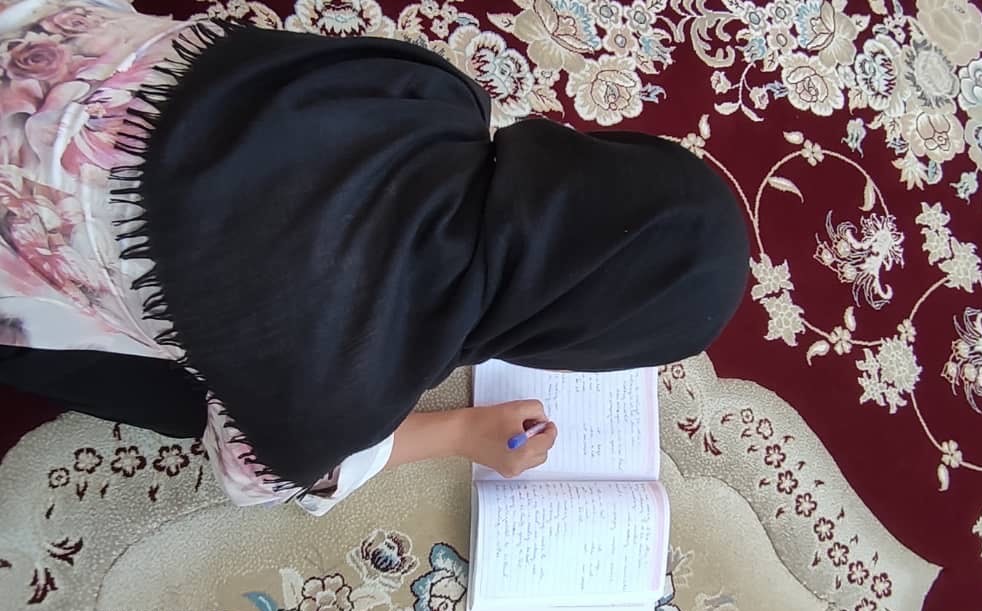
More
How distance learning keeps Afghan girls’ education hopes alive
For Nadia, who is a midwife, all these constraints are deeply personal and often overlap. Forced into marriage by her family, the 22-year-old is separated from but unable to divorce her husband, who fled to Iran. To supplement her midwife’s income, she ran an underground hair salon from her home – part of an industry the Taliban shut down.
“Until two weeks ago, I would do my midwife job and run the hair salon at home,” she says. “Not anymore. The Taliban came inside my house and caught me. They gave me a fine of 50,000 Afghanis (CHF620). Women would like to work and be economically independent in their lives.”
For Nadia, the greatest fear is not only what the restrictions have already taken from women, but what they will mean for the next generation. She was able to train as a midwife before the Taliban returned to power; girls growing up now may never get that chance.
And without access to secondary and higher education, there will be fewer female midwives, nurses and doctors, she points out. That means fewer women will seek medical help because they cannot be examined by a man, according to the World Health Organization and UN Women.
“This is a matter of life,” says Nadia. “It is a human problem, not just a women’s issue.”

Generation lost
UNESCO is one of many institutions calling attention to the scale of the looming crisis. The agency estimates that 2.4 million girls have been excluded from secondary education since 2021, a figure that has risen by 200,000 in the past school year. More than half of primary-age school children are out of school. More than 90% of ten-year-old boys and girls cannot read and understand a simple, age-appropriate text. By 2030, Afghanistan is projected to face a shortage of 11,000 qualified female teachers.
“Today Afghanistan is facing a crisis of access, a crisis of gender equality and the crisis of learning at the same time,” Hoda Jaberian, UNESCO’s Programme Coordinator for Education in Emergencies, told journalists at a UN briefing on August 11. “Five years is not a temporary interruption in a child’s education. It is clearly almost an entire secondary school cycle. “
The crisis has been compounded by weak infrastructure, natural disasters and mass returns from neighbouring countries. Almost half of schools lack clean water, sanitation or heating. Disasters since 2021 have forced more than 1,000 schools to close. More than seven million Afghans have returned or been forced to return since 2023, with children aged 15 or younger accounting for more than half of them.
External Content
External Content
UNESCO says its literacy and skills programmes have reached around 70,000 people, 70% of them women and girls, across more than 2,600 community classes in 20 provinces. Media-based education, including curriculums delivered online or via chat applications, has reached more than 17 million Afghans. But Jaberian stressed that these efforts cannot replace formal schooling.
“It is not negotiable. It’s a basic human right,” she said. “There is no substitute for this.”
Hajj Ahmed, who spoke to Swissinfo via a video call is a real estate agent in western Afghanistan. He too is determined that his daughters should get an education and sends them to a private education facility that officially presents itself as a Quranic learning centre, where teachers supplement their income by offering English lessons. Because the facility is nearby, he feels comfortable escorting the girls there. It’s a small comfort for the eldest, who had to stop studying law. Beyond those journeys, however, the family rarely ventures outside.
“If women go out with their husband or a male relative, they are immediately asked: Why are you outside? What is the relationship between you? People are in a state of anxiety,” says Ahmed.
The hope that his daughters might one day build a future beyond Afghanistan is enough for him to justify the risk of keeping them in class so that they can learn English, an internationally useful language. “Maybe one day they will have an opportunity outside this country,” said the worried father. “So it is better for them to be prepared.”
Graphics by Pauline Turuban. Image research by Vera Leysinger
Edited by Imogen Foulkes/vdv/ts

More
International Geneva

In compliance with the JTI standards
More: SWI swissinfo.ch certified by the Journalism Trust Initiative

You can find an overview of ongoing debates with our journalists here . Please join us!
If you want to start a conversation about a topic raised in this article or want to report factual errors, email us at english@swissinfo.ch.