








Fondue, or how to agree to disagree

Switzerland: chocolate, chalets, watches, banks… and fondue. Abroad, it’s hard to find a more universally recognised symbol. Except that in Switzerland, this dish – which is supposed to embody national conviviality – is often accompanied by minor controversies, right down to the bottom of the fondue pot.

Let’s start with the controversial question: is fondue really Swiss? Savoy in neighbouring France, in particular, also claims to have invented the dish – a claim that is not entirely without foundation.
More broadly speaking, people were melting cheese long before the Swiss Confederation came into being. The idea is an ancient one: traces of it can already be found in the Iliad. Homer describes a mixture of grated goat’s cheese, wine and barley flour, heated until it forms a sort of porridge.
This idea of melted cheese mixed with alcohol even reached the British Isles, that hotbed of gastronomic daring where people have no qualms about serving warm beer, stuffed sheep’s stomach and mint sauce. In Wales, as early as the Middle Ages, people came up with the idea of combining melted cheddar with beer, a mixture enjoyed on toast.
Closer to Switzerland, throughout the Alps – from the valleys of Savoy to the slopes of Tyrol – cheese has been melted for centuries. In these regions, where milk had to be processed quickly, heating it helped to soften it, preserve it a little better and turn it into a nourishing winter dish.
But while the basic principle seems to have been shared, it was indeed in Switzerland that the modern fondue took root. The first recorded reference appears in 1699, in a Zurich cookbook; the recipe ‘Käss mit Wein zu kochen’ already describes the mixture of melted cheese and wine, into which bread is dipped, and, above all, the communal aspect that characterises the dish. As for fondue as we know it today, it wasn’t until 1875 – and then another ten years – that the Zurich Home Economics School established the ‘official’ version.
More
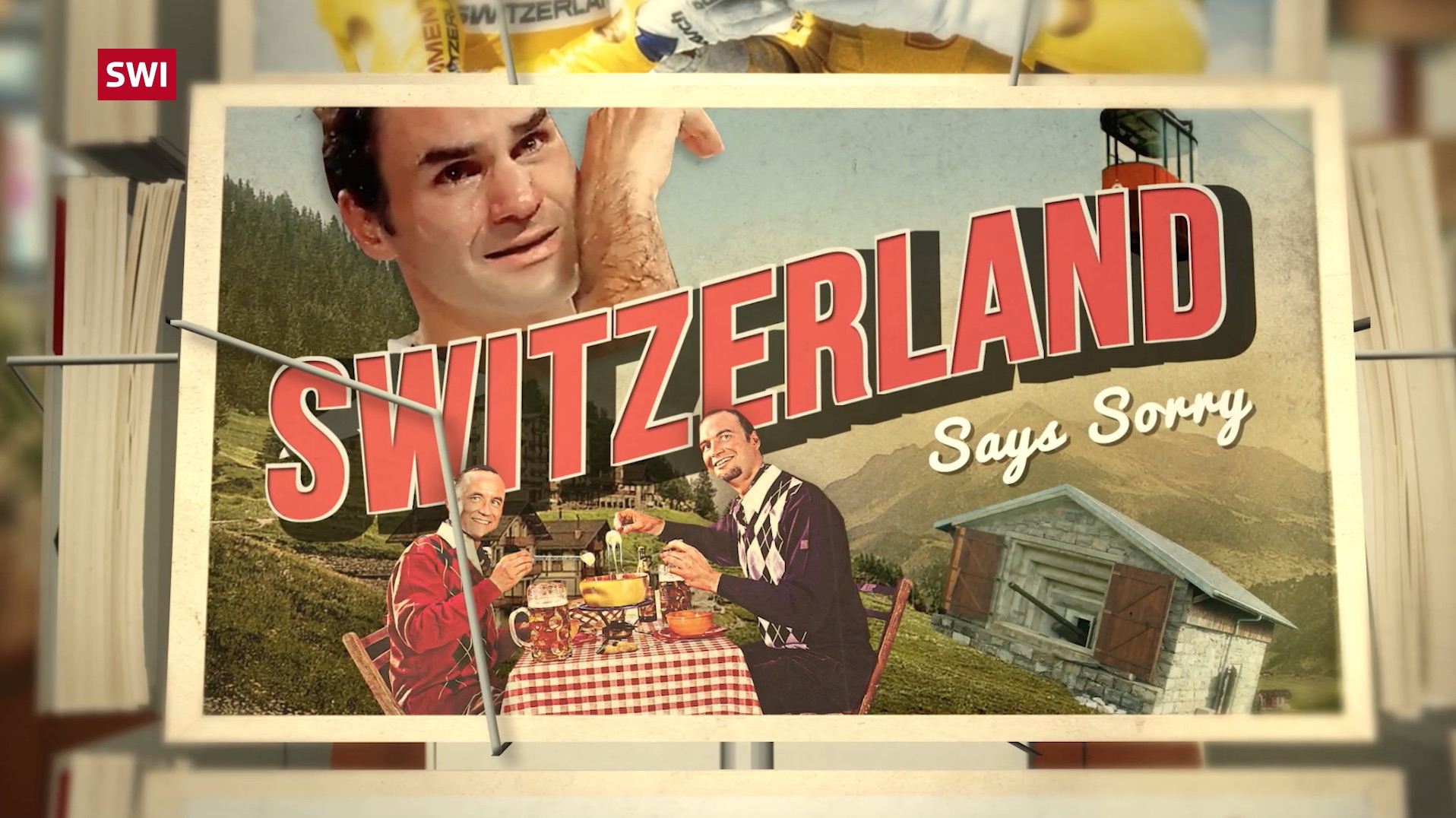
Switzerland says sorry! The fondue invasion
A dish that unites as much as it divides
In principle, fondue holds no great secret. It is based on the melting of hard cheeses heated with white wine (Chasselas, of course!), the acidity of which stabilises the proteins and prevents them from separating. The result is an emulsion that must be constantly stirred with a steady motion to maintain a smooth, even texture.
The quintessential Swiss dish for socialising, fondue is nonetheless a source of disagreement, where sharing is often accompanied by discussions – sometimes heated – about the ‘right’ way to make it.
The question of ingredients is where the first divisions arise. Some add a pinch of cornflour, sometimes mixed with kirsch, to firm up the texture – a widespread practice, but one far from being universally accepted. For purists, these additions amount to a form of heresy, an unnecessary alteration of the original balance.
Garlic, too, is a divisive issue. Should one simply rub it into the caquelon – a discreet, almost ritualistic gesture – or allow it to have a more pronounced presence? The answers vary, often with great conviction. And when it comes to stirring the bread – preferably slightly stale – the debates do not necessarily subside. Should one draw figure-of-eights, never stop, or stir constantly? Around the fondue pot, convictions are as firmly held as personal tastes.
As we can see, fondue is far from neutral territory – even in Switzerland. But beyond these differences, the crux of the matter lies elsewhere: in the control of the heat. If the heat is too high, it breaks the emulsion; if it’s too low, it causes it to set – a delicate balance that everyone, in their own way, strives to achieve.
More

The success of a compromise
While the basic principle remains the same, fondues vary depending on the cheeses chosen. Hard or semi-hard cheeses, rich in casein and sufficiently matured, are generally preferred. In Switzerland, Gruyère, Vacherin Fribourgeois, Emmental and Appenzeller form the basis of the most common blends. Elsewhere, the compositions are adapted to local produce: in France, for example, Comté, Beaufort and Emmental predominate.
In Switzerland, however, one blend has become the standard: the ‘moitié-moitié’ (half-half), an equal mixture of Gruyère and Vacherin Fribourgeois. Its success lies in a simple balance between texture and creaminess – a stable, accessible compromise that has come to be seen as the obvious choice.
Curiously, this obvious choice is not universal. Abroad, it was for a long time the Neuchâtel fondue – a blend of Gruyère and Emmental – that served as the benchmark. Milder and more elastic, it was better suited to palates less accustomed to strong flavours. Its popularity was further driven by the industry, which favoured this type of blend – easier to standardise – in ready-to-use fondue mixes for export.
A tradition that isn’t so recent
These industrial sachets, now widely available, fuel a persistent controversy. In contrast to the Alpine herdsman patiently fine-tuning his mixture, they represent standardised recipes, calibrated for consistency rather than for the art of preparation – a contrast that fuels a certain unease among advocates of ‘authentic’ fondue.

In reality, however, the results are less clear-cut. Tests regularly show that shop-bought fondues perform better than expected: consistent, even and technically reliable, they can win people over in blind tastings. But this efficiency has a downside: a flavour that is considered more uniform, less distinctive. A fondue that is perfectly controlled, without any rough edges.
As we can see, fondue does not merely warm the stomach; it also says something about an identity. Or, perhaps, about a way of shaping it. For behind the image of an age-old tradition, the reality is more recent. Until the mid-20th century, fondue remained a regional dish, far from any claim to national status.
It was the Swiss army, in the 1950s and 1960s, that helped turn it into a unifying ritual: a simple, inexpensive dish, suited to soldiers from all 26 cantons. At the same time, the cheese industry launched an active campaign to turn it into a Swiss symbol. Within a generation, fondue’s status thus changed. From a local speciality, it became a national emblem – not merely through heritage, but through construction – a sort of ‘manufactured natural product’, as described in an article on the Swiss National Museum’s blogExternal link.
And no doubt this is, ultimately, where its uniqueness lies: in its ability to bring together, in a single fondue pot, a claimed tradition, debated practices and a collective narrative.
Edited by Samuel Jaberg. Translated from French, sub-edited by ts

In compliance with the JTI standards
More: SWI swissinfo.ch certified by the Journalism Trust Initiative

You can find an overview of ongoing debates with our journalists here . Please join us!
If you want to start a conversation about a topic raised in this article or want to report factual errors, email us at english@swissinfo.ch.