








From film princess to animal queen: the many kingdoms of Isabella Rossellini
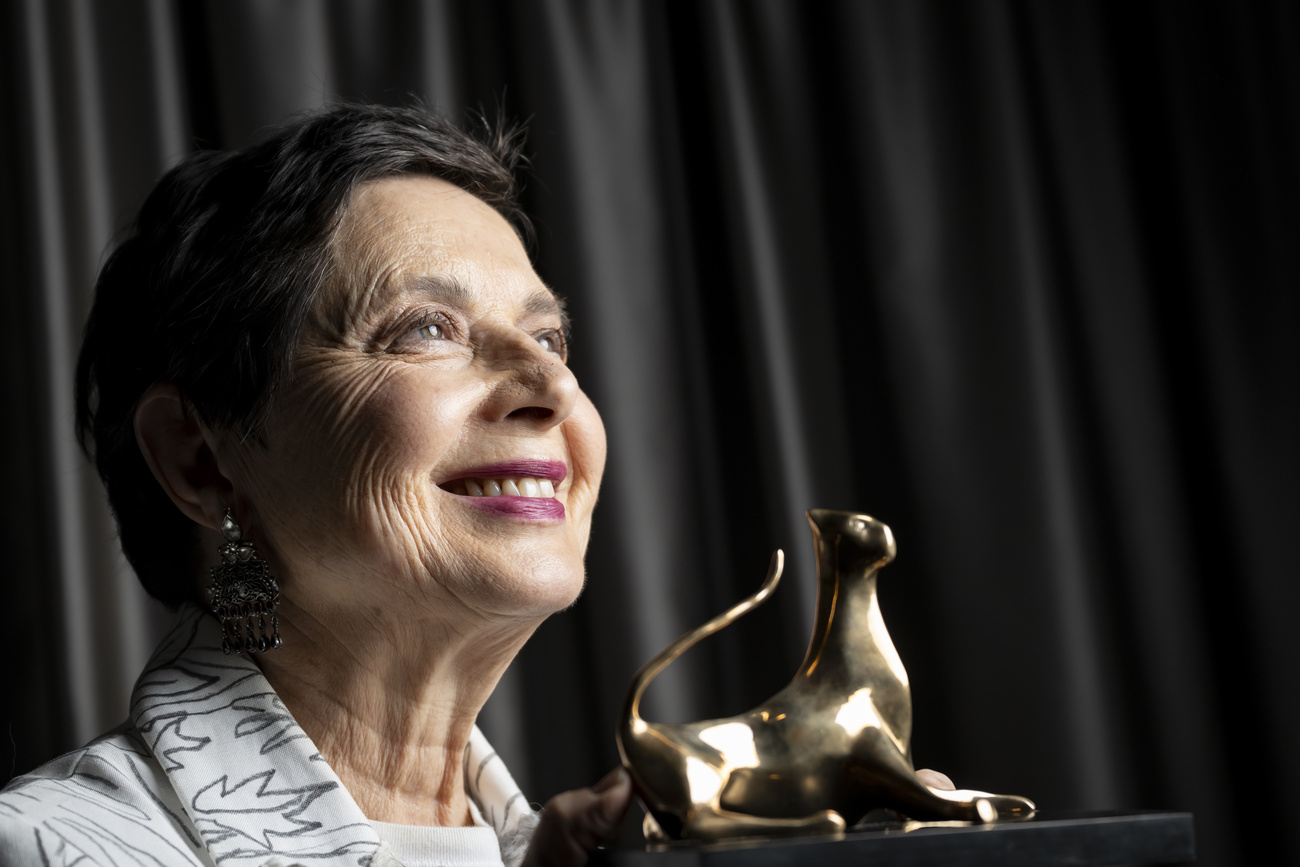
The recipient of an Excellence Award at Locarno Film Festival, Isabella Rossellini has gained fame as a model, actor and director. She spoke to Swissinfo about growing up as the daughter of film royalty, her fascination for animal behaviour and ageism in the beauty industry.
Select your language
Generated with artificial intelligence.
Listening:
From film princess to animal queen: the many kingdoms of Isabella Rossellini

Arriving in Locarno for the opening of the film festival, Isabella Rossellini had good reason to be annoyed. Due to overbooking, the American airline she was traveling on downgraded her New York to Milan flight from business to economy class. But she kept to a schedule laden with interviews, talks, film presentations and a Piazza Grande gala with grace.
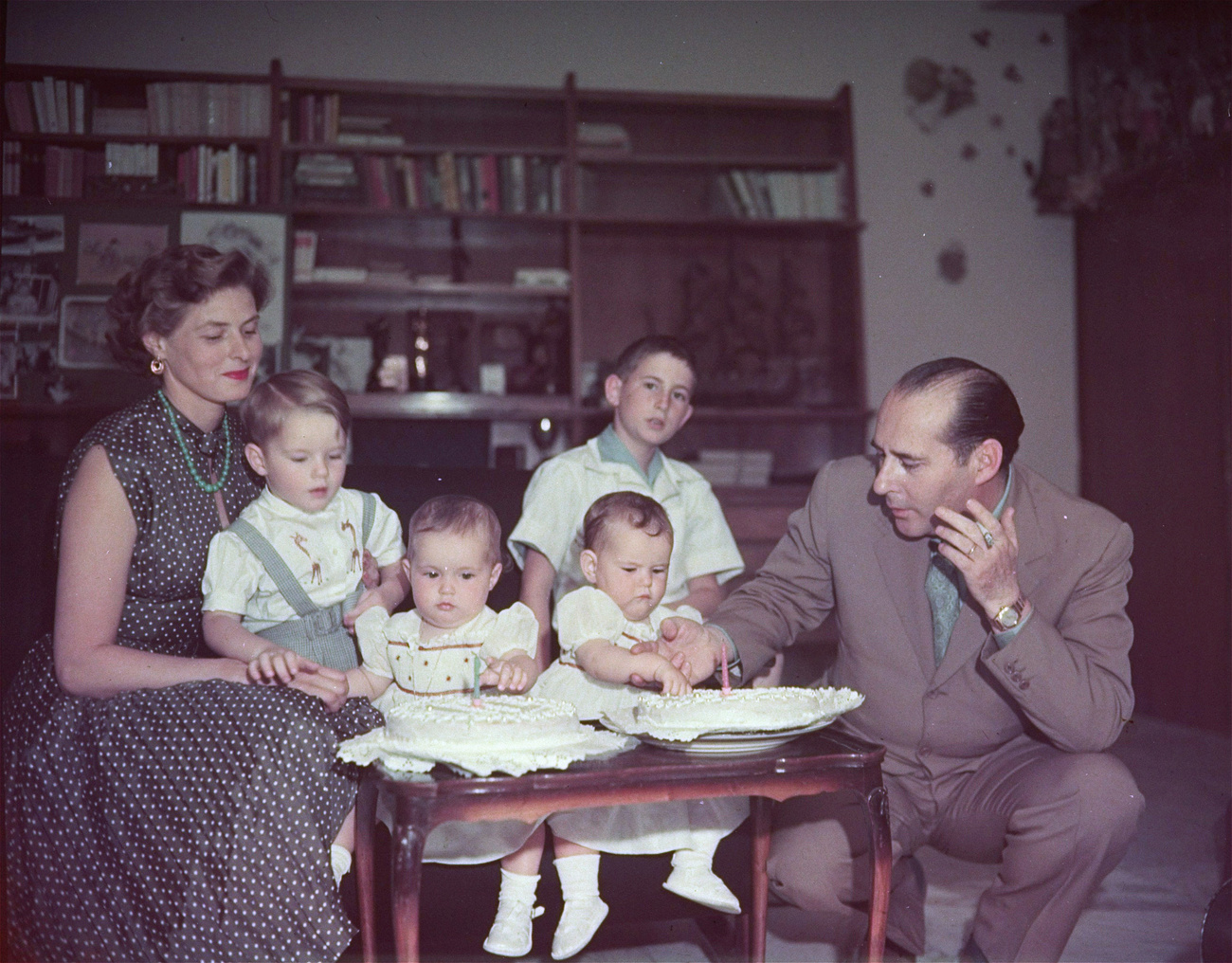
The daughter of the actress Ingrid Bergman and the cinema author Roberto Rossellini, Isabella grew up with the crème de la crème of Italian and European post-War cinema: Federico Fellini, Pier Paolo Pasolini and Vittorio de Sica — among many others — were frequent visitors to her home. When she speaks of her childhood, it sounds as though film sets were her playground.
“I went to more of my father’s sets than my mother’s, because it was always the producer, or the director, who was the boss,” she says. “[American director] Vincente Minnelli, specially, was very kind to let us kids into the set, as I did in A Matter of Time (1976), which was shot in Rome. Mama was delighted to work in Rome, where we lived, because the conflict of family and work is always very strong for every woman, but especially for actresses.”
This is why she refuses to act in series – it usually demands many months away from home. “Guest appearances, yes, but main roles, definitely no,” she says.
Crossing the Atlantic in the late 1970s, she conquered – and married with – the two coasts of America’s film industry; in New York she met Martin Scorsese, whom she married in 1979, and in Hollywood she collaborated and married David Lynch and was mentored by John Schlesinger and Robert Redford. Her best-known films include Lynch’s Blue Velvet (1986) and Conclave (2024), for which she won an Oscar nomination. She was also the public face of the cosmetic giant Lancôme for decades.
Trying to escape the shadow of her celebrity mother – “in the beginning I was so intimidated by my mom’s huge reputation”, she says – Isabella studied costume design and started working as a model. She would surrender to cinema much later. “I always arrive late,” she says. “I started modelling at 20, acting at 32, and as an ethologist at 55”.
External Content
Animal Farm
Now 74, Rossellini lives on a farm in upstate New York, surrounded by animals, the main passion of her life. “I started to collect stray dogs and cats in the streets until my parents said, ‘Basta!’ And then my father, when I was about 14 years old, gave me a book by Konrad Lorenz, the founder of the science of ethology, which studies animal behaviour, entitled King Solomon’s Ring that at the time was a bestseller.”
Ethology was not available as a course when she was 20. “But it became a career when I was about 50, so I went back to university and got my degree in ethology,” she notes.

In the 21st century Isabella debuted as a director, blending her passion for animals with her natural habitat of cinema. The series of mini-films Green Porno, Mammas, and Seduce Me were conceived at the advent of YouTube following a tip from Redford, the maverick actor, director, and entrepreneur who founded the Sundance Film Festival and the Sundance Channel, both devoted to independent productions.
“Bob told me that, in this new age where people were watching films on their telephones, this series would only make sense if each episode had a maximum of two minutes.”
The Green Porno series began in 2009 and is still ongoing: Rossellini says that a new series of shorts is currently being produced, called The Survival of the Friendliest, about how wild animals became domestic pets.
External Content
Swissinfo: What inspired you to make the Green Porno series, focused exclusively on the sexual lives of animals?
Isabella Rossellini: I think the difference is what makes it so interesting, because generally you always think: mommy + daddy = babies. There are animals that change sex in the middle of their lives. They start as male, then become female, or vice versa. There are animals that are hermaphrodites, that have both sexes. So it wasn’t really the sex itself that interested me, the Green Porno films are not very porno.
Swissinfo: It’s all about different behaviours, right?
I.R.: Yes, so I made another series about maternal instinct (Mammas), and another about seduction strategies where there is singing or dancing or perfumes. But somehow Green Porno remained the title that glues them all together. The fascination comes from the fact that these things can be so different. And it is not about trying to learn from animals how to behave as a human being, but to know that anything is possible.
External Content
Swissinfo: You have had several lives: model, actress, director, author, animal activist and ethologist. What connects all these experiences?
I.R.: My interests follow my curiosity. And so, to me, they are always connected. You cannot be defined just for one thing, like for example, being either a mother or an actress. [Photographer] Richard Avedon, with whom I worked quite a lot, used to say that modelling is like being a silent movie star. You don’t have dialogue, but you still have to act because they photograph the emotion. There is no beauty without emotion.
Swissinfo: In the Green Porno series, you not only wrote and directed but also designed the costumes. Is it a compunction to have total control?
I.R.: Yes, I do all the storyboards, and I do all the drawing of my films, but I must also credit my two collaborators, Rick Gilbert and Andy Byers. I do want to have control of the process, but I have to do it with what I know. So I had to eliminate technology because it’s something I don’t know how to do. I can hardly send an email.
The special effects are always done with strings, everything is done in the kitchen, so to say. There is no computer because I don’t know how to control it. My reference is [cinema pioneer] Georges Méliès. He used an enormous camera. He never moved. Sometimes he just pushed it a bit. My films are the same. No reverse shots, no shots from above. It is all very simple.
External Content
Swissinfo: Do you have any special memories or attachments to Locarno Film Festival?
I.R.: I must confess that this is the first time I come to the festival, although it does have a special relationship with my family. My father won the Locarno Grand Prix in 1948 with a film that I adore, Germany, Year Zero, a wonderful film that he did as part of what the press refers to as the “trilogy of the War”. My father first did Rome, Open City with Anna Magnani, then Paisan, and closed it with Germany, Year Zero. We went to Germany, to a Berlin that was completely destroyed, and followed the story of a child who lives in that wrecked Berlin.
Besides, my older brother [film producer Renzo Rossellini], who produced a lot of Fellini and Ettore Scola, among many others, also won a Lifetime Achievement Award at Locarno in 2023. Since I was a little girl, I always looked up to my father and my older brother, so I can’t believe it to be in the same group as them.
External Content
Swissinfo: Coming back to your modelling career, you were at the centre of a very heated debate about ageism in the advertising industry. How did you take it?
I.R.: Well, it was indeed a clear case of ageism. Lancôme dropped me after a successful run of many years when I was 42. I went to my executive and I said, ‘I want to understand because generally in any job, when you’re very successful, you get promoted or you get a bonus. Why am I being fired?’ But I wasn’t fired, they just didn’t renew my contract. And the executive said ‘women dream to be young. Therefore, the model who represents our product and the ideal woman cannot be a person in her 40s. Even if you’re successful.’
‘What?’ I said; ‘are you sure that we dream to be young?’ But they do the market research. I just asked my friends if they want to stay young, and their answer was no. Maybe my friends are exceptional. Or maybe Lancôme was doing the wrong research or asking the wrong questions. And then they hired me back when I was 63.

Swissinfo: How was this reconciliation?
I.R.: I was so surprised. The first few years I thought they would say they were sorry and call me back. After 23 years, I had given up.That story had some negative repercussion in the press and these companies are very careful with their image. I said, ‘why don’t you get Meryl Streep or Helen Mirren? If you get me, the story will come back.’ ‘No, we want you,’ they said. ‘We want to make it right.’ Okay. So I went to Paris because I wanted to confront them.
Swissinfo: Were they the same executives who fired you?
I.R.: No, that’s the thing. I saw a motorcycle stopping at the hotel where I had the appointment. It was a woman with hair like Brigitte Bardot. She came to me and said, ‘hello, I’m the new CEO of Lancôme’ [she is now the former CEO Françoise Lehmann]. I said: ‘you don’t need to say any more.’ She said to me, ‘I was a young worker at Lancôme when they fired you and I thought it was so unfair. Then in 20 years, I became the CEO, and I said, I’m going to make it right.’
Edited by Catherine Hickley/ds

In compliance with the JTI standards
More: SWI swissinfo.ch certified by the Journalism Trust Initiative

You can find an overview of ongoing debates with our journalists here . Please join us!
If you want to start a conversation about a topic raised in this article or want to report factual errors, email us at english@swissinfo.ch.