








When a former Swiss foreign minister turns her hand to acting
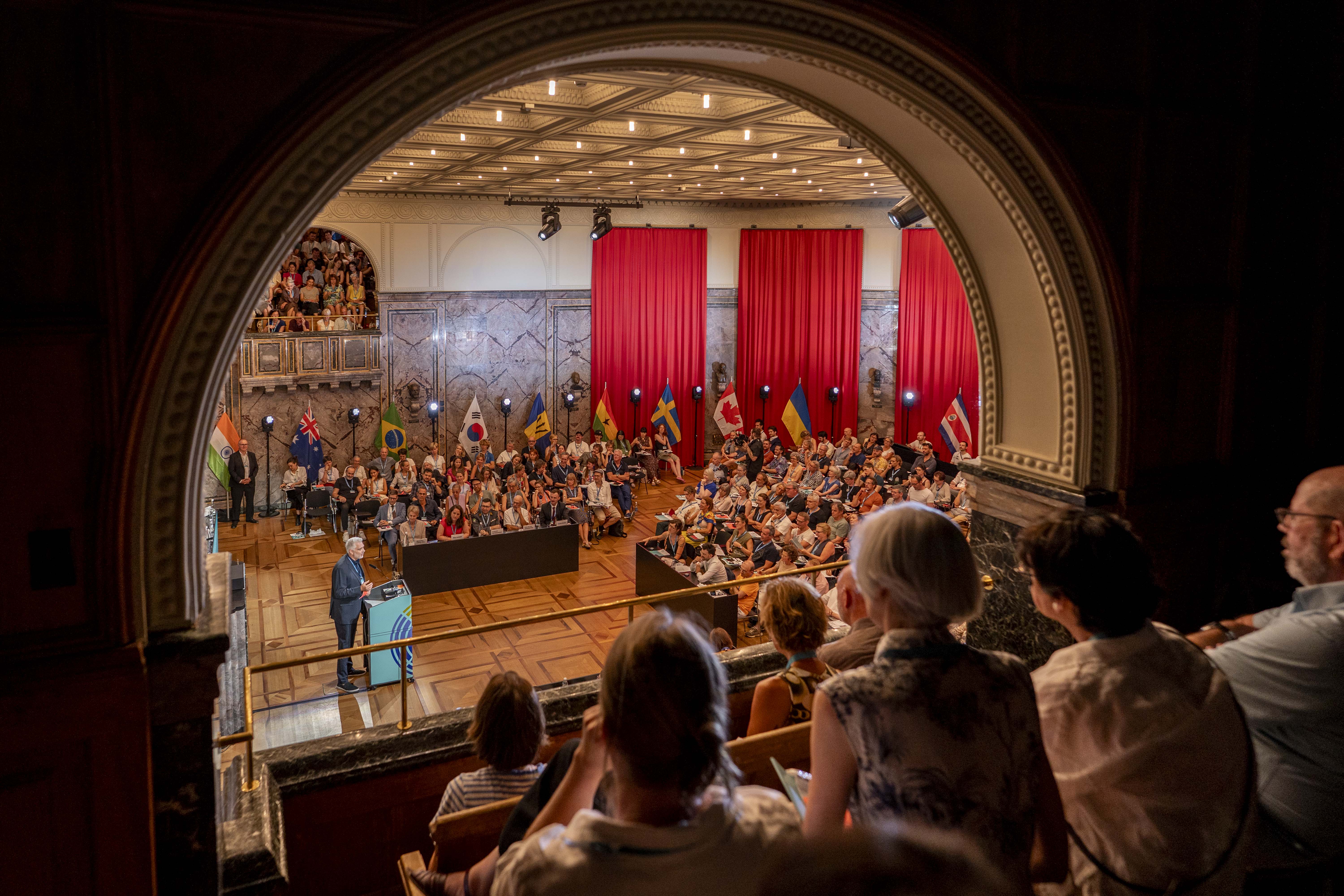
Should Switzerland join an international democracy alliance? The fictional question behind a recent performance in Zurich questions the country’s global role and the links between politics and theatre.
Select your language
Generated with artificial intelligence.
Listening:
When a former Swiss foreign minister turns her hand to acting

In September 1946, in a famous speechExternal link at the University of Zurich, Winston Churchill called for a “United States of Europe” to follow the cataclysm of the Second World War. Almost 80 years later, on a balmy Friday evening in the same hall, his spirit is being invoked. This time, however, the talk is of an “International Democratic Alliance” (IDA): a group of 40-odd nations banding together against rampant authoritarianism. Can it save democracy – and should Switzerland be a member?
The scenario, as you may have guessed, is a theatrical one. But reality is never far away; from ex-Swiss Foreign Minister Micheline Calmy-Rey to ex-Swedish Prime Minister Stefan Löfven, most of the cast are real public figures, playing versions of themselves; the 200-strong audience also has a role as a “citizens’ delegation”, debating the arguments for and against the IDA before voting on Swiss membership. And while the fictional scenario is a future one – we are in August 2027 – but the global situation is plausibly turbulent.
“When such an evening is well constructed, a realness emerges that fosters political imagination,” says Eneas Prawdzic, the director of the Proberaum Zukunft show, which runs over four evenings in August as part of an annual festival. Within the space of two short hours – “condensed reality”, Prawdzic says – we are plunged into an alternate reality that not only asks us to consider the thorny question of Switzerland’s global role, but also aims to spur awareness of a real democratic emergency. Will it work?

‘Shattered’ rules-based order
The event goes to lengths to hammer home the stakes. In plugging the show beforehand, it highlighted dire threats to democracy in the real world of 2026. “The rules-based international order is currently shattered, with three big players [Russia, China, and the US] who don’t want to abide by it,” said Helen KellerExternal link, a University of Zurich professor and former European Court of Human Rights judge, who also performed on Friday. The fictional scenario of 2027 is also pressing: far-right politician Marine Le Pen is in power in France, the US has left the United Nations and NATO, cloud infrastructure has been weaponised, terrorism and “pogrom-like” riots abound (albeit not in Switzerland).
Orchestrated spontaneity also tries to create a sense of urgency. As the show goes on, speaking times get shorter; audience members have to wait to have their say. A US representative storms in to warn Switzerland against joining the alliance, levelling direct threats at the audience. It’s reminiscent of the chilling real-world remarks of Donald Trump, telling GreenlandersExternal link that “you can say ‘yes’ and we will be very appreciative, or you can say ‘no’ and we will remember”. But is it a heightening of reality or a pale imitation?
The public figures playing versions of themselves add to a sense of authenticity, if not always urgency. Many back the positions they would likely hold anyway. In such a context, “politicians are much better actors than actors themselves”, Prawdzic says.
As for the politicians, nothing concrete is at stake in the theatre, but a rhetorical goal remains. You still want to “pull listeners onto your side”, Nina Fehr Düsel from the right-wing Swiss People’s Party said before her performance on Friday. In the play, she is against joining the IDA – as is the official Swiss negotiating delegation, led by Social Democrat Calmy-Rey. Fehr Düsel says the performance felt like a “mix” between a theatrical and a political one.
>> The theatre also made use of a popular democratic form – the “citizens’ assembly”. What does this do?

More
Are citizens’ assemblies on the decline in an era of eroding democracy?
Politics or political attitude?
But blurring the boundary between reality and fiction, or theatre and politics, is naturally only the start. The larger goal of political theatre, as German critic Florian Malzacher described in 2023’s The Art of AssemblyExternal link, is to turn the performance itself into a public space that is “truly political and not just performing a political attitude” – to make it a “container for trying out, analysing, performing, representing, testing, pushing the limits of, and even reinventing social and political procedures”. Does the show in Zurich have such impact?
A few of those involved mention the effect it has of sparking discussions: about democracy, geopolitics, the future in general. Priska Seiler Graf, a Social Democratic parliamentarian who performed on Saturday, says debates really kicked off for her – including with her husband and son – after the show was over. Petra Holtrup, a University of Zurich political scientist who was part of an expert group which helped to design the evening, says the event fosters what is “perhaps what we most need for democracy right now: direct analogue exchange with others”.

Too much fun?
So far, so Swiss. But as the evening goes on, does a gap threaten to open between the sheer seriousness of the situation and the nature of the response? Before the event, the RepublikExternal linkmagazine worried it would be too “discussion-heavy” or theoretical. In the end, the danger seems to be a different one: of occasionally sliding into “cabaret”, as a reviewer wroteExternal link of another pre-enactment by the same theatre group. An audience wants to be entertained, but shouldn’t it also be jolted out of its comfort zone?
On Friday, despite the earnest efforts of figures like Keller, the evening often seems keen on providing enough fun to justify the entrance fee. It’s not all laughs, but there is banter among the cast, and some in-jokes about Swiss politics – “the government is always here for you”, says its fictional spokesman, to general amusement. But even when the US representative is threatening her worst, there is not much of the “unease and discomfort” which art historian Claire Bishop, writing two decades agoExternal link, identified as a component of art which explores “democracy as antagonism”.
Indeed, radical disagreement or antagonism is in much shorter supply than in the work of another Swiss director, Milo Rau. Whether this is due to topic, cast, or design is hard to say. Rau tends to use polarising figures; but Micheline Calmy-Rey is not Peter Thiel. A plot involving the mechanisms of Swiss democracy might also be less likely to really tap into the type of issues seen in Rau’s work or in re-enactment films such as Joshua Oppenheimer’s The Act of Killing: the far-right Alternative for Germany, Russian repression, or mass killings.
On a technical level, it’s also debatable whether Swiss democratic procedures – or the citizens’ assembly format – are best-suited to generate what Malzacher describes as a key goal of Rau’s: “experiences that are supposed to be cathartic and full of feeling”. In Zurich on Friday, there is occasional emotion. But it’s often most impressively realistic when most bureaucratic: midway into a long exposition of the budgetary set-up of the new international alliance (something of a UN-EU-NATO hybrid), you’d be forgiven for thinking you’ve been dragged into a parliamentary session in Bern.
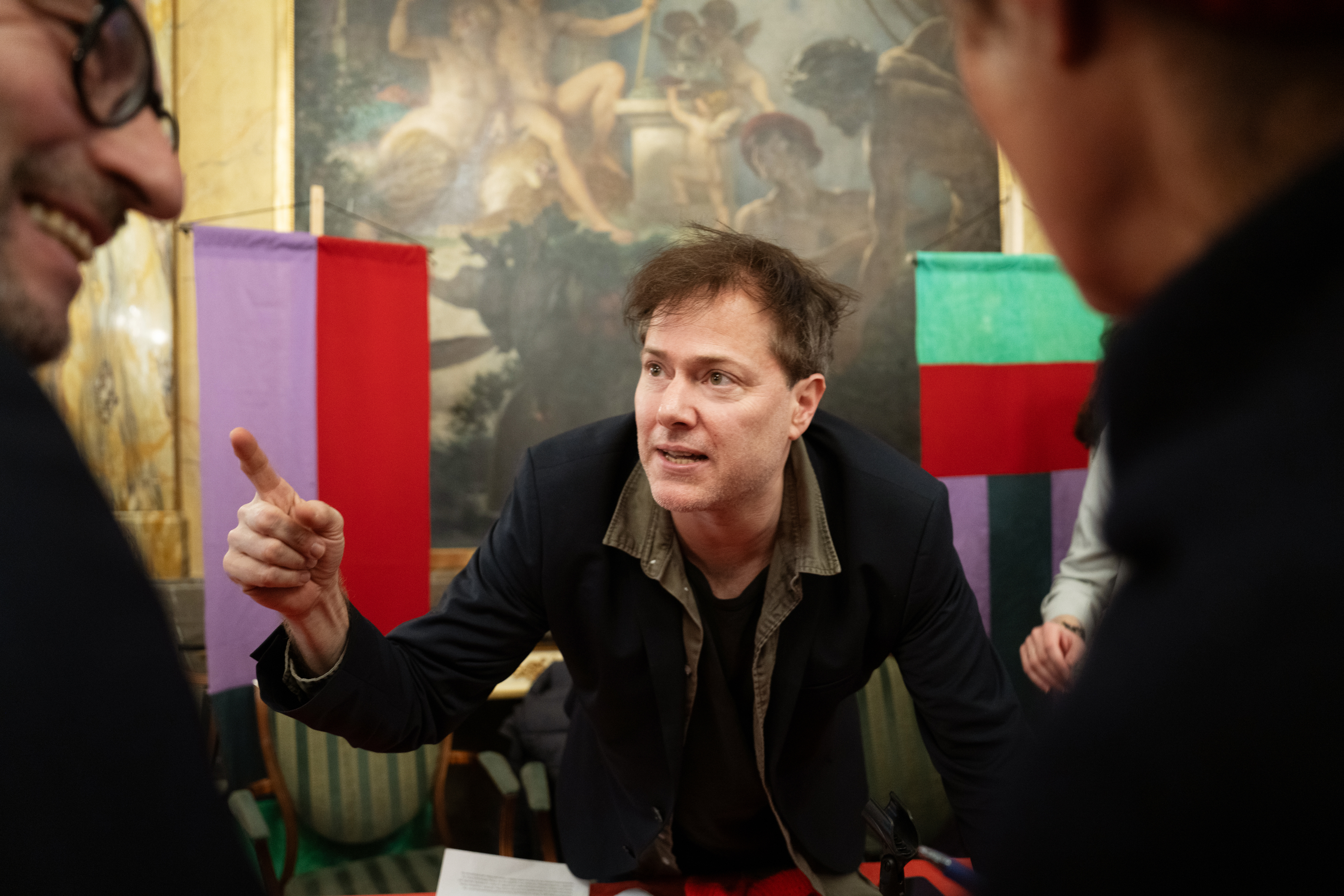
>> Since 2024, Milo Rau has been the director – and disrupter-in-chief – of the Vienna Festival:
More
Swiss theatre director Milo Rau stages revolution in Vienna
The many forms of representation
Or does it come down to us – the audience? After all, just as citizens are not mere consumers of democracy, we are not only consumers of theatre this evening, but an integral part of it. Yet none of us, at least on Friday, manages to throw in the type of radical remark that could break the script. Not to mention that we are hardly a diverse bunch: urban, proficient in English, probably economically comfortable. This is not Rau’s “General Assembly”, a 2017 simulated world parliament which gave a voiceExternal link to “those who are underrepresented, who are not heard, the global Third Estate”.
As such, when the audience does vote, it’s not surprising that a majority opts for the rather “progressive” choice of IDA membership – despite opposition by the Swiss government. At least this sparks one of the more memorable speeches of the evening, when Calmy-Rey, a government minister until 2011, takes to the floor to remind us where we are. Such an outcome might be normal in Zurich, but Zurich is not Switzerland, she says. “Where are the farmers, the French-speakers, the Italian-speakers?” In a national vote or citizens’ assembly, whether at the theatre or the ballot box, the result would likely be a different one.

Edited by Benjamin von Wyl/gw

In compliance with the JTI standards
More: SWI swissinfo.ch certified by the Journalism Trust Initiative

You can find an overview of ongoing debates with our journalists here . Please join us!
If you want to start a conversation about a topic raised in this article or want to report factual errors, email us at english@swissinfo.ch.