








Wildheuer: the gravity-defying haymakers above Lake Brienz
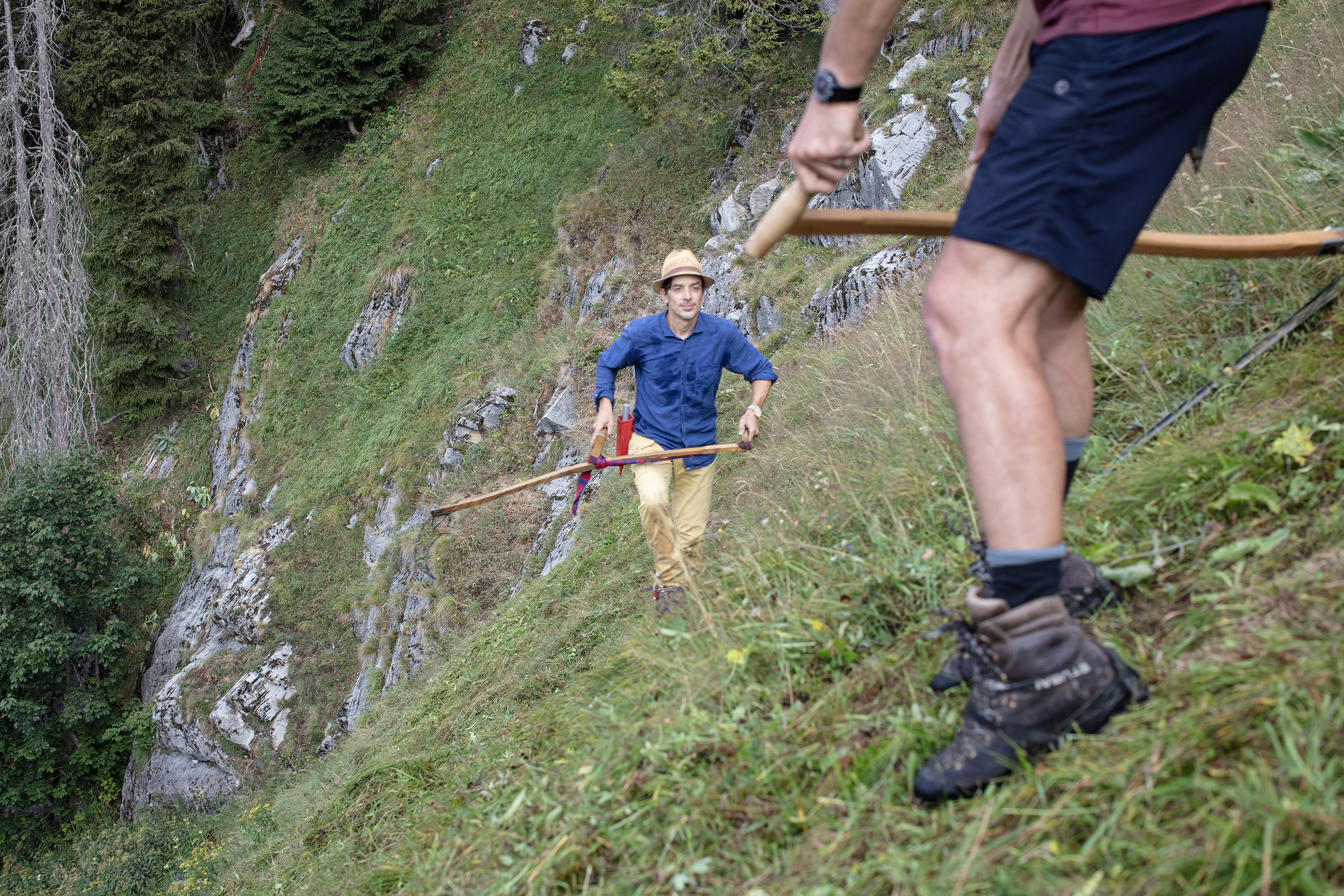
Scythes, whetstones, grass and sheer cliffs. Above Lake Brienz in canton Bern five friends return to Teni every summer to spend a few days in the footsteps of the Wildheuer – the haymakers who, for centuries, have braved the most inaccessible slopes to harvest wild hay. This activity has been enjoying a revival for almost three decades thanks to growing awareness of biodiversity and the Alpine landscape.

Outside, night is slowly giving way to day. The first light of dawn filters through the logs of the mountain hut. Silently, Reto, Thomas, Christof and Tom slip out of their sleeping bags and leave their beds on the hay. On the doorstep, they are greeted by the ring of mountains of the Bernese Oberland and, below, by the cobalt blue of Lake Brienz.
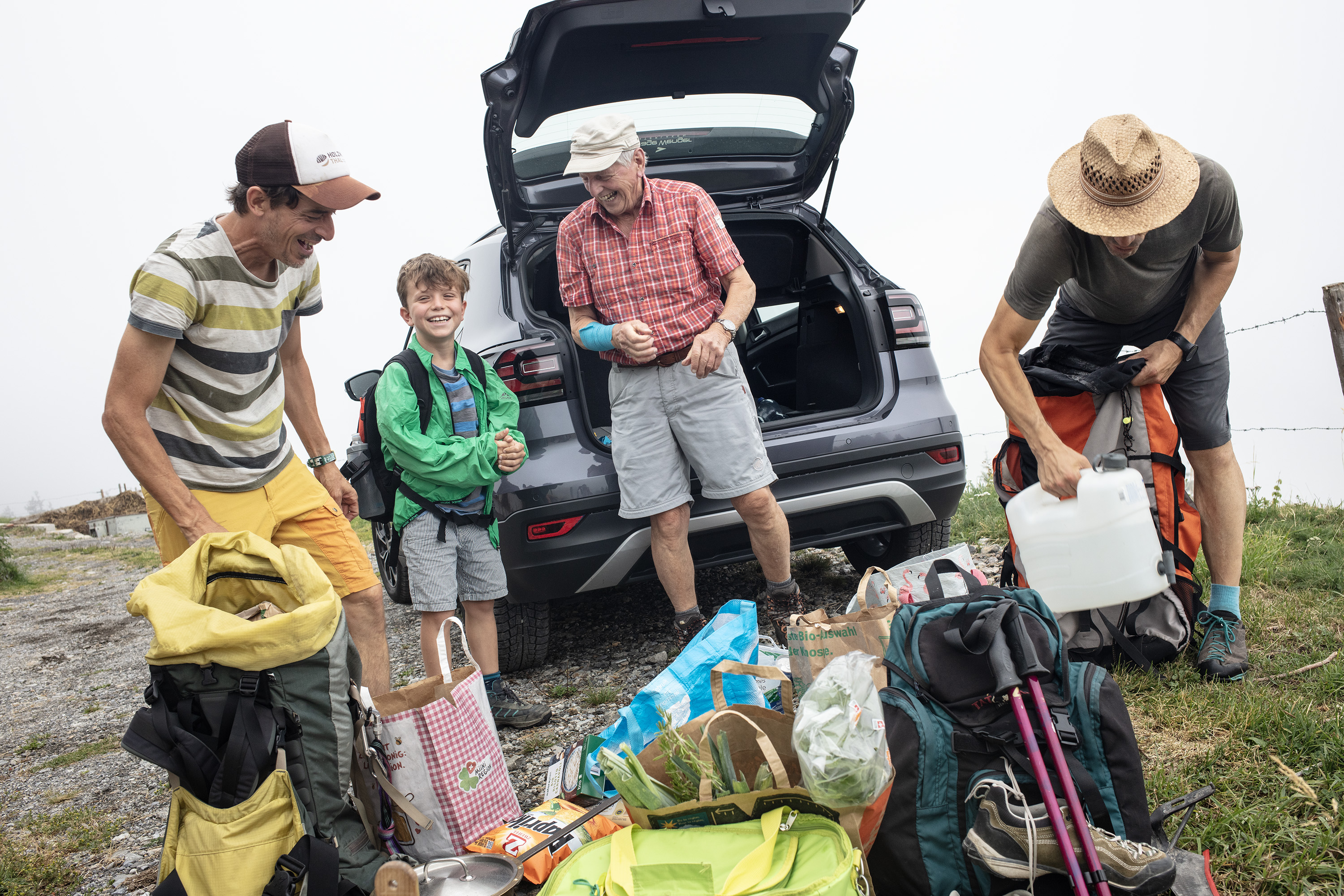
We are in Teni, above the municipality of Ringgenberg, in canton Bern. The simple mountain hut, at 1,600 metres above sea level, will be their home for the next five days. The four friends reached it the day before, weighed down by rucksacks laden with provisions and water. They climbed up there along a steep, winding path, passing through the Graaggetor – a natural gateway in the rock – and scaling the cliffs overlooking Lake Brienz. There is one detail that sets them apart from ordinary hikers: each of them is carrying a scythe.

Reto, Thomas, Christof, Tom and Fritz – who will be joining the group a little later this year – are haymakers, Wildheuer. For a few days, they step into the shoes of these legendary figures who, for centuries in Switzerland and other Alpine regions of Europe, have braved the steep, grassy slopes hanging over sheer cliffs to harvest wild hay (wild means wild and Heu means hay).
“What brings us back up here every year is the charm of tradition, direct contact with nature, the desire to leave the hectic pace of everyday life behind for a few days, and the friendship that has grown stronger through working together,” says Reto.
One false step can be fatal
Dawn looks promising in Teni. A few clouds linger in the sky after the previous evening’s rain. One by one, the four friends sling their scythes over their shoulders, clip their scythe holders to their trousers and set off along a short path to reach the meadow to be mown. They have attached crampons to their boots: slipping here could be fatal. Just below the grassy slope, in fact, lies a rock face nearly 100 metres high.
Over the past few weeks, the five friends have felt a growing sense of anticipation about returning up here: a sort of call to Teni.

At last, the sound of the whetstone on the scythe’s blade puts an end to the wait. Thomas sharpens the edge and, after a quick glance at the ground, begins. A swathe, a step, a swathe, a step. It feels as though we’re watching a dance between him and the scythe, interrupted now and then to sharpen the blade. Reto, Christof and Tom do the same.


They carry on like this until breakfast time and then until midday, when the morning dew has long since evaporated and the grass is too dry to mow.
They go back and forth along the slope. Like the shuttle of a loom, they weave a regular pattern across the now bare lawn, made up of long, horizontal mounds of grass. Sometimes they stop to look at the surrounding landscape and give their arms a rest. Their foreheads and backs are drenched in sweat.
Usually they sit in an office in front of a computer, perhaps with a steaming cup of coffee on their desk. Now the scent of wet grass and aromatic plants fills their noses; the sounds of Wildheuer cutting fill their ears.
“I’m moved by the steady tapping of the hammer on the scythe as the edge is re-sharpened, the sound of the grass being cut, and the sound of the whetstone when the blade is sharpened,” says Tom.
External Content
When hay was worth a fortune
What is now a hobby for Reto, Thomas, Christof, Tom and Fritz – and a way of preserving a centuries-old tradition – was once an essential activity for mountain farming families.
“In the first half of the 17th century, the production of hard cheeses, which were sold in Lombardy, became widespread. Hay, essential for feeding livestock during the winter, became such a precious resource that it sometimes took on the value of a genuine currency,” explains geographer and journalist Elsbeth Flüeler, author of a book on the Wildheuer of canton Nidwalden. “And so, although Wildheu was leaner than the hay from the meadows in the valley floor, it became increasingly valuable and sought-after.”
When the steep high-altitude meadows, the so-called Plangge, were not privately owned but belonged to guilds or cooperatives, their use was regulated very precisely: the plots could be auctioned off, allocated on a permanent basis, utilised under customary law, or allocated by lot. In some places, competition for the best meadows could even lead to conflicts.
“In the Erstfeld Valley, in canton Uri, these disputes have gone down in history as the ‘scythe wars’,” Flüeler says.
Between the late 19th and 20th centuries, the harvesting of wild hay gradually declined in importance, mainly due to the economic and social changes that were transforming Alpine agriculture.
“The advent of the railway, with the resulting access to markets and growing competition, put pressure on mountain economies,” Flüeler explains. Later, with industrialisation, many people left the agricultural sector for wage labour in factories. “As a result, there was a shortage of the labour needed for such a strenuous and demanding activity.”
A culture coming back to life
Since the end of the 20th century, wild haymaking has regained importance in several Alpine cantons, particularly in central Switzerland. This resurgence has been driven by the drastic decline in biodiversity and a growing awareness of the ecological value of these areas which, unlike those intensively farmed in the valley floor, are rich in insect and flower species.
Around 75 species of orchid grow wild in Switzerland, 58 of which are found in canton Bern. Many are rare or threatened and are highly sensitive to changes in their habitat. In the Bernese Oberland, around 25% of the orchid species originally found there are now extinct or under threat.
In nutrient-poor mountain meadows, the cessation of mowing leads to the formation of a thick layer of grass, which causes biodiversity to decline rapidly.
To preserve orchids, it is therefore important to continue mowing, but only after the seeds have been dispersed. In Teni, the areas are mown on a rotational basis, roughly once every three years, so as to encourage the growth of orchids.
Some of these areas have therefore been included in the federal inventory of dry grasslands and pastures of national importance. Their management to promote biodiversity is also supported by cantonal and federal grants, which provide a significant financial incentive to resume farming on these lands. Another reason is avalanche prevention: tall grass that is bent and flattened by the snow can, in fact, cause the snowpack to slide more easily.
“Wild haymaking is more than just a tradition: it is a culture, with its own language, practices and symbols. It is a defining feature of our identity,” Flüeler points out.
“This culture has also left a deep mark on the landscape. As well as species-rich meadows, there are infrastructure features such as the ropes suspended on the slopes to transport hay down to the valley, or the small huts hidden away in the countryside.”
Family rituals and customs have also developed around Wildheuen. And so this activity has become almost a communal ritual. “In many cases, friends and acquaintances take part in the cutting and harvesting,” Flüeler says.
Over the past 50 years, haymaking on uncultivated land has also become highly mechanised. The scythe has been supplemented by motorised mowers specially adapted for slopes. In addition, blowers and other machinery, such as Twister hay turners, are used, making hay harvesting easier and quicker than the traditional method using a rake and pitchfork.
Transport has also changed: large nets, capable of holding 15 or more bales of hay, are transported down to the valley by helicopter, replacing the traditional suspended ropes in many places.
The Wildheuer of Teni have chosen to do without mechanical mowers and blowers and not to transport the hay by helicopter. Their aim is to preserve this practice in its most traditional and original form.
Mountain farming families also appreciate the quality of this fodder, which is rich in fibre and aromatic herbs. “Livestock farmers use this hay in a targeted way during the winter: they feed it to the animals at the start to stimulate digestion and at the end, almost as if it were a dessert, partly because the animals are very fond of it.”
Meanwhile, in Teni, work has only just begun for Reto, Thomas, Christof, Tom and Fritz. They are also supported by Werner, the father of Reto and Thomas. He carries out various tasks around the mountain hut and takes care of the logistics, transporting food, water, hay nets and hooks up to the alp on the opposite side of the Brienzergrat.
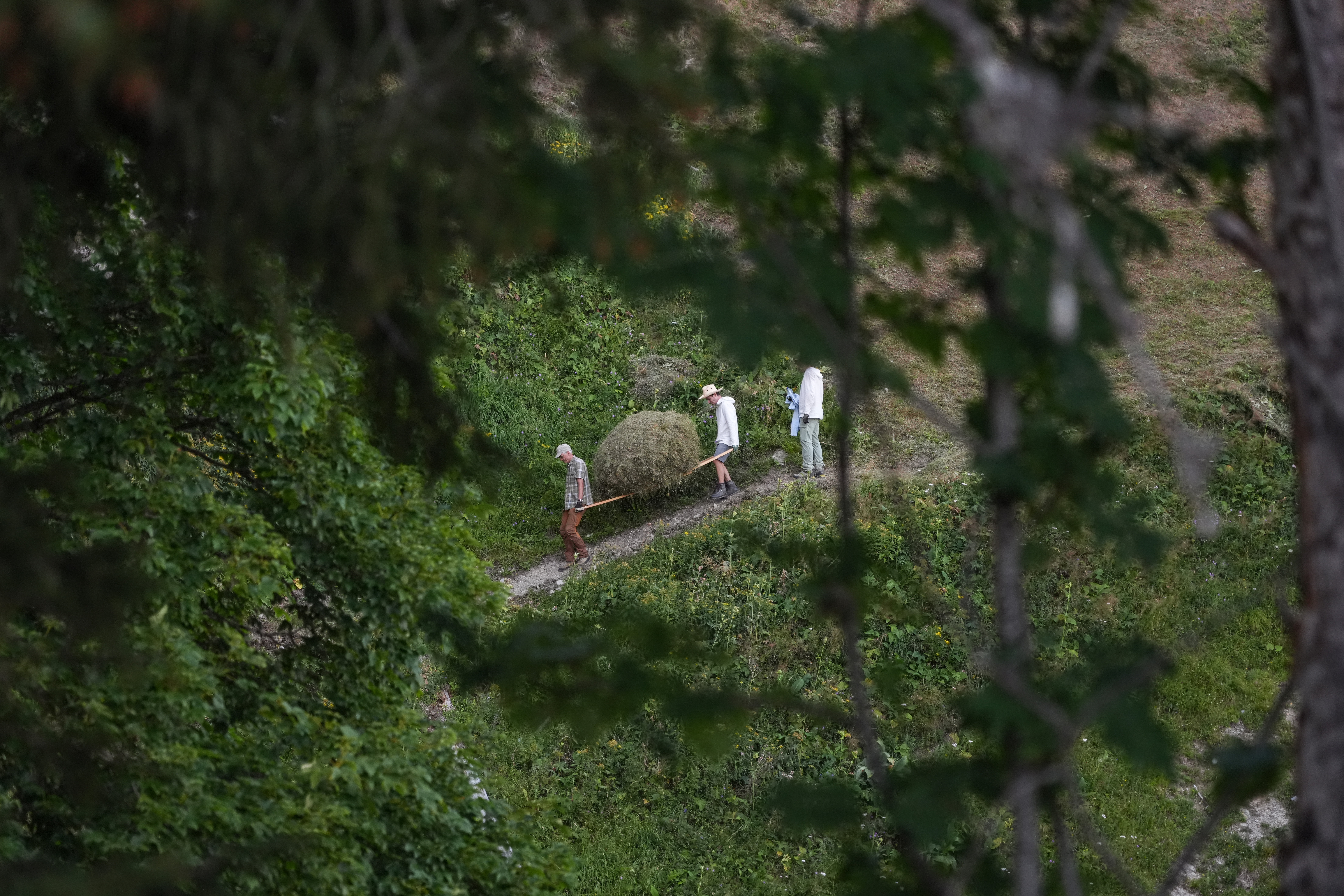
Once mown, the grass must be left to dry in the sun. The five of them will turn it over once or twice, then the dried hay will be gathered into transport nets, known as Seiltücher.
The bales of hay weigh between 40 and 80 kilograms. The group will have to hoist around 20 of these heavy bales onto their shoulders and walk along the path to the mountain hut: a task that requires strength and agility.
Finally, the most spectacular part begins: transporting the hay down to the valley floor via wires suspended above the rock faces and the woodland. Once hooked onto the cable, the load will pick up speed and the wire will begin to vibrate, emitting a sort of song. For Reto, Thomas, Christof, Tom, Fritz and Werner, it will be one of the most intense and thrilling moments of their five days spent in the shoes of the Wildheuer. An experience that will draw them back to Teni again next year.
Edited by Daniele Mariani. Translated from Italian, sub-edited by ts

In compliance with the JTI standards
More: SWI swissinfo.ch certified by the Journalism Trust Initiative

You can find an overview of ongoing debates with our journalists here . Please join us!
If you want to start a conversation about a topic raised in this article or want to report factual errors, email us at english@swissinfo.ch.