








Swiss experts downplay risk from unstable glacier

Swiss authorities have warned that part of the Weisshorn East hanging glacier above Randa, in canton Valais, could collapse in the coming days after accelerated movement and several icefalls over the weekend. Local officials and experts, however, stress that the situation is being closely monitored and poses no immediate threat to residents.
Select your language
Generated with artificial intelligence.

Listening:
Swiss experts downplay risk from unstable glacier
The glacier, which has been under surveillance since the end of June, showed significant movement over the weekend. Large chunks of ice broke away on three occasions on August 24, prompting authorities to increase monitoring.
Despite the heightened alert, Randa Mayor Frédéric Imboden sought to reassure residents, insisting that the situation is nothing new. “This glacier has been monitored for years and there are always movements – sometimes more, sometimes less,” he told Swiss public television SRF.
A danger zone has been defined and marked out since June. A ban on entry remains in force within the defined perimeter until further notice. In addition, the official access routes for pedestrians and cyclists remain closed.
‘Part of life in the Alps’
Imboden said the village’s 479 residents are not at risk.
“The residential area is not in the danger zone,” he told SRF, noting that people in Randa are accustomed to living alongside natural hazards and understand the risks.

Residents interviewed by SRF echoed the mayor’s assessment, describing the situation as a familiar aspect of life in the Alps.
Norbert Carlen, a natural hazards engineer for canton Valais, said further icefalls are likely. But it is impossible to predict whether a small section or a much larger portion of the glacier will break away.
In a worst-case scenario, several hundred thousand cubic metres of ice could collapse. Even then, the village itself would not be endangered, he said: “At the moment, the security personnel, the municipality and the canton have taken all possible measures to protect the population.”

‘Nothing new’
Glaciologist Martin Funk also downplayed concerns, describing the current developments as typical behaviour for hanging glaciers and “nothing new”.
“At some point, they reach a size they can no longer support and then the glacier or parts of it break off,” he said.
More
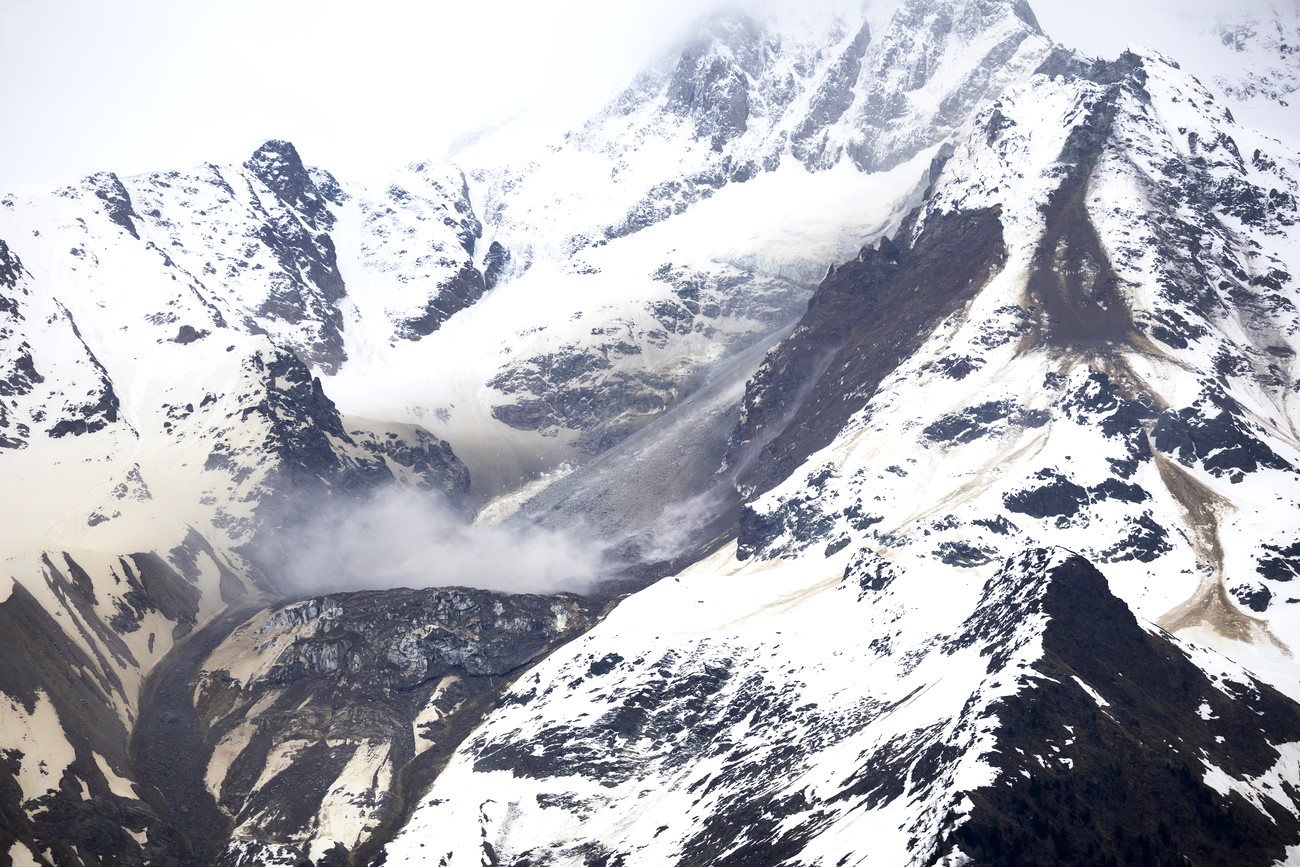
Why do Swiss mountains collapse? It’s complicated
Funk was involved in monitoring a similar episode at the Weisshorn East hanging glacier in 2005 and said the municipality has long-established safety systems in place. For the past decade, instruments have monitored avalanches descending from the Weisshorn into the valley.
“As soon as a major avalanche comes down, the road and railway are automatically closed,” Funk added.
Not first threat
Randa has experienced glacier collapses before. The largest recorded event occurred in 1819, when an ice avalanche caused extensive damage in the village. Subsequent break-offs in 1972 and 1973 were less severe and halted on a glacier field before reaching inhabited areas.
More
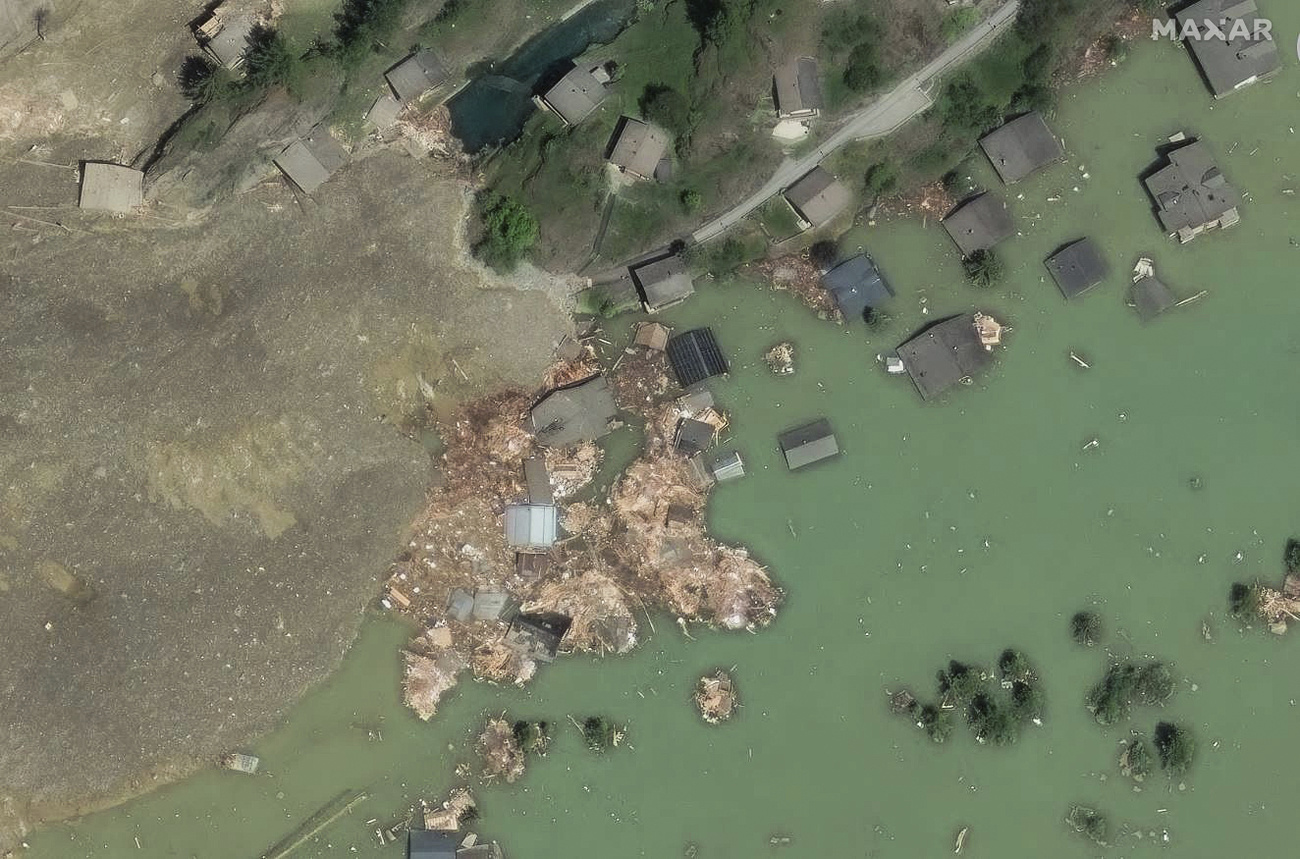
The seven worst landslides in Swiss history
The municipality of Randa has also historically been affected by other natural hazards. In 1991, a major triple rockslide occurred on the Längenfluhberg mountain. Within a few weeks, almost 50 million cubic metres of rock tumbled into the valley.
The rock masses buried the railway line and the road. They also dammed up the River Vispa. No people were harmed in the rockfalls, but livestock perished and 33 buildings were destroyed.
Randa is ‘not comparable to Blatten’
Guillaume Favre-Bulle, head of the natural hazards service in canton Valais, rejected comparisons with the recent disaster in the mountain village of Blatten, which was largely buried after a glacier collapsed on May 28, 2025.
“The type of phenomenon is completely different. We are not considering the same type of scenario,” he told Swiss public radio RTS on August 25. According to Favre-Bulle, there is currently no indication that an ice avalanche could reach the village.
He outlined two possible scenarios: the glacier could continue to disintegrate gradually, or the entire unstable mass could break away in a single event.
Monitoring has been intensified to detect any further acceleration in glacier movement.
“This is quite normal once an increase in movement has been observed,” he said.
Favre-Bulle also dismissed comparisons with Randa’s devastating 1991 rockslide, noting that the rockfall originated close to the valley floor, whereas the Weisshorn glacier sits much higher up the mountain.
“There’s a glacial plateau to cross first,” he said.

More
Unstable slopes and warming peaks: Scientists race to understand Blatten collapse
Translated from German by Simon Bradley/amva

In compliance with the JTI standards
More: SWI swissinfo.ch certified by the Journalism Trust Initiative

You can find an overview of ongoing debates with our journalists here . Please join us!
If you want to start a conversation about a topic raised in this article or want to report factual errors, email us at english@swissinfo.ch.