








‘Since the war in Ukraine, no one disputes the need for rearmament’

The Swiss army itself acknowledges that it would be unable to defend itself in the event of an attack. So how can military capacity be brought up to scratch? And where should the funding for rearmament come from? We discussed these questions with two guests in the latest episode of our Let’s Talk podcast.
Select your language
Generated with artificial intelligence.
Listening:
‘Since the war in Ukraine, no one disputes the need for rearmament’


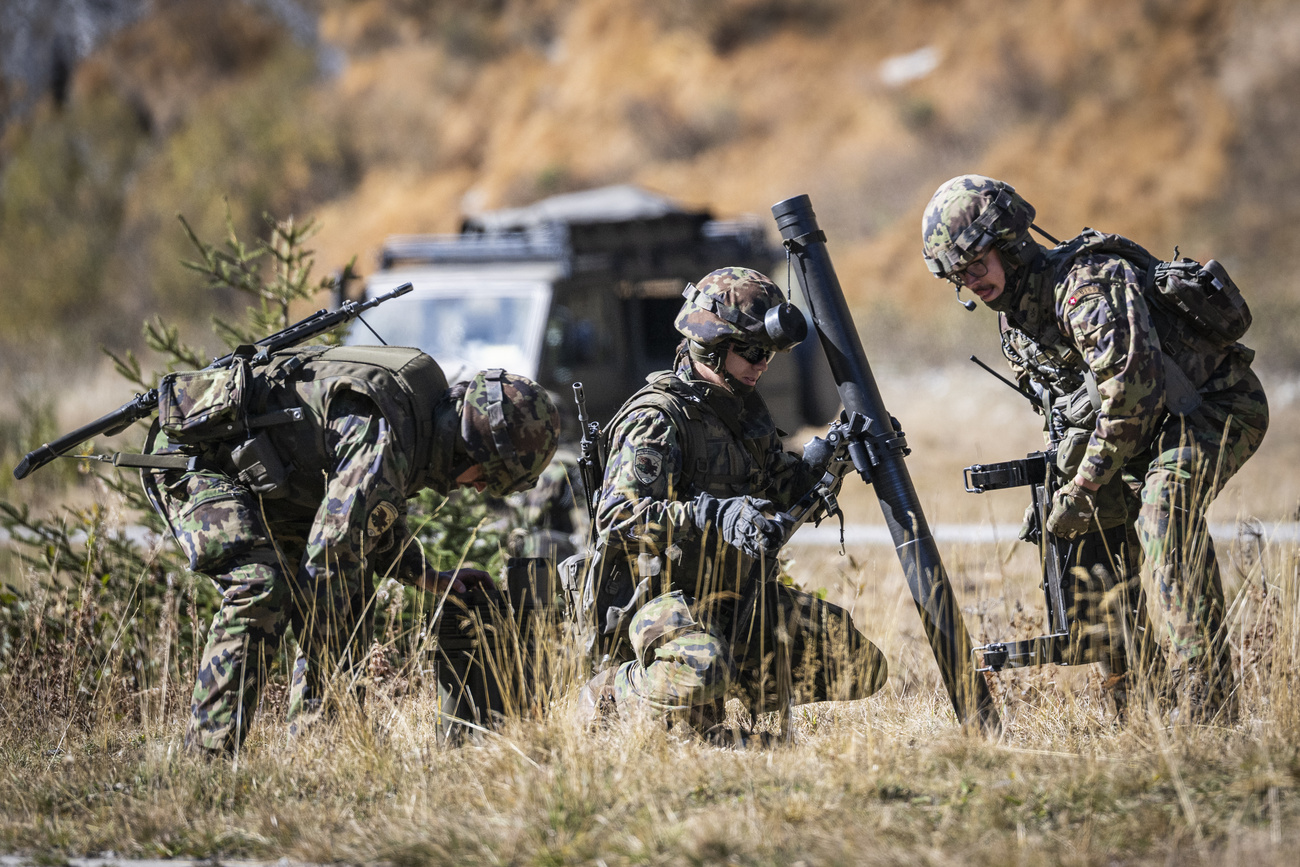
“Those who are unable to defend themselves in the case of an attack no longer have a say,” argues Patrick Mayer, a major in the Swiss army and adviser on defence and security issues. He believes that principle now holds true for Switzerland and describes a worrying situation for the country’s defence apparatus.
Even ex-army chief Thomas Süssli acknowledged the country’s shortcomings. “We could not withstand a large-scale attack,” he told the Neue Zürcher ZeitungExternal link newspaper late last year.
While other European countries have pledged to earmark 5% of their public spending to defence, Switzerland currently allocates only 0.7% of GDP to the military, a figure that is set to rise to 1% within six years. “For decades, Switzerland has lived in a haven of peace at the heart of Europe,” Mayer says. “It is difficult for it to understand that the environment beyond its borders has become less secure and that it has to adapt.”
More
Why Switzerland is struggling with its national defence
This view is shared by Florent Quiquerez, a political reporter for leading Swiss media group Tamedia. “For years, Switzerland has reaped the dividends of peace. When savings were necessary, cuts were made to the army, as it was believed that this was possible in the middle of a continent at peace.” The war in Ukraine has meant a dramatic shift in attitudes, the journalist says. “Today, no one disputes the need for rearmament, not even the left.”
However, Switzerland is now paying the price for decades of neglected investment in defence, both experts say. The army, they note, is not up to the challenges of the present.
For Patrick Mayer, Switzerland is not in a position to defend itself in the case of an attack:
No agreement on funding
While there is political consensus on the need to boost defence capacity, there is deep disagreement on how to fund the necessary investment. The Swiss government’s executive body, the Federal Council, wants to raise value added tax (VAT) by 0.8 percentage points (from 8.1% to 8.9%) to provide additional resources for the army, but the proposal has so far failed to win over either the public or the parliament.
But opinion could shift rapidly depending on the international security situation, Quiquerez says. “A referendum on increasing VAT won’t take place immediately. If, in the meantime, the war in Ukraine spreads to Moldova or the Baltic states, the measure could be accepted,” he believes.
Other possible funding sources have also been discussed, such as the profits of the Swiss National Bank (SNB), selling government shares in Swisscom, increasing public debt or introducing new taxes. Quiquerez does not hold out much hope for any of these options, which were already put forward several times in other contexts, in vain.
“Parliament didn’t even want to consider using the SNB’s profits to fund the old-age and survivors’ insurance (OASI), the cornerstone of the Swiss pension system. So I cannot see how this option could miraculously come back on the table to fund the army,” he says.
It is up to the parliament, the journalist adds, to find a source of funding, if it does not want an increase in VAT. “If the members of parliament do not accept the Federal Council’s solution, they will have to come up with a new proposal. The onus is now on them.”

More
Seven weaknesses in ‘Fortress Switzerland’
Loss of trust in the army?
Mayer is convinced that the lack of public enthusiasm for any of the funding options does not reflect a loss of confidence in the army. “I think it is more a question of understanding and accepting just how serious the security situation is,” he says. Meanwhile, he laments, criticism abounds but no one is proposing solutions.
Quiquerez sees things differently. Left wing groups regularly cite the delays and cost overruns affecting several defence ministry projects to oppose increases in military budgets, he says. “These issues need to be resolved so that the public is willing to invest in the army, safe in the knowledge their money will not be wasted.”
Mayer, meanwhile, regrets a tendency to “see the glass as half empty rather than half full”. “The army is indeed ageing, but it has invested in key sectors and shown a clear understanding of its needs. After all, our recruits are not working with equipment dating from the Middle Ages,” he states.
Buy local – or give up some sovereignty
Speaking on Let’s Talk, Luc Jeannin-Naltet, a delegate to the Council of the Swiss Abroad for France and a reservist in the French army, raises the question of the procurement of military equipment. Buying local is essential in order to boost domestic industry and jobs, he stresses.
“This does not apply at all to Switzerland’s political and economic culture,” Mayer counters, also noting the modest size of the Swiss army compared to its French counterpart. “I certainly think we should try to buy as much as possible within Switzerland. What is more, the Swiss arms industry cannot survive solely on orders from the Swiss army. It must be able to export.”
Florent Quiquerez explains that security is not at the forefront of the Swiss population’s preoccupations:
Most notably, Switzerland opted to purchase American F-35 fighter jets rather than a European model. It believed it had secured a fixed price, but this then proved not to be the case. It will therefore receive only 30 aircraft, instead of the 36 originally planned, for CHF6.4 billion ($8 billion). Nonetheless, Quiquerez refuses to call this a strategic error. “History cannot be rewritten with a few years’ hindsight. The context has changed completely. When Switzerland decided to buy the F-35, the US was an ally. Now Donald Trump is in the White House, the reality is different.”
These purchases also raise sovereignty issues. “It is often said that choosing an aircraft means choosing who you agree to cede part of your sovereignty to,” Quiquerez says. A few years ago, it seemed logical to entrust some of this sovereignty to the US. “Today, of course, we would prefer to have it back in Europe,” he says.
Strategic considerations also need to be taken into account when purchasing military equipment, defence adviser Mayer adds. “It is not simply a matter of issuing a call for tender and selecting the most advantageous bid. We need to seek cooperation with countries that respect our military neutrality.”
More

Edited by Samuel Jaberg. Adapted from French by Julia Bassam/ds

In compliance with the JTI standards
More: SWI swissinfo.ch certified by the Journalism Trust Initiative

You can find an overview of ongoing debates with our journalists here . Please join us!
If you want to start a conversation about a topic raised in this article or want to report factual errors, email us at english@swissinfo.ch.