








Empty shop windows hurt attractiveness of Swiss cities
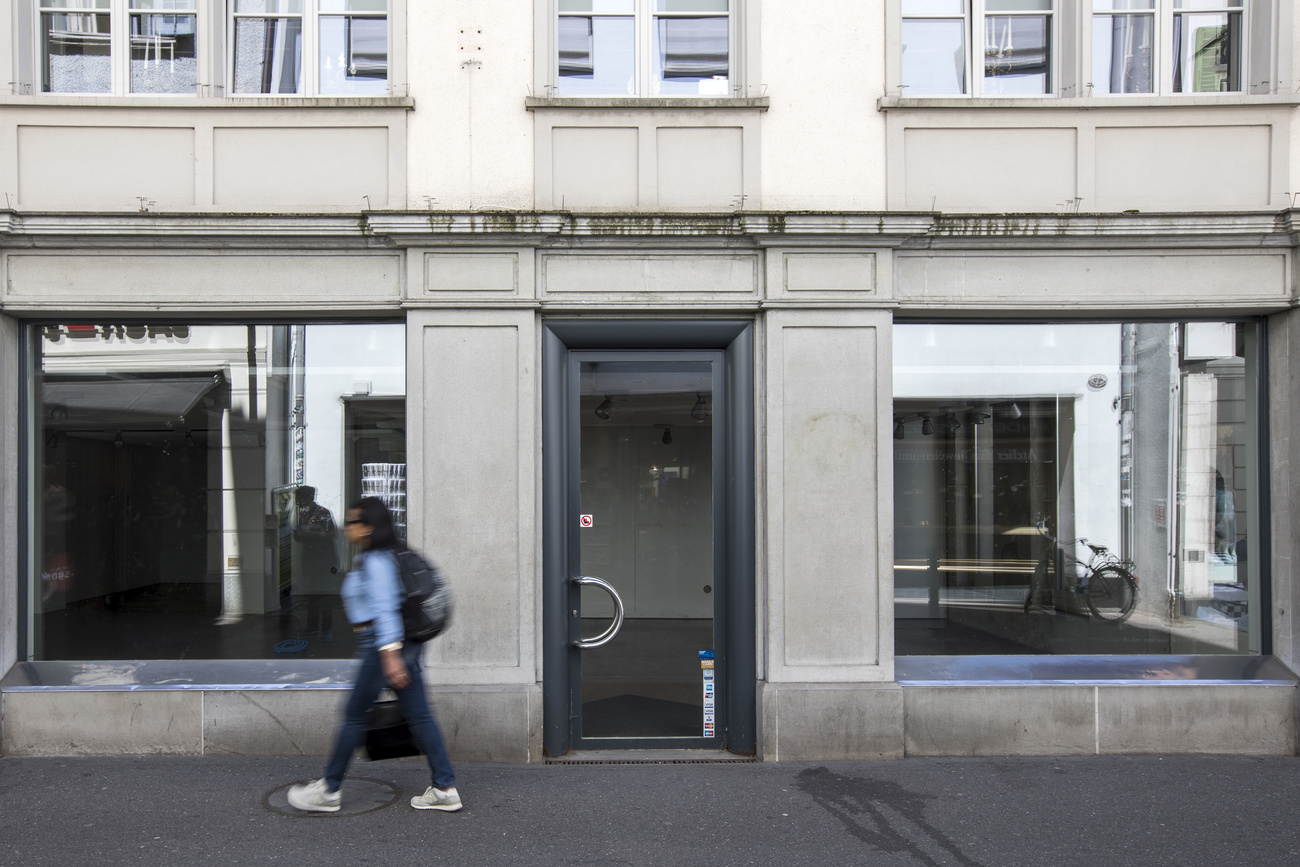
As online shopping expands at breakneck speed, falling sales are forcing bricks and mortar Swiss retailers to close their doors, particularly in town centres. To bring deserted shop windows back to life, locals and municipalities are taking action.
Select your language
Generated with artificial intelligence.
Listening:
Empty shop windows hurt attractiveness of Swiss cities
In January, Guillaume “Toto” Morand announced the closure of his funeral home in Geneva after 28 years in business. A month later, his children’s shoe store Neverland in Lausanne began liquidating its stock. From ten shops across Switzerland, the business now operates just eight.
“Like many clothing and fashion shops, we’ve reached a situation where sales are falling sharply because of online retail, and we can no longer pay our wages,” the Vaud-based entrepreneur told the Basik programme on Monday. The causes cited for the proliferation of empty shop windows are varied: the boom in e-commerce, rising rents and bills, weak purchasing power, parking problems, the impact of the strong franc, cross-border shopping, security concerns and construction work.
But for Morand, the main culprit is the surge in online sales, driven by giants such as Zalando, Shein and Temu – and above all their free returns policies. His solution? “Let the consumer pay for free returns with a tax of CHF5 or CHF10 $6.32 or $12.65), which would go into a climate fund. That would immediately stop the excesses of people who buy five or six pairs to make sure they have the right colour for their Instagram photos, and who send them back 90% of the time.” In Switzerland, almost one in five non-food purchases is now made online. This proportion is expected to double between 2019 and 2025.
Subletting premises to young entrepreneurs
Morand benefits from a moderate rent thanks to a lease signed in 1993. He plans to keep the keys to his Lausanne premises and sublet them to two young entrepreneurs looking to enter the retail business. “Preferably in fashion, because we’re the sector most affected. Many of these empty shop windows are transformed into restaurants, bars, grocery shops, tattoo parlours or barber shops.”

More
Why the farm shop works so well in Switzerland
To replicate his approach, Morand – who is also politically active with the Green Liberals – has joined forces with the association Economie Région Lausanne (ERL). Together with the City of Lausanne, they have formed a working group. The challenge is significant: persuading property managers to rent out empty commercial premises at reduced prices. “ERL guarantees the rent, and then we sublet the space to start-ups with a sound business plan and a strong chance of success,” Hélèna Druey, ERL’s general secretary, told Swiss public broadcaster, RTS.
She added: “Ideally, for a fashion retailer to succeed, rent should not exceed CHF300 per square metre. But we are talking about between CHF700 and CHF1,500 in central Lausanne. Persuading management companies to lower rents is not easy. Many agencies prefer to keep premises empty, but here we found one that understands the approach. It also realised that it shares our interest in keeping the city attractive.”
Contrasting vacancy rates and rents
In 2025, Wüest Partner, a Swiss property consultancy and analysis firm, published a study on retail space. The results show that after rising during the Covid years, the percentage of empty shop windows in Switzerland fell back to 3.4% in 2024, returning to pre-pandemic levels.
External Content
Average rents are also falling. “We expect a decline of 1.5% in 2026,” explains Corinne Dubois, economist at Wüest Partner. However, she stresses the need to distinguish between peripheral locations and “prime” areas, where prices per square metre reached CHF11,300 in Zurich and CHF7,700 in Geneva in the first quarter of 2025.
Sion launches a plan to revitalise local commerce
Sion’s rate of vacant shopfronts is in line with the national average. In autumn 2025, however, the town launched a plan to revitalise local commerce and appointed a city manager. “A city manager is like the manager of all the shops in a shopping centre, but at city level,” explains Silvia Esteves. Her role is to stay close to the ground, speak with retailers’ associations and event organisers, and facilitate appropriate measures.
One measure included in the “Cœur de ville” project is dressing up empty shop windows. A striking example is a closed butcher’s shop in the town centre: instead of a simple tarpaulin, an attractive visual has been created “to make it more appealing and show what we are looking for – namely a new butcher”, Esteves explains.
In another initiative, the town commissioned a communications agency to help Sion retailers use social media to promote their businesses. “I’m not sure we can win against Shein or Temu. But the aim is to make ourselves known in the Sion area, raise the profile of retailers and give them the tools to have a shop window in the digital world,” says trainer Marie-Christine Eggs.
As digital shop windows increasingly compete with physical ones, various initiatives are being launched. Only time will tell whether they help preserve the appeal of Swiss town centres.
Translated from French using AI/amva/ac
How we translate with AI
We use automatic translation tools, such as DeepL and Google Translate, for some content.
Each translated article is carefully reviewed by a journalist for accuracy. Using translation tools gives us the time for more in-depth articles.
Learn more here about how we work with AI.
External Content

In compliance with the JTI standards
More: SWI swissinfo.ch certified by the Journalism Trust Initiative

You can find an overview of ongoing debates with our journalists here . Please join us!
If you want to start a conversation about a topic raised in this article or want to report factual errors, email us at english@swissinfo.ch.