








Switzerland’s queer community fears rollback of LGBTIQ+ rights
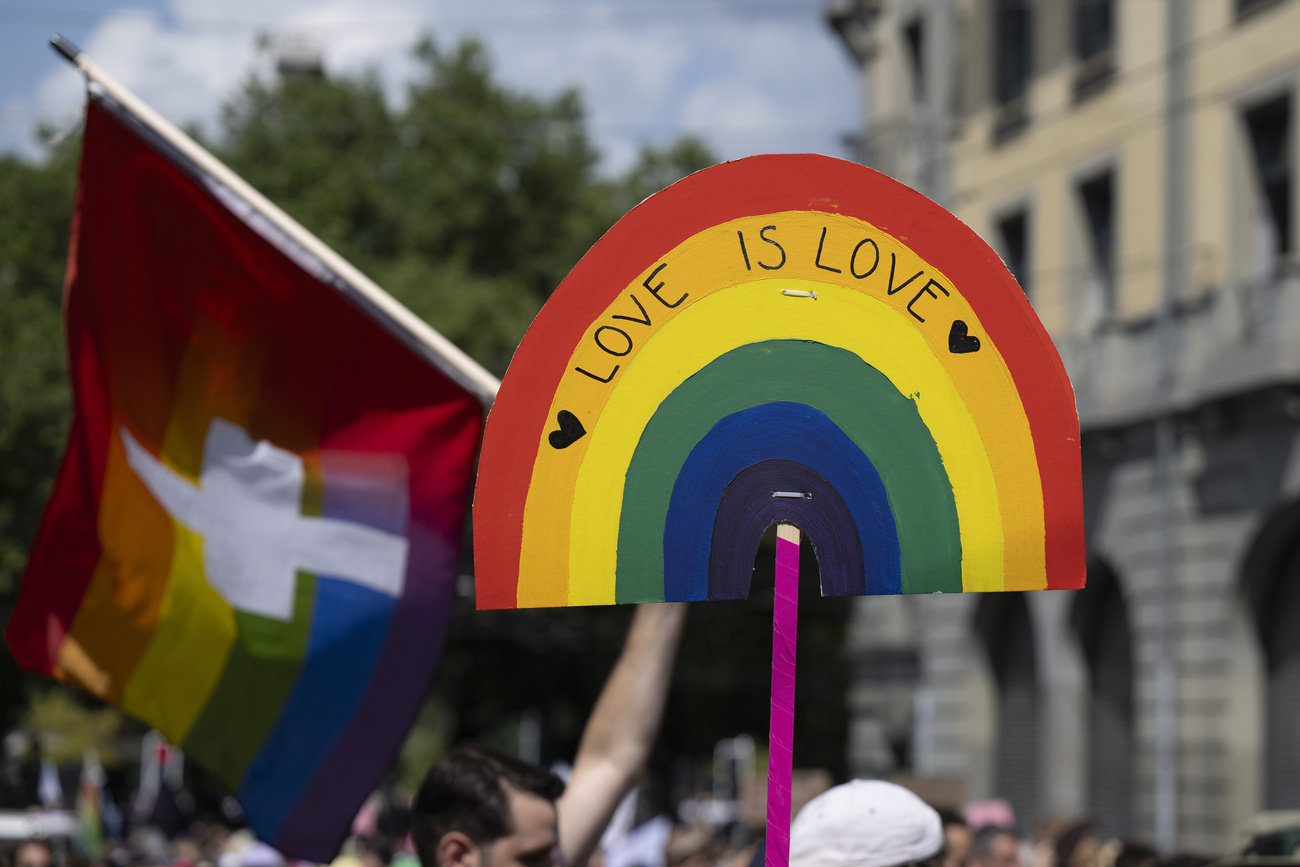
Campaigns targeting the LGBTIQ+ community in the United States are also affecting Switzerland. In an interview, social psychologist Tabea Hässler of the University of Zurich tells us about discrimination, self-harm, and child protection, and how research is being threatened.
Select your language
Generated with artificial intelligence.
Listening:
Switzerland’s queer community fears rollback of LGBTIQ+ rights

Swissinfo: Each year, your report examines LGBTIQ+ people’s living conditions in Switzerland and their expectations for the future. What are the most notable changes compared with previous years?
Tabea Hässler: We see that physical violence has increased, albeit at a low level, and that a large group reports feeling unsafe in public spaces. For the first time, many have expressed concern that there may be a backlash. Legal rights for LGBTIQ+ people and their social acceptance could begin to erode.
In its sixth annual report, the Swiss LGBTIQ+ Panel provides insight into the lives of queer people. Researchers Tabea Hässler and Léïla Eisner from the Institute of Psychology at the University of Zurich use the panel’s longitudinal data to track developments in Switzerland. This year, 6,177 people completed the online survey, including 5,422 LGBTIQ+ participants.
Later this year, Hässler and Eisner plan to launch an international comparative study involving more than 70 countries. In the summer, researchers will gather in Zurich to design a questionnaire that can be used worldwide, including in countries where queer communities face intense hostility, such as Ghana, Uganda, Russia, Hungary, and the US.
Swissinfo: One finding is that in Switzerland, half of all trans, non-binary, and intersex teenagers report self-harming. What explains this?
T.H.: Research shows that young people who lack public role models and experience discrimination, whether directed at them personally or at others, are more likely to self-stigmatise. Many trans and non-binary people struggle with their gender identity and feel they must hide who they are to avoid being excluded. This has negative effects on their health.
Self-harming behaviour becomes a misguided coping mechanism for dealing with stress. Instead, queer young people need trusted adults who they can turn to, role models in society, and better education about diversity, especially in schools.
When queer young people feel supported at school, at home, and by their friends, it has a positive impact on their health.

Swissinfo: Is Switzerland falling short when it comes to protecting young people?
T.H.: The situation varies widely. The curriculum used in many cantons, called Lehrplan 21, covers the topic, but it is left to teachers to decide whether to bring in external support. The problem is, these programmes tend to be used by those who are already aware of the issue, rather than by those who might need them the most.
Swissinfo: Many young people wait a long time to come out. How do you explain this?
T.H.: On average, it takes about four years from the moment young people realise they are queer until they come out publicly for the first time. We observe the same pattern across Europe.
In most cases, the reason is fear. They are often afraid of how their parents will react. Many parents are supportive of sexual minorities, but they often do not say so because it simply does not occur to them that their own child might be queer.
We have found that for many people, coming out goes far better than they had expected. Of course, there are still cases where children are forced out of their homes, especially for being queer.
Swissinfo: Gay and lesbian people face less discrimination than, for instance, trans people. But recently, the co-president of the Protestant Party resigned after receiving threats following her coming out. If discrimination comes from a vocal minority, what can realistically be done about it?

T.H.: My colleague Léïla Eisner led a compelling study on this question. It examined how people react to situations like, for example, two men being in a relationship. The findings showed that people tend to be quite tolerant themselves, but they assume that others are much less tolerant. As a result, many do not challenge discriminatory behaviour. For example, they may stay silent when someone makes a derogatory comment.
Swissinfo: You argue that debates about queer and trans people are often oversimplified. What would be a typical example of this?
T.H.: Puberty blockers. They can be given for a year to postpone a decision. But they cannot be prescribed for longer, because it affects bone density. What they do is allow time to delay decisions about further treatment.
The traditional approach is to simply wait while allowing puberty to proceed without intervention. But for children who feel they are in the wrong body, this can lead to depression, self-harm, or even suicide. In other words, doing nothing is a decision too, and it is one that can have serious consequences.
The issue is that we are talking about very young children, when many things can still change. Most importantly, our research shows that the gender identity of trans children is just as stable as that of cisgender children.
Swissinfo: In recent years, gender dysphoria has risen sharply in Western societies. Could this partly be an overreaction and might we see more people later re-identifying with their birth gender?
T.H.: Trans and non-binary children have existed in all cultures and throughout all periods of history. The numbers today appear to be rising because more people are coming out. At the same time, we need more data on the stability of gender identity. We need to understand how young people develop over time.
The problem is that we cannot assign young people to a control group and run a randomised study. These are limitations that researchers in our field have to deal with in other ways.
It is important to know that sexual identity and gender identity exist on a spectrum. I was involved in a project in the US with children aged three to 12 who had socially transitioned, meaning they had changed their name.
Of these children, very few later changed their gender identity again. If they did, it was usually from binary trans to non-binary. In interviews, they did not express regret about their journey. What became clear was how important it is to relieve their pressure, support them, and avoid pushing them in any one direction.
Swissinfo: Does thinking about gender in non-binary terms help reduce the pressure to change physical characteristics?
T.H.: Not all trans people take hormones or undergo surgery. It varies widely from person to person. But the idea of a society in which people can live openly and feel accepted for who they are remains largely unattainable.
More
Seven graphics showing how LGBTIQ+ people are doing in Switzerland
We live in a world shaped by cis-heteronormativity, in which every person is assigned to a binary category. Being labelled incorrectly day after day will obviously have an effect on a person. In the end, trans people simply want to be accepted for who they are.
Swissinfo: In the US, conservative groups, often fundamentalist Christians, are putting particular pressure on the queer community. And this reactionary movement is active worldwide. Where do we see its effects in Switzerland?
T.H.: I can mainly speak about this from the perspective of the academic community. In the US, funding has been completely cut off. In some instances, data has been wiped out. Many researchers are afraid to work in this field right now. Anything relating to “women” or “trans” is flagged. We have colleagues who are considering leaving the US. Inquiries have also been made about the kind of research being conducted in Zurich. Wherever there are collaborative projects, the US tries to intervene and influence research in other countries.
Swissinfo: Countries once seen as progressive, such as the UK and Sweden, have restricted gender-affirming treatments in the name of child protection. Surgery for minors is not allowed, and puberty blockers may only be used in research studies. A parliamentary motion in Switzerland is calling for the same. Do you expect Switzerland to follow this trend?
T.H.: Using scientific research to study treatments is valuable. But making access to treatment conditional on participating in a study raises serious ethical concerns. Personally, I would not want to lead such a study.
In Switzerland, minors can consent to medical treatment if they are deemed capable of judging it for themselves. I would consider it deeply troubling if these rights were restricted for trans young people, given it is a topic so important to their health.
Swissinfo: The related surgical procedures for minors are rare in Switzerland. They mainly involve breast removal, and the patients are usually close to legal adulthood. Is this an argument against stricter regulation?
T.H.: In general, I think it is difficult to set an arbitrary age threshold. There are, and should continue to be, thorough discussions with specialists in which young people or young adults are made fully aware of the irreversible nature of some procedures. It is also important to continually evaluate what the best course of action is.
Intersex people are still subjected to medically unnecessary operations without their consent, which is a clear violation of bodily integrity. Yet Swiss policymakers have so far seen no need to address this issue. Meanwhile, procedures involving trans people are being targeted for prohibition.
Operating on intersex children without their consent while at the same time denying trans children access to gender-affirming treatments would be a clear double standard, and would not solve the problem. Ultimately, the wellbeing of all children must come first.
Join the debate:
External Content
Edited by Balz Rigendinger. Adapted from German by David Kelso Kaufher/ds

In compliance with the JTI standards
More: SWI swissinfo.ch certified by the Journalism Trust Initiative

You can find an overview of ongoing debates with our journalists here . Please join us!
If you want to start a conversation about a topic raised in this article or want to report factual errors, email us at english@swissinfo.ch.