








Seven graphics showing how LGBTIQ+ people are doing in Switzerland
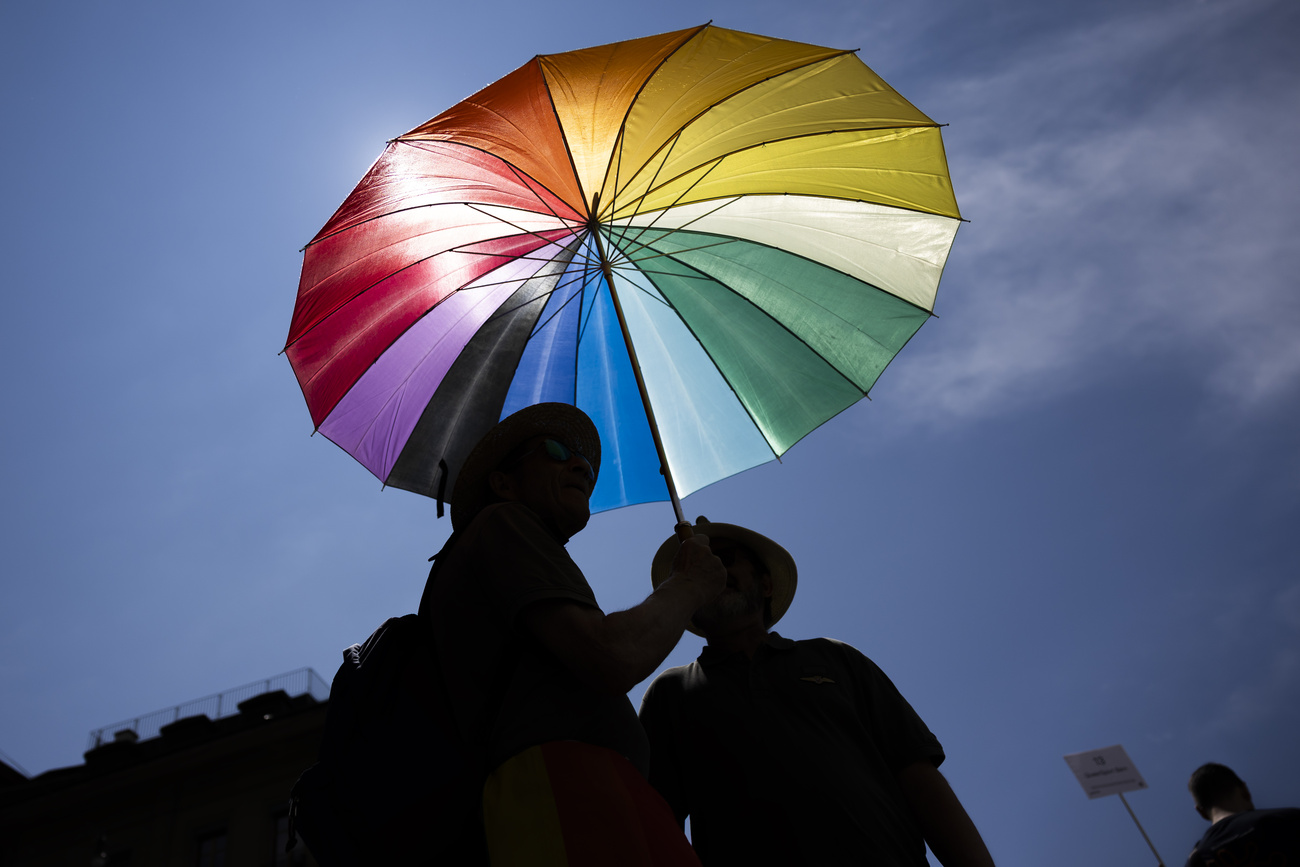
What is life like as a queer person in Switzerland? A study sheds light on discrimination, coming out and self-harm. It shows that the campaign against gender minorities in the US casts a long shadow overseas.
Select your language
Generated with artificial intelligence.
Listening:
Seven graphics showing how LGBTIQ+ people are doing in Switzerland

This is the sixth major survey conducted by researchers Tabea Hässler and Léïla Eisner from the University of Zurich. At the beginning of the year, they published the results of the latest LGBTIQ+ Panel survey – the most important such longitudinal study in Switzerland.
More
Switzerland’s queer community fears rollback of LGBTIQ+ rights
In the 2025 edition, 6,117 people took part in the survey, of whom 5,422 identified as LGBTIQ+ and 695 as heterosexual.
The most important findings are summarised below.
Discrimination: one group is clearly the most affected
Gender minorities, such as trans and non-binary people, experience significantly more discrimination in Switzerland than members of other sexual minorities.
They are most frequently subjected to derogatory remarks: more than 93% reported being the target of inappropriate jokes.
The second most common experience is not being taken seriously in their identity – although experiences of discrimination decrease slightly in adulthood.
The report describes sexual harassment, particularly of inter-sex people, as “worrying”. In this group, every second person has been affected.
External Content
Discrimination typically occurs in public spaces. More than half of gender minorities have experienced it there. For sexual minorities, the figure is around one-third. Social media comes next.
But the family is also a place of discrimination. Every third trans or non-binary person has experienced discrimination within the family.
LGBTIQ+: The abbreviation stands for lesbian, gay, bisexual, transgender, inter-sex and queer people; the plus sign is a placeholder for other identities.
Cis-heterosexual: Refers to people who identify with the gender assigned to them at birth (cis) and feel attracted to the opposite gender (hetero).
Queer: A positive collective term for all people who deviate from social norms in terms of gender or sexual orientation.
Non-binary: A collective term for people who do not or do not exclusively define themselves as men or women.
Trans: People whose gender identity does not correspond to the sex they were assigned at birth.
Inter-sex: People who were born with physical characteristics (such as hormones or genitalia) that are not clearly categorised medically as only male or female.
Coming out: The voluntary disclosure of one’s chosen gender or sexual identity.
Well-being: gay and lesbian people feel good overall
According to the study, sexual minorities in Switzerland are almost as happy as their cis-heterosexual peers.
The other groups report poorer outcomes, with gender minorities showing the lowest levels of well-being.
Participants were asked how often they experienced positive or negative emotions over the past 12 months on a scale from 1 (very rarely) to 7 (very often).
External Content
Mental health: young people have the biggest problems
Trans and non-binary people also have the worst mental health scores. Over half of this group state that their mental health is poor. Among young people, the figure is as high as 56%, and only one in five feels good.
External Content
Members of sexual minorities rate their mental health only slightly lower than cis-heterosexual people. Inter-sex people fall in the middle.
Across all groups, self-assessed mental health improves in adulthood.
Self-harm: almost 50% of trans youth are affected
Self-harming behaviour is significantly less common among adults than adolescents. This applies to all groups analysed in the report.
For example, the proportion among cis-heterosexual people falls from 19.6% to 7.7%, and among sexual minorities from 27.9% to 12.6%.
The figures are alarmingly high for trans, non-binary and inter-sex people: around one in three adults and, at 49.7%, almost one in two young people report self-harming behaviour..
External Content
Coming out: friends are the most trusted
The report also provides a detailed picture of the contexts in which LGBTIQ+ people make their identity visible.
According to the report, the greatest trust is placed in friends, followed by family. Coming out is also more common at work than at university.
External Content
LGBTIQ+ people are least likely to share their identity fully at school and during apprenticeships. This is partly because many take several years to openly disclose their sexual or gender identity.
External Content
Social climate: only one group feels accepted
More than 40% of sexual minorities feel positively accepted in Switzerland, and only around one-third report negative social perception.
Trans and non-binary people, by contrast, feel far less comfortable. Some 76.5% perceive social perception as negative, while only 7.8% describe it as positive.
External Content
The report links these figures to political campaigns against queer people, particularly in the United States.
Inter-sex people also feel poorly accepted in Switzerland: 57.1% perceive the climate as negative.
Join the debate:
External Content
Edited by Balz Rigendinger, adapted from German by Alexandra M. Andrist/ac

In compliance with the JTI standards
More: SWI swissinfo.ch certified by the Journalism Trust Initiative

You can find an overview of ongoing debates with our journalists here . Please join us!
If you want to start a conversation about a topic raised in this article or want to report factual errors, email us at english@swissinfo.ch.