








What happened to the orphans who fled Ukraine for Switzerland?

Four years ago, a group of Ukrainian orphans escaped the horror of Russian attacks on their home of Mariupol to the safety of Switzerland. But as the war in Ukraine drags on with no end in sight, some are facing the question of when or whether to go back.
Select your language
Generated with artificial intelligence.
Listening:
What happened to the orphans who fled Ukraine for Switzerland?

After four years of exile, Tara is going home. The Ukrainian orphan, only eight when Russia besieged his birthplace of Mariupol, was evacuated with his four-year-old sister Vera and almost 100 other children three days before the city was surrounded.
A convoy of four buses carrying the kids took eight hours to travel just 200 kilometres northwest to the relative safety of Zaporizhzhia, before onward journeys to Lviv, then Poland, and finally to what was to be temporary refuge in Switzerland.
External Content
It was a blessed escape. The siege of Mariupol went on for three agonising months, with upwards of 20,000 civilians killed before the city was overrun. Yet a year later, safe in ruralcanton Valais in Switzerland, Tara only wanted to know when he and his sister could go home.

“We have only one goal,” Natalia Lashchevskaya, director of the Wings of Hope children’s home, by then operating in Switzerland, said at the time. “Ukraine.”
No end of the war is in sight
Few expected it to take so long, with around half of the evacuees still living outside Ukraine and with no end in sight for a war that has entered its fifth year. Even those who return can’t revisit the communities they once knew. Mariupol is still occupied by Russia and the building that once housed Wings of Hope is destroyed.

In a surveyExternal link of Ukrainian refugees conducted through January this year the UNHCR international refugee agency reported that just 3% planned to return within the next 12 months, while 46% hope to go back some day. Another 23% saw no hope of return and 28% were undecided. Aspirations to return have declined steadily in each of the six surveys the UN agency has carried out, from a high of 83% in 2022, to the latest 49%.

Tara and Vera will be among those in the group that will soon make it back to their country. The siblings, currently in temporary accommodation in Germany, are expected to return to relatively peaceful Western Ukraine by the end of the year.
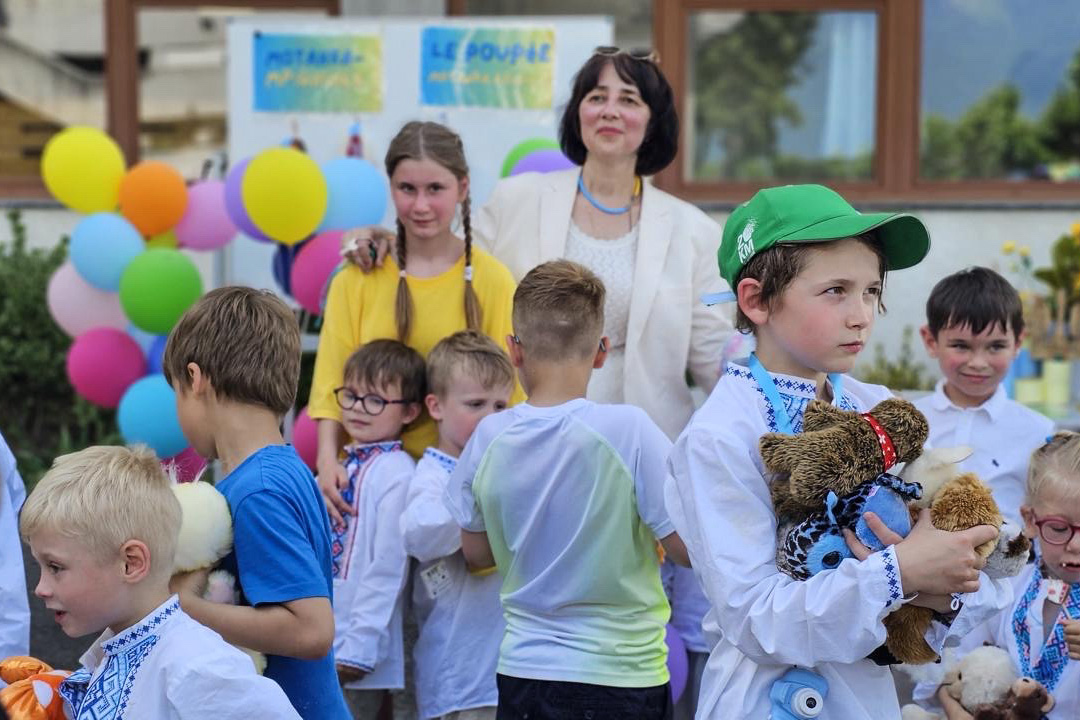
More than 40 others remain in Switzerland, while another 14 have already become adults. The kids who fled in 2022 have attended Swiss schools, learned French, made friends, grown up. At the same time, they have kept links with Ukraine, speaking their language, celebrating Ukrainian holidays and continuing parts of their home education.
“Most of them now live between two worlds,” Lashchevskaya tells Swissinfo. “They are grateful to Switzerland for the safety, support and opportunities it has given them, but at heart they remain Ukrainian.”
External Content
The situation is far worse for children who were unable to escape the occupation.
One girl who had been under Lashchevskaya’s care lost her mother and grandmother in the bombardment of Mariupol. Her younger sister, just three years old in 2022, was taken to Russia and later placed with a Russian family.
“Will these sisters ever see each other again?” Lashchevskaya asks. “I don’t know.”

This year, Switzerland formally joined an international coalition that’s working for the return of Ukrainian children who have been forcibly taken to Russia. That followed criticism of the Swiss government for only participating as an observer for two years.
For Lashchevskaya, what matters is whether such efforts produce tangible results.
“Every child who returns is not a statistic or a number in a report,” she says. “It is a life saved, a connection restored with family, culture and country.”

From one group to many individuals
Even for those who did escape, returning is complicated by continuing violence, with attacks from Russian missiles and drones on homes, power plants and water supplies. But the kids understand the reality, Lashchevskaya says, even as they want to return to a Ukraine where they can study, work, have families and build futures without fear.
The group of kids that arrived on four buses are finding their own way. Some have new families; others are completing education or beginning independent adult lives. They are increasingly making their own decisions about where and how they want to live.
Back in 2023, there was a joke at Wings of Hope. The children were trying to teach Gosha, their pet blue parrot, to say “Slava Ukraini!”, Glory to Ukraine. Lashchevskaya told them that they could go home once he learned the words. Three years on, there’s a second parrot to keep Gosha company but he’s still struggling with his Ukrainian.
“Gosha does say ‘Slava Ukraini’, but so indistinctly that I’m the only one who can hear it,” Lashchevskaya insists, laughing. “Now we’re teaching both of them. It’s still a work in progress, but we really believe they’ll get there.”

More
Swiss mobilise quiet diplomacy to help return Ukraine’s stolen children

More
Our newsletter on geopolitics

In compliance with the JTI standards
More: SWI swissinfo.ch certified by the Journalism Trust Initiative

You can find an overview of ongoing debates with our journalists here . Please join us!
If you want to start a conversation about a topic raised in this article or want to report factual errors, email us at english@swissinfo.ch.