








Switzerland played role in Nobel Prize-winning research

Francis Halzen’s Nobel Prize in Physics has a Swiss connection. Researchers from the University of Geneva are involved in the IceCube experiment, for which Belgian-born physicist Halzen was honoured this year.
Select your language
Generated with artificial intelligence.
Listening:
Switzerland played role in Nobel Prize-winning research
The research group led by Geneva-based physicist Teresa Montaruli is part of the international IceCube collaboration. They work with data from the giant detector, using it to investigate, amongst other things, the origin of high-energy neutrinos.
“I am so happy,” Montaruli told the Keystone-SDA news agency. She said the Nobel Prize was recognition for a field of research that offers a completely new perspective on the universe.
IceCube detects neutrinos by tracing the light trails created when these particles interact – albeit rarely – with the Antarctic ice. Because neutrinos interact very little with their surroundings, they can travel to Earth from great distances almost unimpeded.
“You can see neutrinos coming from very far away,” explained Montaruli.
The particles thus open “a completely new window” onto high-energy astrophysics. Unlike when observing light, neutrinos allow us, so to speak, to “peer into the depths of the sources”, said the physicist.
More
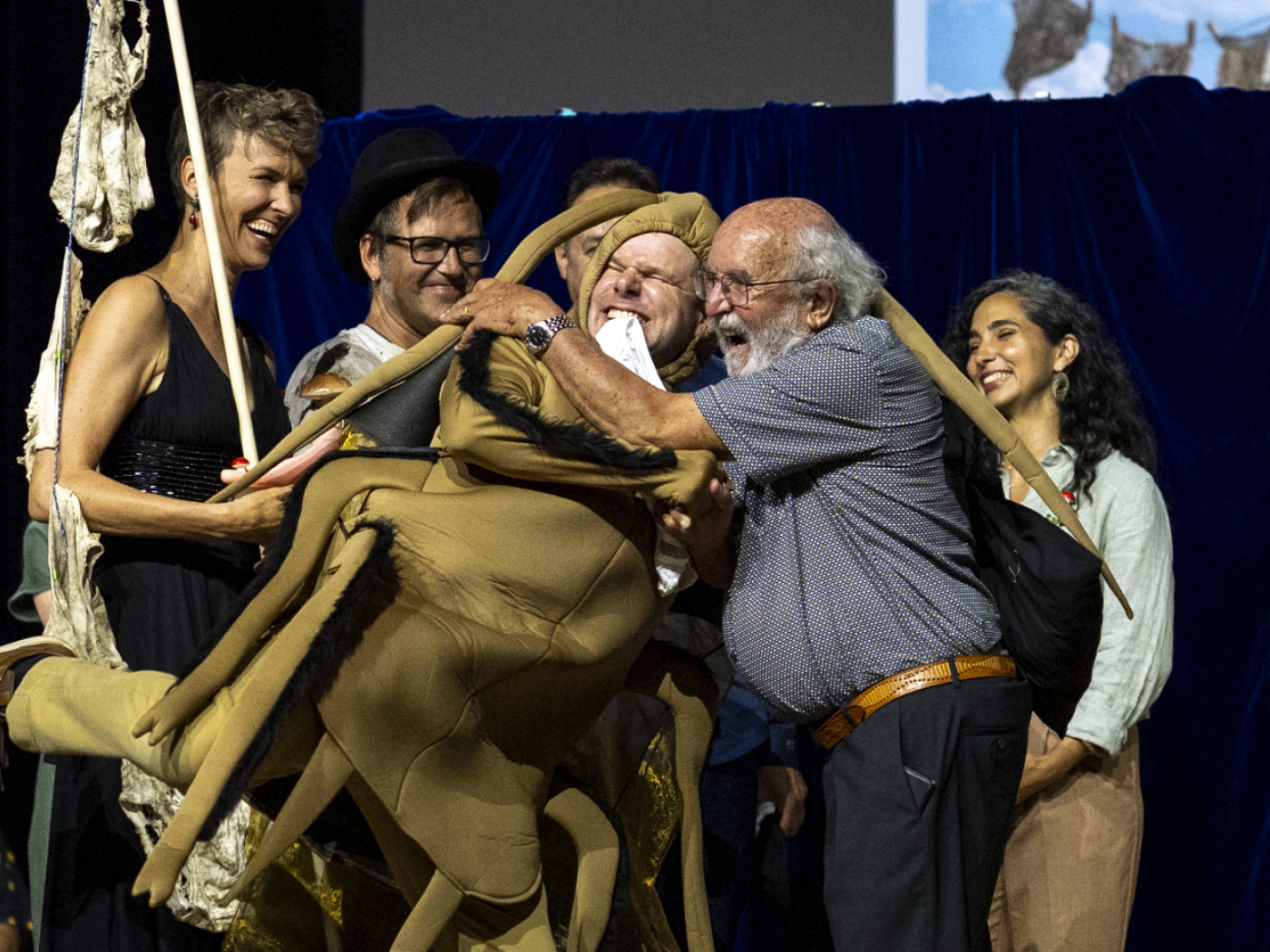
Swiss soil underpants study win Ig Nobel Prize
+ How we produce news in English
Translated from German, reviewed by an English Department journalist.

In compliance with the JTI standards
More: SWI swissinfo.ch certified by the Journalism Trust Initiative

You can find an overview of ongoing debates with our journalists here . Please join us!
If you want to start a conversation about a topic raised in this article or want to report factual errors, email us at english@swissinfo.ch.