








Switzerland seeks to build role in post-Assad Syria

Since the fall of the Assad regime in late 2024, many states have been striving to rebuild their relations with Syria. What is Switzerland doing?
The Syrian foreign minister, Asaad al-Shaibani, had planned to attend the opening of Switzerland’s cooperation office in Damascus. Instead, he had to travel with President Ahmed al-Sharaa to the NATO summit in Turkey, which was taking place at the same time.
Al-Shaibani’s intention nonetheless shows that the Syrian authorities are favourably disposed towards Switzerland, according to Monika Schmutz Kirgöz, head of the Swiss foreign ministry’s Middle East and North Africa Division. “Our partners in Syria tell us: ‘We know you were there’,” she said, following her trip to Damascus for the inauguration of the cooperation office. Thanks to its longstanding commitment, Switzerland enjoys a high level of credibility in Syria, she said.
More
New country, old fear: an overview of Syria’s realities
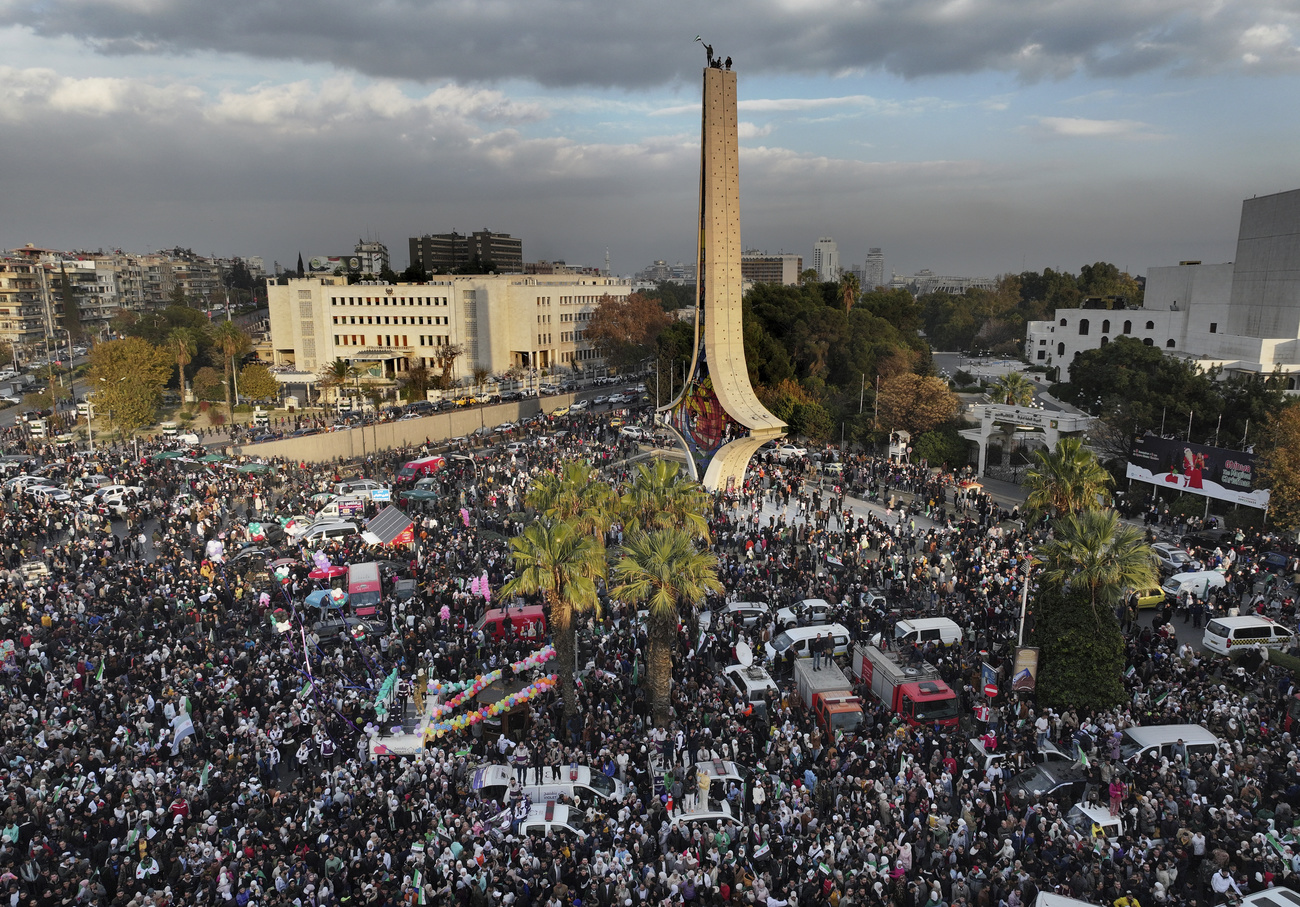
Syria has been in a transition phase for the past year and a half, since the collapse of the Assad regime, which held the land in its grip for over 50 years. The new government has the colossal task of rebuilding a country – politically, economically and socially – in large part devastated by war. At the same time, the interim president, Al-Sharaa, is working hard to bring his country out of isolation; for decades, Syria was one of the most heavily sanctioned nations in the world.
Now the country has been opening up at breakneck speed. Many of the sanctions have already been lifted. US President Donald Trump recently held out the prospectExternal link of taking Syria off the list of state sponsors of terrorism. Once pursued as an al-Qaeda terrorist, al-Sharaa addressed the UN General AssemblyExternal link and travelled to Washington, D.C., on a state visitExternal link last autumn to meet the US president.

Not only the Syrian government is committed to this process; many countries also want to restore and normalise ties with Syria. Over a dozen statesExternal link reopened their embassies in Damascus in the year following the fall of Bashar al-Assad.
In July, France’s Emmanuel Macron became the first European head of state to visit the Syrian capital under the new government. During the visit, he affirmed his country’s readiness to returnExternal link frozen Assad-regime assets. When asked by Swissinfo whether Switzerland planned to follow suit, the State Secretariat for Economic Affairs (SECO) was non-committal, adding that the activities of Swiss companies in Syria were still limited, in particular because of ongoing restrictions on payment transactions.
Meanwhile, many observers remain sceptical of the transitional government. They doubt the new leadership’s sincerity and fear that the country could be ruled in a much more Islamic manner in the future, that minorities will be oppressed and that al-Sharaa may, ultimately, not build a democracy, but instead establish a new authoritarian regime.
So how is Switzerland responding to the new situation in Syria, and what are its goals?
Humanitarian office upgraded
Switzerland is keen to play a role in the new Syria, as clearly demonstrated by Schmutz Kirgöz’s trip to Damascus in late July – accompanied by the director of the Swiss Agency for Development and Cooperation (SDC), Patricia Danzi – and the upgrading of the Swiss humanitarian office there to a cooperation officeExternal link.
The humanitarian office was opened in 2017, when the Assad regime was in power and the war was at its height. “We constantly tailored our humanitarian aid to the needs of the population,” said Schmutz Kirgöz. “We did not work with state channels.”

Keeping a distance from Assad’s regime was no easy task, however. Journalists repeatedly uncovered evidenceExternal link that international funds – including from UN agencies such as UNICEF and the WHO – had wound up in the hands of the regime. Switzerland, too, had provided financial support for the work of various UN agencies in Syria, although the Swiss foreign ministry affirms that these funds were not misappropriated. “The terms and conditions governing contributions are subject to strict regulations,” the foreign ministry wrote with regard to Switzerland’s financial support for UN operations in Syria, adding that “the foreign ministry also has its own monitoring mechanisms to ensure that no funds are misappropriated.”
Since the transitional government came to power, Switzerland has been in direct contact with the Syrian authorities. This may well make a crucial difference. “The upgrade puts us on a broader footing. Today we are also in dialogue with state institutions,” said Schmutz Kirgöz. Switzerland still does not provide financial support to the Syrian state, but it does back projects inside the country.
Many of these concern basic services and infrastructure, where needs are huge after 13 years of war, Schmutz Kirgöz explained. Examples include microloans for women in al-Bab in northern Syria and a recycling project in Aleppo, where rubble is used to make bricks, which are then used to rebuild houses. Switzerland also plays an active role in peace diplomacy and transitional justice and has supported efforts to trace missing people for years. “Our consistent commitment in this area has earned us a high degree of credibility,” Schmutz Kirgöz said.
The activities of the cooperation office will be carried out jointly by the SDC, the Swiss foreign ministry’s Peace and Human Rights Division and the State Secretariat for Migration, which provides on-the-ground support for UN projects to facilitate the return of Syrian refugees.

More
Syrian refugees in Lebanon in dilemma over staying or returning
Reluctance to criticise transitional government
Switzerland and many other countries are clearly keen to play a role in Syria, despite repeated, fierce criticism since the forming of the transitional government – for instance after the two massacres last year, each claiming over a thousand lives, in which members of government forces were involved, and whose victims were predominantly members of the Alawite and Druze minorities.
“The massacres had no repercussions on the part of Western states,” noted Syria expert Joseph Daher. On the contrary, relations were further strengthened. “The prevailing narrative is that the transitional government simply needs time. Even when they admit that there are difficulties, the main thinking is that their intentions are good.”
Daher thinks states may be holding back on criticism to prevent the Syrian authorities from withdrawing their cooperation with them. Demand for engagement with Syria is currently high, he said, and Western states, and European ones in particular, are not Syria’s top priority. More important for Syria are relations with the US and regional powers, such as Turkey and the Gulf states.
According to Daher, Switzerland, like the other European countries, should focus on a range of complementary political initiatives. Long-term support for NGOs is important, he noted, but so, too, is a consistent stance on human rights. This means taking a clear stand towards Syria’s transitional government while at the same time criticising other states when they violate international law in Syria – such as Israel’s occupation of the country’s south. Otherwise, countries such as Switzerland would risk losing credibility, Daher cautions.
Focus on water diplomacy?
To gain greater clout and thereby meet its goals in Syria, Switzerland could work together with Arab states, for instance building on existing cooperation agreements, according to Achim Wennmann, a professor at the Geneva Graduate Institute. It could thus try to launch projects in Syria in the field of water diplomacy or diplomatic training, together with Qatar. “Switzerland could contribute its collective expertise, with Qatar’s help,” said Wennmann.
According to Sara Hellmüller, a Syria expert at the Graduate Institute, Switzerland has carved out a niche for itself thanks to its focus on civil society. From 2016 onwards, it backed a UN initiative aimed at including civil society in the Geneva peace talks. “The task now is to find a similar niche,” she said. In this, Switzerland is aided by the broad network of civil society organisations it has built over the years. “I see great potential here, because in order to build democracy, you need civil society.”
For the moment, it is not entirely clear how Switzerland will fulfil its role in the new Syria. One thing is sure, however: it wants to play a role, just like many other countries.
Edited by Benjamin von Wyl. Adapted from German by Julia Bassam/ts

More
Our newsletter on geopolitics

In compliance with the JTI standards
More: SWI swissinfo.ch certified by the Journalism Trust Initiative

You can find an overview of ongoing debates with our journalists here . Please join us!
If you want to start a conversation about a topic raised in this article or want to report factual errors, email us at english@swissinfo.ch.