








When hospital patients swelter, is it time for Switzerland to turn to air-conditioning?

The long hot summer is over, but debates on how to keep buildings cool during heatwaves continue. In Switzerland, questions remain about the role of air-conditioning and restrictions on its use.


The question came up time and again during the stifling summer of 2026. Social media usersExternal link, foreign tourists at hotel receptions and hospital patients all wondered: why is air-conditioning so rare in Switzerland?
Indeed, air-conditioning systems are an exception in the country. In many cantons, installing split-system air-conditioning – made up of an indoor and an outdoor unit – means complying with some strict energy, environmental and town-planning regulations. Surveys across EuropeExternal link and in Switzerland show however that most people are in favour of relaxing any restrictions.
“In Switzerland, heat already claims more lives than road traffic accidents,” saysExternal link Arno Schlüter, professor of architecture and building systems at the federal technology institute ETH Zurich. Air-conditioning is sure to become more important, in particular to protect the most vulnerable people in hospitals, care homes and schools. However, the expert cautions, a future in which every apartment and every office is air-conditioned is not the solution.
Like in France and Germany, air-conditioning has become a hot political issue in Switzerland, prompting several parliamentary motions at both cantonal and national levels. The federal parliament is due to discuss the matter, along with other questions related to heat and drought, in a special session on September 30.
>>Switzerland was built for winter; now it has to equip itself to cope with increasingly hot summers:
More
Switzerland’s new energy challenge: keeping cool in a warming climate
More air-conditioning to protect the vulnerable
The right-wing Swiss People’s Party wants current restrictions in Switzerland to be eased. In a parliamentary initiativeExternal link, Thomas Burgherr has proposed changing the legal framework so that a permit is no longer required to install split-system air-conditioning.
For the People’s Party parliamentarian, a lack of air-conditioning also has negative economic consequences. People arrive at work less refreshed, hotel guests are left disappointed, and high temperatures in industrial plants increase the risk of accidents.
Modern air-conditioning systems, Burgherr notes, have a much lower environmental impact than in the past. In summer, they can be powered by solar electricity, of which there is ample supply.
The centre-right Radical-Liberal Party also stresses that installing air-conditioning to protect the population must be a top priority. A motionExternal link tabled in mid-September calls for a simplified notification procedure, similar to that already in place for fitting solar panels.
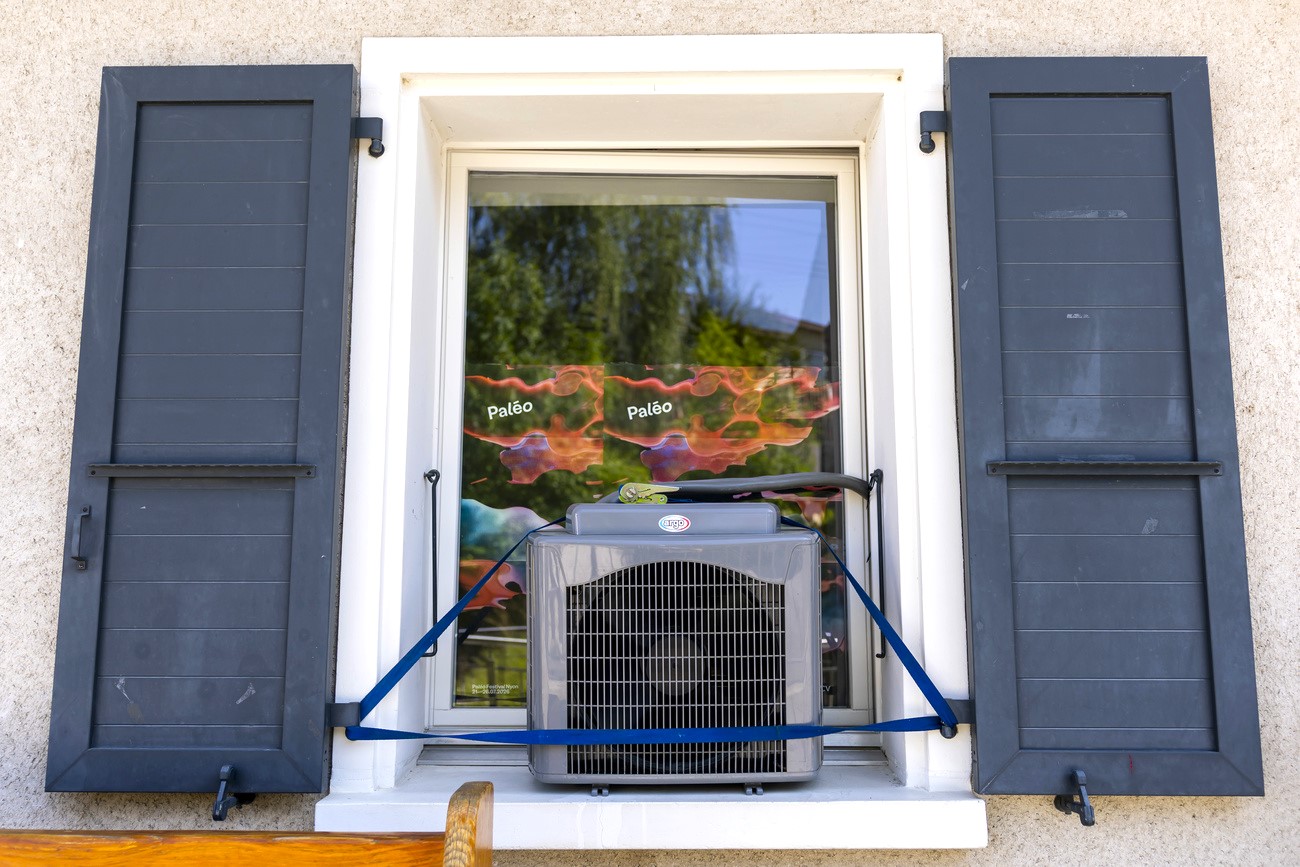
The aim is also to limit reliance on portable air-conditioning units. These do not require special permission, but are generally less efficient and consume more electricity than fixed systems.
Even left-wing political parties – which are traditionally skeptical of artificial cooling – no longer rule out its use in certain situations, such as hospitals, care homes for the elderly and schools, as reportedExternal link by the Swiss public broadcaster RTS.
Air-conditioning increases comfort on the hottest days of the year and reduces the health risks associated with heatwaves. However, its use leads to higher electricity consumption and exacerbates the climate crisisExternal link. Worldwide, air-conditioning systems consume around 7% of electricity and produce 3% of CO₂ emissions.
External Content
Medical certificate needed
In Switzerland, fewer than one in ten homes is fitted with a fixed air-conditioning system, which is below the European average of around 20%. In the US and Japan, some 90% have artificial air-cooling.
Installing a fixed air-conditioning system in Switzerland can also be more complicated than in neighbouring countries. There is, in fact, no single federal law; instead, the rules depend on cantonal laws and various energy and environmental regulations.
In most cantons, a building permit or energy authorisation must first be obtained. Geneva is one of the most restrictive cantons in this respect. Those aiming to install a permanent system may have to demonstrate a genuine need by providing a medical certificate. In Fribourg and Neuchâtel, the energy used for air-conditioning must be offset by locally produced renewable sources.
Despite the restrictions, the market for split-system installations is growing in Switzerland, albeit slowly. Sales are rising by around 2% a year, according to GebäudeKlima Schweiz, the Swiss Association for Heating, Ventilation and Air-Conditioning Systems.
External Content
A rarity in Swiss hospitals
Air-conditioning is also rare in facilities which care for particularly vulnerable people. An investigation published in June by the news portal Schweiz HeuteExternal link shows that in the major Swiss hospitals, air-conditioned rooms and wards remain the exception. At Geneva University Hospital, indoor temperatures soared above 30°C this summer.
It is not just the patients who suffer the consequences; healthcare staff are impacted too. Some facilities have taken action by installing portable air-conditioners and fans and setting up air-conditioned spaces for the most vulnerable patients.
Overheating is a particular problem in older or protected buildings. Tomas Honegger, a spokesman for Bern’s Inselspital, told Swissinfo that before installing air-conditioning systems, various building regulations, health and hygiene requirements and patient safety must be taken into account. Meanwhile air-conditioning can, for instance, lead to an increased risk of bacterial proliferation.
In newly built hospital buildings, by contrast, air-conditioning is standard across many departments, Honegger said. “Patient areas in newer buildings are largely, if not entirely, air-conditioned.” Inselspital has renovated most of its facilities in recent years, and around 75% of the buildings are now air-conditioned.
Protecting the elderly in care homes
The situation is similar in care homes. “Most residents do not have air-conditioning in their rooms,” says Christina Zweifel of Curaviva, the umbrella association for the country’s elderly care institutions. Many facilities opt instead for organisational adjustments, sun-shading systems and other passive cooling measures.
Care homes are well able to assess which architectural, technical or organisational solutions best suit their specific circumstances, Zweifel adds. However, they must be given the necessary leeway, and permission, to implement the most effective measures to protect vulnerable people during heatwaves.

A much broader debate than just air-conditioning
The Swiss Energy Foundation, a non-profit organisation which advocates for ecological energy policies, acknowledges that air-conditioning can be a sensible – and sometimes even essential – solution for coping with the heat. However, the foundation stressesExternal link, it should only be considered after trying out passive cooling measures.
According to Schlüter of ETH Zurich, with the climate as it is in Switzerland, much can already be achieved by simple yet effective measures – such as shading systems, night-time ventilation and fans to improve air circulation – and by changing daily habits.
Protection from heat is a broader societal challenge that requires a coordinated approach based on climate-adapted urban planning, appropriate infrastructure and green spaces. As such, for Schlüter, the debate should not overly focus on air-conditioning, but also on the different ways to ensure the well-being of people inside buildings. “This calls for a shift in mindset,” he concludes.
Edited by Balz Rigendinger. Adapted from Italian by Julia Bassam/sb,dos

In compliance with the JTI standards
More: SWI swissinfo.ch certified by the Journalism Trust Initiative

You can find an overview of ongoing debates with our journalists here . Please join us!
If you want to start a conversation about a topic raised in this article or want to report factual errors, email us at english@swissinfo.ch.