








Making synthetic fuels: a Swiss scientist’s bid to decarbonise cars and planes

Millions of combustion engines – powering machines, vehicles and aircraft – will remain in use for decades to come. Instead of replacing them, a Swiss chemical engineer is developing a greener alternative: a synthetic, “drop‑in” fuel that works with existing engines and infrastructure.
Select your language
Generated with artificial intelligence.
Listening:
Making synthetic fuels: a Swiss scientist’s bid to decarbonise cars and planes


Inside her labyrinthine lab at the Swiss Federal Laboratories for Materials Science and Technology (Empa) in Dübendorf, a network of pipes and custom-built modules hums away as Alessia Cesarini shows off the prototype e-fuel unit she took two years building.
She aims to turn it into a business offering a viable alternative to conventional fossil fuels.
“There are lots of systems with combustion engines still running, and the idea is to provide a locally produced and less-polluting solution,” she explains.
Transport accounts for 47% of Switzerland’s energy-related CO2 emissionsExternal link, versus 25% globally. A Swiss study estimatesExternal link that around two million combustion-driven vehicles will remain on the country’s roads by 2040. Globally, BloombergExternal link estimates that 55% of cars will still run on combustion engines by that time. Also, for hard‑to‑abate sectors such as aviation, long‑term decarbonisation will depend heavily on the adoption of renewable fuels.
Cesarini’s approach is simple: “The goal is a solution that works with existing vehicles and infrastructure – sustainable both environmentally and economically,” she says.
Synthetic fuel research is expanding rapidly, especially in China, the US and Europe. The International e‑fuels Observatory 2025External link lists more than 120 large-scale projects in 28 countries. But it remains early-stage and highly concentrated, with a clear shift from conceptual work to industrial pilot projects.
Switzerland is positioning itself as an advanced research hub, combining CO₂, green hydrogen, and innovative chemistry to produce low-carbon fuels. Cesarini’s work targets a unique niche by focusing initially on “drop-in” gasoline using energy-efficient catalysts, before later also tackling the aviation sector. Many of her peers are exploring aviation fuels directly or working on “sun-to-liquid” solar processes.
Building hydrocarbons like Lego
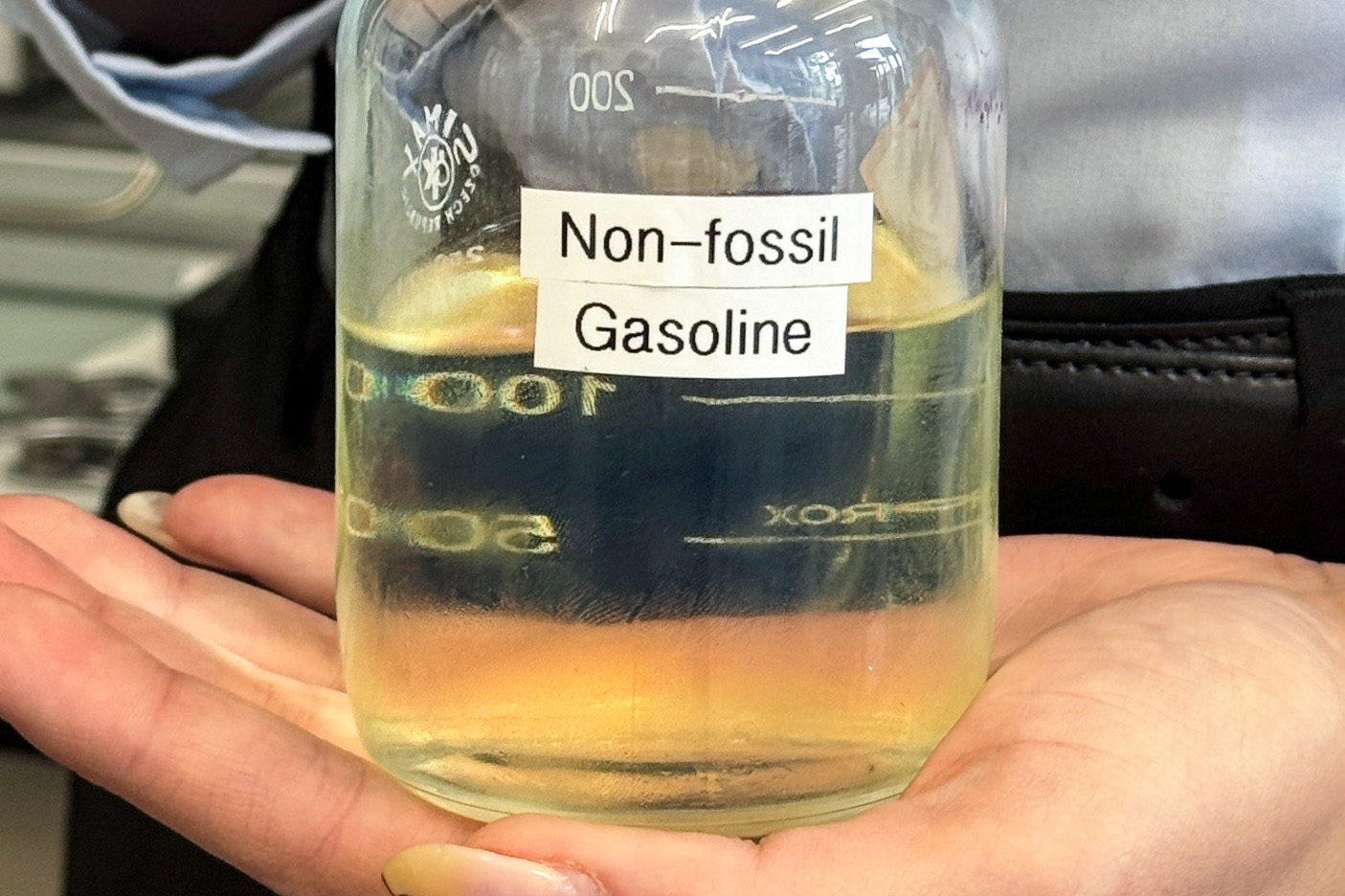
In the lab, Cesarini holds up two flasks of yellowish liquid.
“Can you spot the difference?” she asks. Both have that distinctive sharp, pungent smell. But one is standard 95-octane gasoline, while the other is her synthetic version.
At the heart of her innovation is a chemical process called oligomerisation, which converts ethylene or propylene molecules into a liquid fuel closely resembling conventional gasoline. Another advantage of her process is the possibility to extend the production to kerosene chemical compounds, which could be used in the future in planes.
>>In this short video, Swiss researcher Alessia Cesarini explains how her synthetic fuel is created:
The cycle starts with carbon dioxide (CO2) being removed from the biosphere or atmosphere and transformed into alcohols like methanol or ethanol. Water is then removed from these liquids via an existing method known as dehydration, converting them into ethylene and propylene.
These gases are then sent to a reactor where a catalyst breaks the molecules apart and recombines them into longer hydrocarbons, creating a synthetic fuel that can be used directly in cars, planes or other machinery.
The catalyst is a key element to make the process efficient and keep energy consumption low, Cesarini explains. “We start from very small molecules that you can compare with small Lego building blocks. With Lego, we want to build a construction with a specific shape with the small building blocks. Making the fuel is no different. We have the small molecules that we combine into a designed mix of longer molecules. And this combination is accurately done by the catalyst.”
Secret catalyst
The catalyst is a special ingredient that remains a secret. Cesarini can’t say much apart from that it is different from other catalysts and that it combines the building blocks to obtain a fuel with pre-defined properties that can be used immediately.
This is a huge competitive advantage, she says. Independent tests have shown that her synthetic fuel already reaches a research octane number (RON) of 95, a key benchmark for standard unleaded gasoline, and initial estimates suggest it could be cost-competitive with fossil gasoline once produced at an industrial scale.

“You don’t need to do expensive retrofitting. You can just replace the fossil fuel, and the engine will run as it should,” she explains.
Empa describes the fuel as climate-friendly, though precise emissions data is still pending.
“In general terms you can reduce your emission, based on which source you take, theoretically up to 100%,” she says. “More realistically, it will be around 90–95%.”
Leading German fuels researcher Jörg SauerExternal link calls Cesarini’s project “highly relevant”. While recent oligomerisation research has focused on sustainable aviation fuels, he told Swissinfo that “gasoline-type compounds will remain necessary on a long timeline”.
But Sauer, the head of the Institute for Catalysis Research& Technology at the Karlsruhe Institute of Technology (KIT), stressed that ensuring strict quality standards will be essential.
Forestry-first strategy
Cesarini began her synthetic fuel research at the federal institute of technology ETH Zurich working on projects focused on sustainable chemicals and fuels for aviation. But strict global certification rules – which can often take more than a decade to implement – prompted a strategic shift to supply a road transport fuel first, where approval is faster and nationally regulated.
Just down the corridor from her lab, a larger test prototype is also in action, able to produce around 10,000 litres of synthetic fuel per year.
With an Empa Entrepreneur Fellowship, the researcher from canton Ticino is now scaling up and launching a start-up.
“The PhD has apparently turned into a company,” she says with a smile. “It’s like learning a new language.”
Initial applications of the sustainable fuel will focus on the forestry sector, where smaller volumes and controlled usage make market testing easier. The next step will involve increasing production to one million litres annually before moving toward industrial supply.
The ‘unknown unknowns’
Expanding production to bring the new fuel to market will be a huge challenge, Empa researchers acknowledge.
“At scale, many problems may arise that you didn’t think of before. It’s always called the ‘unknown unknowns’,” notes Nathalie CasasExternal link, who heads Empa’s energy, mobility and environment department.
Sauer echoes this, urging tight integration of the next pilot into a well-defined production process, with precise inputs and target chemical outputs, so that operating conditions can be directly linked to product quality.
Large-scale production will also require significant investment – potentially tens of millions of francs – though Cesarini’s start-up project will benefit from using existing industrial reactor designs.
“There are many investors around the world committed to providing capital to these kinds of environmentally friendly technologies. But the world is changing, and the landscape is becoming more difficult,” admits Casas.
She sees Switzerland’s role as developing and exporting such innovations: “Switzerland is very strong at innovation and companies that can sell this innovation to the world. This is not a local problem, it’s a global problem. And if Switzerland can help the world decarbonise fuels, that’s a very strong asset we can provide.”
Sauer agrees, saying Switzerland has the opportunity with this work to carve out a technological edge through its “excellent and world-leading basic research, which is linked to transfer to application”.
Competitive environment
Despite the hurdles ahead, Cesarini is confident demand and investors will materialise. Alongside sustainability, energy security is driving interest, she says, a trend regularly highlightedExternal link by the International Energy Agency (IEA).
“The urgency of replacing fossil fuel is increasing,” prompting industry players and market actors to explore “where this can go and how potential collaboration can be established,” she notes.
So, when will drivers finally be able to buy her climate-friendly gasoline at Swiss filling stations?
“As soon as possible,” she says, adding that her aim is to cut emissions now.
“Every time we refuel, we’re still using fossil fuels. We want to change that.”

More
‘Our biggest challenge is to meet the demand for sustainable fuels’
Edited by Gabe Bullard/Veronica De Vore

In compliance with the JTI standards
More: SWI swissinfo.ch certified by the Journalism Trust Initiative

You can find an overview of ongoing debates with our journalists here . Please join us!
If you want to start a conversation about a topic raised in this article or want to report factual errors, email us at english@swissinfo.ch.