








Explainer: Why does Switzerland host peace talks?

From Geneva’s historic buildings to chic mountain resorts, Switzerland is a perennial backdrop for peace talks. Why do warring parties often choose it for negotiations – and what do the Swiss gain from hosting them?
Select your language
Generated with artificial intelligence.
Listening:
Explainer: Why does Switzerland host peace talks?

In 1925 and 1926, a trio of European foreign ministers won the Nobel Peace Prize for negotiating a continental security pact after the First World War. It was a remarkable achievement for France, Britain and Germany, who had been bitter adversaries in the conflict.
The setting for talks was a lakeside town in southern Switzerland that gave the pact its name: Locarno. There, Swiss officials provided plush accommodation, security, discretion and multiple venues for meetings to hammer out the treaties.

More
How Locarno became the ‘city of peace’
A century later, Switzerland remains a top location for peace summits, a diplomatic tradition it has carefully constructed by investing in mediation infrastructure.
Where does Switzerland’s responsibility for hosting talks come from?
Promoting peace is inscribed in the Swiss Constitution. To fulfil this, the country offers so-called good offices in which it may act as a third party to help resolve a conflict. In recent years, the Swiss foreign ministry says it has accompanied over 30 peace processes in more than 20 countries.
In this capacity, Switzerland can offer – or be asked – to bring belligerents to the negotiating table. This work has support from across the political spectrum, says Sibylle Obrist, deputy head of the peace and human rights division at the ministry.
“The political will to play this role has been reaffirmed several times by the Federal Council and parliament – and by the people, if you look at surveys,” she says. “That’s why we often say it’s part of Switzerland’s DNA.”
What kinds of talks does Switzerland host?
High-level summits like a 2021 meeting in Geneva between then-president Joe Biden of the United States and Vladimir Putin of Russia attract the most attention. They often feature heavy security, a red carpet and a greeting from the Swiss president in front of a throng of journalists before discussions get underway behind closed doors.

But Switzerland also hosts backroom meetings away from the spotlight. These may be technical talks over, for example, decommissioning weapons or cases of missing persons. They rarely feature in the news but make up most of the meetings that Switzerland hosts.
“These less visible negotiation processes are very important for preparing any final agreement that can be signed,” Obrist says.
What does Switzerland offer as host of peace talks?
Switzerland’s central location in Europe, good transportation and efficient government help to make it an ideal host, but active efforts to develop its role have also contributed.
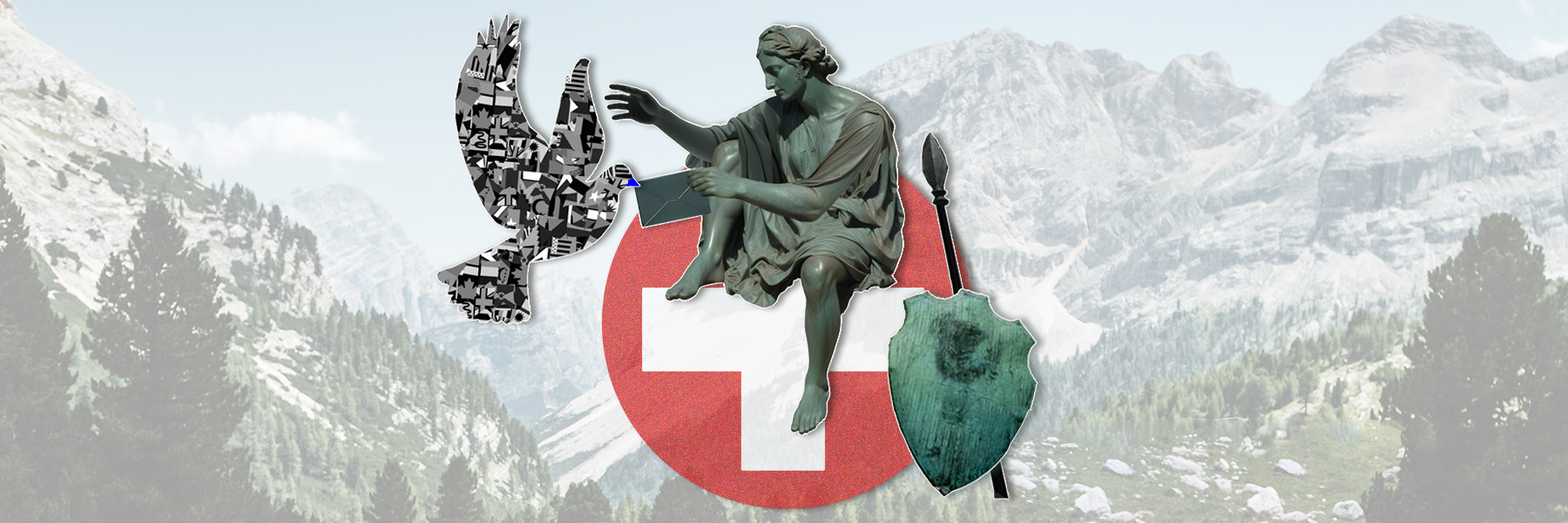
“Switzerland in the post-Cold War period expanded investments in a mediation ecosystem to accompany and support peace processes,” says Sabina Stein, deputy head of the Mediation Support Team at the Center for Security Studies (CSS) within the federal technology institute ETH Zurich. That builds expertise on how to operate talks and resolve issues over justice and governing that follow the end of conflicts – both at the foreign ministry, and institutions like the CSS and research group swisspeace.
More
More than a messenger: how Swiss diplomacy tries to improve the world
“The Swiss brand of mediation is about trust, confidentiality and persistence,” says Stein. The country’s military neutrality also “plays a big role – it helps to build trust, because Switzerland has no vested interest in any particular outcome”.
What does Switzerland gain from hosting so many talks?
Mediation, Stein says, “is really a way for small countries to punch above their weight. Switzerland is no exception – it has used mediation as a way to increase its influence and leverage on the international stage”.
By hosting talks, it gains access to corridors of power in capitals such as Washington, and helps to promote a rules-based international order that works in Switzerland’s favour.
“Investing in a world that is better able to prevent and manage conflicts and preserve a level of stability is also in our economic – and security – interests,” says Stein.
Who picks up the tab for hosting talks?
The size and allocation of costs depend on whether Switzerland is organising a meeting alone, with another country or the United Nations, as well as the number of attendees, location and the status of those involved, according to Obrist at the foreign ministry.
When US Vice-President JD Vance met Iranian officials in June to discuss Iran’s nuclear programme, Qatar covered costs at the venue – the Bürgenstock mountain resort owned by the Qatari sovereign wealth fund – while Switzerland paid for security.
“Mediation is a very cost-effective diplomatic tool which contributes to Switzerland’s soft power,” Obrist argues. Her division, which leads the country’s mediation efforts, gets roughly 2% of the budget for international cooperation – funds that have shrunk compared to those for the military, another form of investment in peacemaking.

There can be reputational costs, though.
“Engaging in mediation means engaging with actors whose positions or actions we might not necessarily agree with or find morally questionable,” says Stein. “That can raise eyebrows and have a political cost with Swiss voters, to whom the government is ultimately accountable, but also with some of our partners.” It’s therefore important to explain Switzerland’s role clearly to build political and public consensus, she says.
A mediator can also come in for criticism if it fails to bring both sides to the table, as happened when Russia refused to take part in the high-level Ukraine peace summit at Bürgenstock in June 2024. Russia’s main ally, China, also stayed away and pitched its own process to resolve the war. Others, like India and South Africa, sent lower-ranking officials.
Does Switzerland work with other countries that mediate?
The risk of incurring political costs has risen with growing divisions along geopolitical faultlines, says Stein. “The world is more polarised – it’s just become harder to be a bridge builder.” Switzerland should “continuously assess where it can bring added value and play a positive mediation role and remain strategic in its interventions”, she says.
Another approach is to collaborate with other countries and organisations. For example, Switzerland has worked alongside a number of states including Norway during a more than two-decade peace process between the government and armed groups in Colombia.
“The era of the lone mediator has evolved – we don’t believe this is the way forward,” Obrist says.
Recently, the Swiss signed memorandums of understanding with Qatar, South Africa and Oman to use what Obrist calls “our different comparative advantages”, such as networks of contacts, geographic location, history, cultural understanding and language. Switzerland was an observer at the launch of a new international mediation body set up by China. It’s also keen to transfer knowledge to new players like Iraq, offering the benefit of its own experiences.

More
China’s project to mediate global disputes underlines divide between the West and the rest
More countries wanting to mediate can be good for peace, Stein says, if they have some expertise and there’s good coordination between them.
“Conflicts like Sudan have so many layers, including a regional dimension,” she says. “To address such a conflict system, you need manifold, complementary peace processes,” or what’s called multi-mediation, facilitated by different brokers.
All of this can be a source of support, rather than competition, for Switzerland. “We need different entry points and forms of leverage for peace,” Stein says. “And at times pressure might need to be wielded, which is not a role that Switzerland can or wants to play in peace processes.”
This article was amended on August 20, 2026, to indicate that India and South Africa sent lower-ranking officials to the 2024 Ukraine Peace Summit.

More
Our newsletter on geopolitics

In compliance with the JTI standards
More: SWI swissinfo.ch certified by the Journalism Trust Initiative

You can find an overview of ongoing debates with our journalists here . Please join us!
If you want to start a conversation about a topic raised in this article or want to report factual errors, email us at english@swissinfo.ch.