








Keeping a Swiss shooting tradition alive abroad
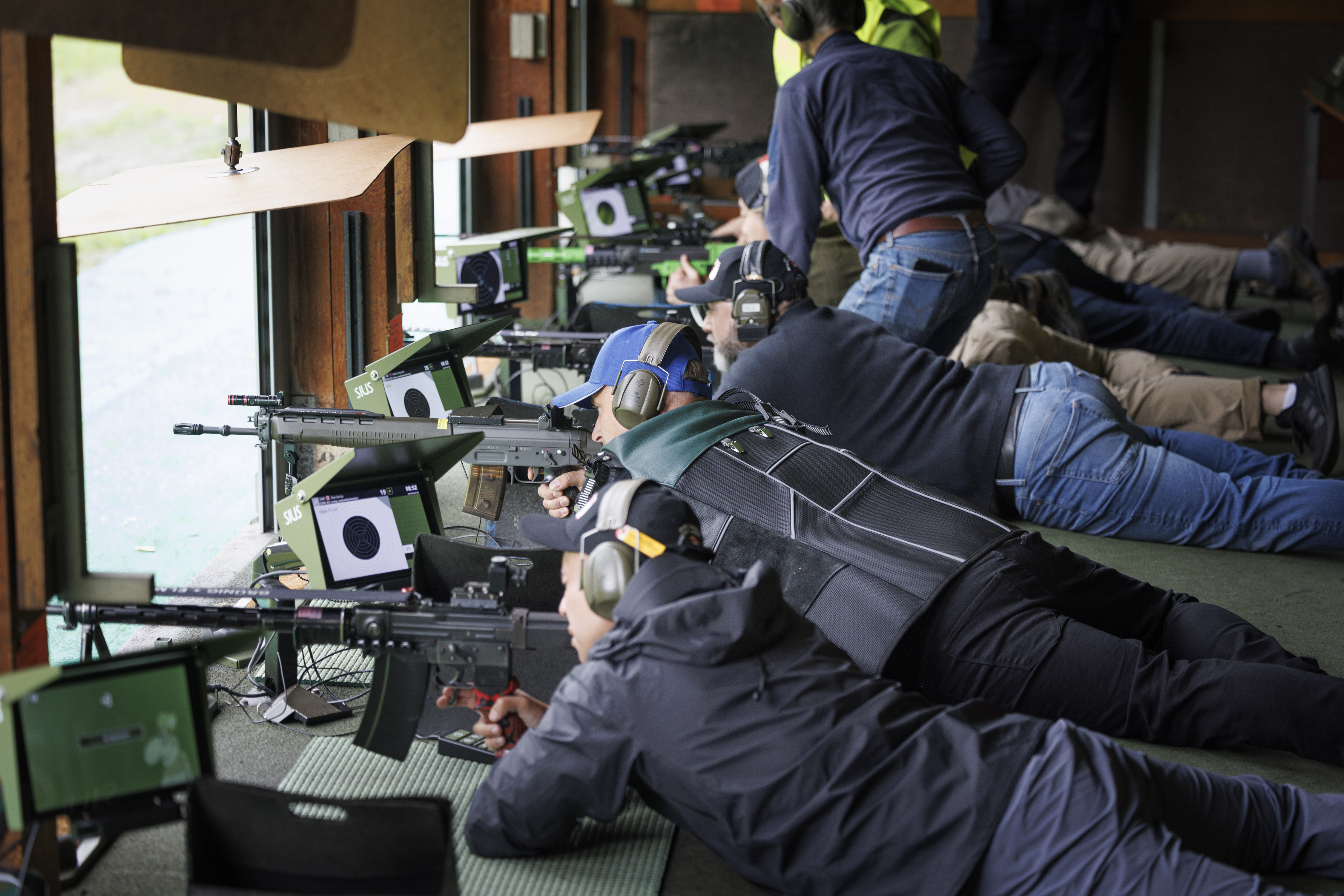
The 2026 Federal Shooting Festival in Chur also brought together Swiss nationals living abroad. Having travelled from South Africa, Canada, the United States and across Europe, nearly 130 shooters took part in the 300-metre competition. For many of them, shooting is not just a sport but a way of keeping their connection with Switzerland alive.
Select your language
Generated with artificial intelligence.
Listening:
Keeping a Swiss shooting tradition alive abroad
The rifle shots, muffled by ear defenders, ring out at irregular intervals. Then comes the smell of gunpowder: a mixture of burnt powder and gun oil. On the racks, perfectly aligned, are carbines and 57 and 90 assault rifles. At 300 metres, around ten targets stand ready. On the screens the flags of South Africa, the United States, Canada, France, Germany, the Netherlands and the Principality of Liechtenstein are visible.
At the Rossboden shooting range in Chur, it is now the Swiss Abroad’s turn to compete.
Shooting as a link to Switzerland
“All over the world, there are Swiss people living abroad who share the same passion for shooting. Getting together here to share this experience is truly special,” says Karin Schmid, a member of the Swiss Rifle Club in Cape Town, South Africa. The French lecturer at the University of Cape Town took up the sport six years ago thanks to her father, who has been shooting for decades. “It allows me to share this quintessentially Swiss tradition with him.”

A tradition also celebrated every five years at the Federal Shooting FestivalExternal link. “Shooting is deeply rooted in Switzerland,” explains Carl Frischknecht, secretary-general of the organising committee. “It would be a shame not to allow those living outside the country’s borders to take part in this event. With around 36,000 participants, it is, after all, the world’s largest shooting festival.”
Many Swiss men and women living abroad accepted the organising committee’s invitation. Almost 130 people entered the 300-metre shooting competition. This is both an individualExternal link and a teamExternal link competition. Participants include the Société Suisse de Tir de Bruxelles, the München Schweizer Schützen, the Fürstentum Liechtenstein Schweizer Schiess-Sektion, the Tireurs Suisses de LyonExternal link, the Société Suisse de Tir de Paris, the Schützensektion der NHG HollandExternal link, the Los Angeles Swiss Athletic Society, the Minneapolis Swiss Rifle Club, the Swiss Rifles of Washington, D.C., the Swiss Canadian Mountain Range AssociationExternal link, the Monterey County Swiss Rifle Club in CaliforniaExternal link, the Cape Town Swiss Rifle ClubExternal link and the Johannesburg Swiss Rifle ClubExternal link.


Shooting clubs: a piece of Switzerland abroad
From Hong Kong to Canada, from the United States to New Zealand, the Swiss tradition of shooting has accompanied those who left Switzerland. “In the 19th century, many Swiss people emigrated and, in the countries where they settled, founded shooting clubs to recreate a piece of Switzerland abroad,” says Cedric Zbinden, historian and research associate at the Swiss Shooting Museum. “These were places where they could continue to speak their own language and keep the traditions of their homeland alive.”
Today, there are around 30 shooting clubs abroad. However, according to a Swiss Army report published in May 2023External link, membership numbers are in steady decline: from just over 900 members in 2013 to fewer than 600 in 2022. This trend could be accelerated by a decision from the Swiss defence ministryExternal link (see box “Too expensive and dangerous”). In January 2020, the then Defence Minister Viola Amherd decided that the Swiss Army would no longer supply ammunition to shooting clubs abroad for organisational and security reasons.
For decades, Swiss shooting clubs abroadExternal link have benefited from support similar to that granted to clubs at home. Recognised by the Swiss defence ministry, they were able to borrow weapons and purchase army ammunition to carry out compulsory training programmes and competitions. In 2018, the 31 recognised clubs had ordered ammunition worth around CHF30,000 ($36,878), intended for around a thousand shooters.
In January 2020, however, the ministry decided to halt these exports. Viola Amherd justified the decision on security grounds and due to an administrative burden deemed disproportionate: abroad, Bern cannot monitor transport, storage, shooting ranges and shooting operations. Clubs may continue their activities, but must procure ammunition directly from the supplier – currently RUAG – at their own risk.
Thomas Bader, of the Minneapolis Swiss Rifle Club, takes it in his stride. “We’re looking at a few options,” says the 58-year-old, who returned to the US in 2003 after completing a chef’s apprenticeship in Switzerland. “It will be more difficult to get hold of ammunition in future, but there are products on the American market similar to the Swiss ones. For now, we have a well-stocked store,” he says with a smile.
In Cape Town, the concern is greater. “The cost of ammunition risks becoming prohibitive,” says Dierk Lüthi, president of the Cape Town Swiss Rifle Club. “The price is affected by transport costs, customs duties and an unfavourable exchange rate,” says Lüthi, grandson of the renowned glass painter Albert Lüthi, who created the cantonal coats of arms in the dome of the Federal Palace.
From Vancouver to Bregaglia, shooting brings people together
At the Rossboden shooting range, the team competition continues: five practice shots, six individual shots and then four in a series. Among the shooters is Alexander Loeffler, a member of the large delegation from the Swiss Canadian Mountain Range Association. “Ours is more than just a shooting club; it’s one big family,” says Alex Loeffler, who lives in Vancouver. He travelled to Chur with his wife and two daughters. The four travelled more than 8,400 kilometres to take part in the Swiss Federal Shooting Festival. “Our club has around 130 members,” explains his wife, Rachel. “The beating heart of the community is a chalet built in the 1970s. Events are held there regularly, such as the Swiss National Day celebrations, jass [card game] tournaments or the Santa Claus party.”

“This is my first trip to Switzerland, a country I find magnificent,” continues her 16-year-old daughter. “My grandfather was from Winterthur and, until now, our connection to his homeland has mainly been through food. As a professional chef, he always treats us to Swiss specialities.” However, the journey of the Loeffler family and the Vancouver delegation will not end in Chur; it will continue southwards. They have, in fact, been invited by the Bregaglia Hunters’ Society to spend four days in the Italian-speaking valley of Graubünden.
The trip was organised by Attilio Tam. “During a trip to Canada, I met some Swiss expats who made me feel right at home. I’ve wanted to return the favour for years, but until now I hadn’t had the chance,” says the head of the young shooters’ courses in Bregaglia. “The programme includes a visit to the Albigna dam, the fortresses at Maloja and Soglio, and a shooting competition with the local club. The visit will conclude with a dinner of barbecued wild boar, imported from Hungary.”
When shooting brings people together
Karin Schmid, from Cape Town, also confirms that shooting brings people together across national borders. The Cape Town Swiss Rifle Club spent an evening with the shooting club in Felsberg, a village in Graubünden about six kilometres from Chur. “They invited us to take part in a friendly competition at their shooting range. The event concluded with a cheese fondue dinner,” said Schmid.
The Swiss Rifle Club Cape Town was founded in 1949, partly thanks to an initiative from Switzerland. On June 26, of that year, the Swiss Club in Cape Town received a letter from Swiss Shortwave Radio – the predecessor of today’s Swissinfo – inviting the Swiss community abroad to take part in a competition linked to the Swiss Federal Shooting Festival. In Cape Town, there was neither a shooting range nor rifles nor ammunition, but enthusiasm was enough. In total, 27 shooters gathered at the Woltemade shooting range. From that experience, the Swiss Rifle Club Cape TownExternal link was born.
And the day for Swiss Abroad is also all about camaraderie. After the morning’s team competition, the shooters gather in the main hall of the Federal Shooting Festival. On stage, a brass band accompanies lunch with folk tunes mingling with the buzz of voices speaking German, French and English. A traditional meal is served at the tables: alpine macaroni with apple purée.
Valérie Page is a member of the NHG Holland shooting section. “We meet twice a month at the shooting range,” says Page, emphasising that it is a passion she shares with her Irish husband. At home, they speak English, Dutch and Swiss German so that their children can forge a connection with her country of origin. “Today, at the Federal Shooting Festival,” concludes the young mother, “I realised that this quintessentially Swiss tradition is practised all over the world. Even though our section is small, we’re part of a much larger community, spread across the four corners of the globe.”
>>Experience the atmosphere of the shooting festival in our short video:
Edited by Daniele Mariani. Translated from Italian, sub-edited by Alexandra MV Andrist

In compliance with the JTI standards
More: SWI swissinfo.ch certified by the Journalism Trust Initiative

You can find an overview of ongoing debates with our journalists here . Please join us!
If you want to start a conversation about a topic raised in this article or want to report factual errors, email us at english@swissinfo.ch.