








What an eased path to Swiss citizenship could mean for the Swiss Abroad

The Democracy Initiative proposes easing access to Swiss citizenship. It also exposes a stark contrast within Swiss democracy: the system imposes restrictive citizenship rules on immigrants, while offering extensive political rights to the Swiss Abroad.

The House of Representatives and the government have both come out clearly against the Democracy Initiative. The popular initiative aims to make Swiss citizenship more accessible to immigrants and standardise naturalisation procedures.
The initiative is backed by left-wing parties as well as people with immigrant backgrounds. Their demand is straightforward: foreign nationals with no criminal record who have lived in Switzerland for five years and have a basic knowledge of one national language should be entitled to Swiss citizenship. Without citizenship, foreign nationals in Switzerland cannot vote in elections or referendums.

More than a quarter of the population is “excluded from democracy”, argues Aktion Vierviertel, the committee behind the initiative.
A model based on descent or place of origin
The initiative also raises a broader question about how Switzerland should award citizenship. Swiss law is based on descent, which means children with at least one Swiss parent become Swiss citizens. This is known as ius sanguinis, or the right of blood.
The Democracy Initiative would add a citizenship model based on birthplace or residence. People could become Swiss if they live in Switzerland or were born there. This principle, known as ius soli, or the right of the soil, is common in countries shaped by immigration, including the US, Canada, Australia and parts of South America.
The debate around the Democracy Initiative has also drawn attention to the rights of Swiss citizens living abroad. “Why are the Swiss Abroad still allowed to vote in Switzerland, even though they have lived abroad for decades?” asks Alec von Graffenried, a Green Party politician and former mayor of Bern, who supports the initiative. On the other hand, he argues, foreign nationals living in Switzerland can be denied voting rights for decades.
An attack on dual citizenship
While the initiative does not seek to restrict the political rights of the Swiss Abroad, they have become part of the discussion because there is a striking discrepancy. Switzerland excludes much of its foreign population from participating in the democratic process, while giving its diaspora broad political rights.
Dual citizenship has also come under fire in the debate. In reaction to the initiative’s campaign, the right-wing Swiss People’s Party has called for naturalised citizens to be allowed to hold only Swiss citizenship in future. It is the party’s first concrete step against dual citizenship, an issue it has long opposed. Three in four Swiss Abroad hold dual citizenship. They may not be directly affected yet, but they are watching every attack on dual citizenship closely.
Around 840,000 Swiss citizens live abroad. To take part in Switzerland’s democratic process, they can simply register to vote when they reach voting age.
External Content
By contrast, 2.5 million foreign nationals live in Switzerland and, at least at federal level, have no say in referendums or elections.
For the backers of the Democracy Initiative, the main issue is that a strikingly large share of Switzerland’s permanent resident population has no political rights. A quarter of the population pays taxes and lives with the consequences of political decisions, so they should also participate in democracy, supporters say.
This issue has been simmering for several years. In 2016 the University of Lucerne warned of a “worrying democratic deficit” in SwitzerlandExternal link. Researchers there developed the Immigration Integrations Index to illustrate the problem. The index showed that Switzerland restricts immigrants’ political participation more than most other countries, placing it second from last in Europe.
This low level of participation has repeatedly drawn criticism from democratic theory scholars. The academic consensus is that the more inclusive a democracy is, the better the quality of its decisions.
Pressure is building
Ten years ago, Lucerne researchers described the “particularly strong exclusivity” of Swiss democracy as nothing new. Women in Switzerland, they noted, had also been excluded from the electorate for much longer than in other countries (they didn’t get the vote at federal level until 1971). “Unlike with women’s suffrage, however, there is still almost no internal pressure to include immigrants.” The initiative has now created that pressure.
The Swiss government also commissioned a studyExternal link in 2024 comparing Swiss naturalisation procedures with those in other European countries. The report confirmed that foreign nationals seeking Swiss citizenship face particularly high barriers.
Across much of Europe, foreign nationals can apply for citizenship after five years of residence. The average across Europe is 6.9 years. In Switzerland, they must wait ten years.
More
Golden passport? Certain groups struggle to obtain Swiss citizenship
Switzerland is also far more selective than most European countries when it comes to second-generation immigrants. In many countries, people born in their country of residence have relatively easy access to citizenship. Switzerland, by contrast, requires them to go through an elaborate procedure to obtain citizenship. This helps explain the country’s low naturalisation rate of 1.9%, compared with a European average of 2.6%.
How Swiss citizenship is inherited abroad
The right to citizenship also brings far-reaching political rights. Fourth-, fifth- and subsequent-generation descendants of emigrants can still participate in Swiss democracy decades after their families have left the country. From the third generation onwards, descendants of emigrants must actively request Swiss citizenship, but there are few substantive obstacles.
More
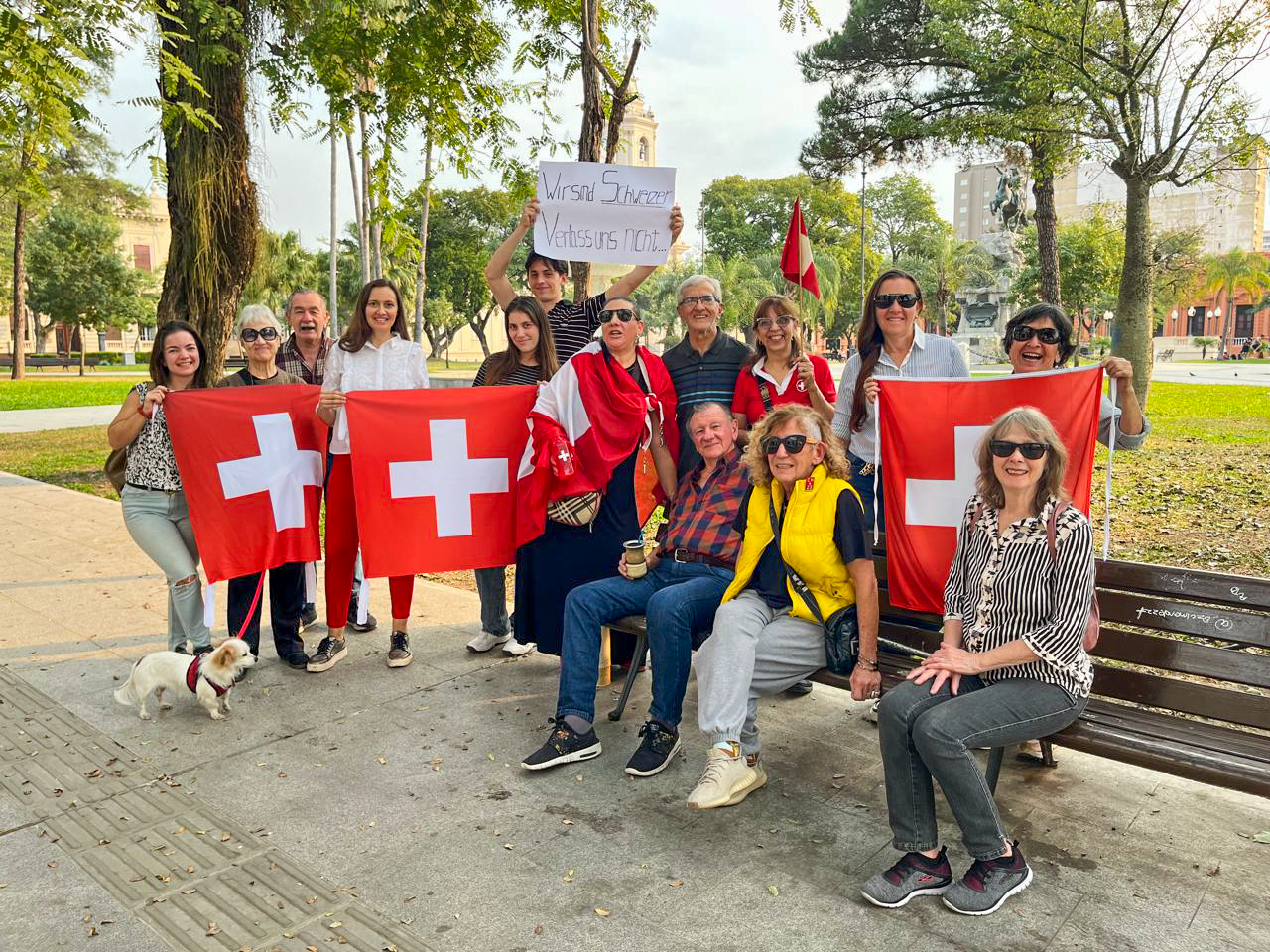
Thousands of emigrants’ descendants in Argentina demand Swiss citizenship
This generous approach has also drawn comment from the Swiss Abroad themselves. In a Swissinfo debate, one reader wrote: “The Swiss would do well to adopt Ireland’s approach to citizenship abroad: up to three generations of foreign birth registration and that’s it.”
‘Citizenship as something sacred’
Given the unusually broad scope for participation in Swiss direct democracy, Switzerland probably goes further than any other country in involving its diaspora. The right to take part in the affairs of the homeland is enshrined in the Swiss Abroad ActExternal link. Domestically, this is not seriously contested, but it resurfaces whenever participation and exclusion are discussed more generally.
The Democracy Initiative is bringing this debate into sharper focus in Switzerland. “Citizenship is about the core, about the identity of our country,” said Pascal Schmid, the Swiss People’s Party’s migration spokesman, during the House of Representatives debate. His party colleague, Therese Schläpfer, put it more starkly: “Either we defend citizenship as something sacred, or we continue to squander it and watch Switzerland lose its soul.”
Supporters of the initiative used similarly blunt language. “The current system divides our society,” said parliamentarian Sibel Arslan, co-initiator of the initiative. “It divides people into those who are allowed to have a voice in democracy and those who are not, even though they went to the same school, speak the same language, do the same job and pay the same taxes.”
Two fast-growing groups
For the growing number of Swiss citizens living abroad, the issue of integration and exclusion is especially relevant. Both groups are growing steadily: Swiss citizens living abroad and foreign nationals living in Switzerland. Both are also growing much faster than the Swiss population living in Switzerland. The number of Swiss citizens living abroad is growing around three times faster, while the number of foreign nationals living in Switzerland is growing six times faster.
External Content
If the Swiss Abroad population continues to grow at the same rate as it has over the past 20 years, there will, in purely mathematical terms, eventually be as many Swiss Abroad as there are eligible voters in Switzerland. On a linear projection, that would happen in 240 years.
The number of foreign nationals living in Switzerland is growing even faster. If that growth continued at the same rate as over the past 20 years, Switzerland would, on a linear projection, have as many foreign citizens as Swiss citizens living in the country in 50 years.
The debate over foreign nationals’ participation in Swiss democracy comes at a time when Switzerland is already intensely debating immigration. The “No to 10 million” immigration initiative will soon be put to voters. It seeks to limit Switzerland’s permanent resident population to ten million by 2050.
The first decision facing Swiss voters, then, is not whether immigrants should be more fully integrated into democracy. It is whether they still want immigration to continue at all.
More
Swiss citizenship: discrimination against women continues
Edited by Pauline Turuban. Adapted from German by David Kelso Kaufher/ts

In compliance with the JTI standards
More: SWI swissinfo.ch certified by the Journalism Trust Initiative

You can find an overview of ongoing debates with our journalists here . Please join us!
If you want to start a conversation about a topic raised in this article or want to report factual errors, email us at english@swissinfo.ch.