








Swiss bid for Security Council seat welcomed
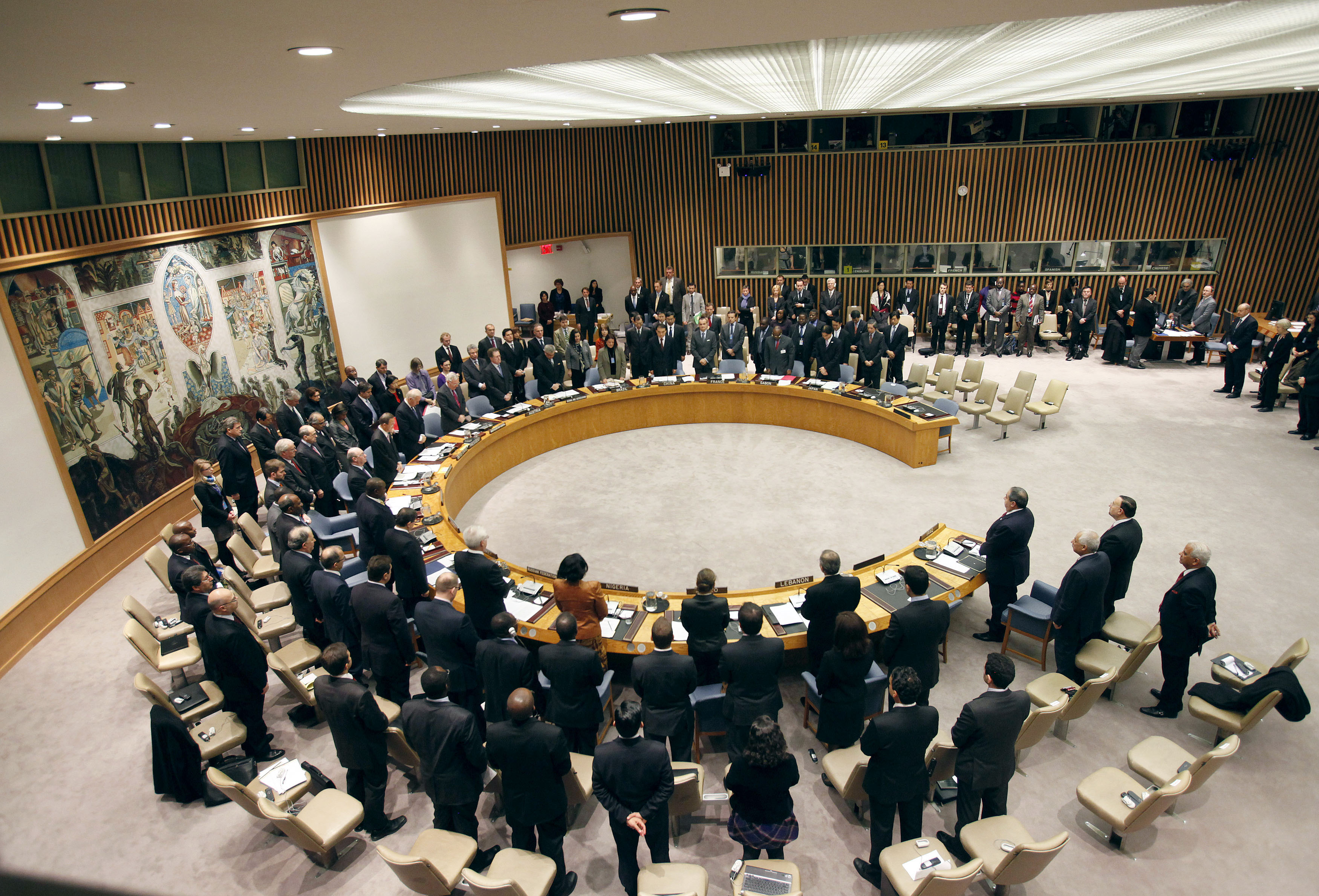
Switzerland has decided to apply for a non-permanent seat on the United Nations Security Council.
Neighbouring Austria has gathered considerable experience during its membership stints. In 2010, the country sat on the Council for the third time since 1955.
swissinfo.ch spoke to Thomas Mayr-Harting, Austria’s UN Ambassador in New York. He shared his nation’s experiences while discussing Switzerland’s possible candidacy for a non-permanent seat on the Security Council.
According to Mayr-Harting, it is important for a country to join the Council for fostering world peace and security as well as for promoting a country’s own values. With its humanitarian tradition and its experience of good offices, Switzerland has the key tools for the task.
swissinfo.ch: What do you think about the Swiss government’s decision to apply for a non-permanent UN Security Council seat?
Thomas Mayr-Harting: We welcome this decision. We’ve been following Switzerland’s UN membership closely and with much appreciation.
During its relatively short membership period, Switzerland has played an extremely active role in areas that are important for both of our countries. Some examples include its commitment to respecting international human rights and the rule of law.
Switzerland is a natural partner for us. And we would be delighted if it took a non-permanent seat on the Security Council.
swissinfo.ch: What can you say about the experience of Austria, which has already served on the Security Council three times as non-permanent member – most recently in a term ending in 2010?
T. M.-H.: Firstly I’d like to point out that non-permanent membership on the Security Council is, in our view, a service to the organisation as well as the international community. It is important that countries like Austria and Switzerland – where multilateralism and the rule of law play important roles – perform this duty. Our experience has also shown that you can have quite an impact.
Some important issues over the past two years have included the Gaza conflict, non-proliferation in Iran and North Korea, and in the last weeks of our membership, the situation in Ivory Coast.
Another main topic addressed by the Council includes respect for international human rights – and who could be more qualified to weigh in than Switzerland, home of the founder of the Red Cross and the seat of this humanitarian organisation?
Legal questions, for example, in connection with the al-Qaida Taliban committee and sanctions regime, were also of concern to us and would be of interest to Switzerland. In fact, we’ve worked closely with Switzerland on this issue and we’ve succeeded in making some headway.
swissinfo.ch: What can membership do for a country?
T. M.-H.: You have to be aware that it is a two-year period which gives a country a chance to promote issues that are important to it. Of course, Switzerland’s possible membership in 12 years is still some way off, so it is not possible to make accurate predictions. But what you can say is that it’s possible to set a course and leave your mark.
In recent years, representatives of Austria have had several opportunities to discuss their Council experience with the Swiss government and its parliamentarians in Bern.
Among other things, we made it clear that as a non-permanent member, there is of course a limit to how much you can do. However, it makes sense to use the Security Council to foster world peace and security while promoting one’s own values and principles. Maybe these discussions with Austrian representatives helped Switzerland decide to apply.
swissinfo.ch: In what areas could Switzerland be most active on the Security Council?
T. M.-H.: An issue that the Council will probably have to address in the future is the protection of civilians during conflicts. This issue is relevant for Darfur, Congo, Sri Lanka, Gaza…
On this topic, Switzerland is especially suited to playing an active role.
Another issue which I think is important is the remarkable experience of Switzerland in the area of good offices and conflict resolution.
Not all countries that sit on the Security Council have such experience in that field. Switzerland, with its reputation as a bridge-builder is viewed as an honest broker and therefore has the tools for crisis management.
Other important tasks include the Council’s mandate to monitor the peacekeeping missions of the UN. It’s good that Switzerland is gaining more experience in this area of importance for the Council.
swissinfo.ch: What do you say to criticism within Switzerland that a seat on the Security Council would be incompatible with the country’s neutrality? Austria is also neutral, even if this neutrality is a bit different.
T. M.-H.: We have 47 more years of UN membership experience than Switzerland does, and we had a different view than the Swiss when we joined in 1955. From our point of view, UN membership was a logical part of an active netrality policy.
But of course it has also been a topic of discussion in Austria over the years. We first sat on the Security Council during the Cold War in 1973 and 1974, and again after the fall of the Berlin Wall in 1991/1992.
And the Iraq-Kuwait War brought about a new round of discussions. Human rights experts concluded that the UN Charter’s collective security system under Article 103 took precedence over all other obligations and did not contradict neutrality. I think that Swiss experts also see it that way.
The Security Council is the most powerful body of the UN. According to the UN Charter, member states carry primary responsibility for the “maintenance of international peace and security”.
When a crisis threatens that peace, the Council normally reacts by summoning the concerned parties to negotiations. The Council may also send peacekeeping missions to defuse a conflict.
To enforce its resolutions the Security Council may impose economic and other sanctions. As a last resort it may choose to apply military force, as happened for example in the case of the Iraqi occupation of Kuwait. The Council may also use international courts to prosecute alleged war criminals, as happened in the case of the former Yugoslavia.
The Council is the only UN organ whose resolutions are legally binding for all members.
The Council has 15 members: five permanent and ten non-permanent. The five permanent members – France, Britain, Russia, the US and China – have veto rights, meaning that any permanent member can block the decisions of the Council.
Every year, half of the non-permanent members are elected by the UN General Assembly for a term of two years. They represent the five regional groups within the UN (Africa, Asia, Latin America, Europe and the rest of the Western world).
The composition of the Security Council no longer reflects today’s geopolitical reality. Yet the debates on reforming the Security Council have made little progress over the years. Many countries, including Switzerland, believe the Security Council risks losing its legitimacy and authority if no changes are made.
For the past five years, Switzerland along with Costa Rica, Jordan, Liechtenstein and Singapore (Small Five, S-5) have called for more transparency and openness for the improvement of the Council’s working methods and for greater dialogue between the Council and General Assembly.
As for the expansion of the Security Council, the five countries hope that the current 65th General Assembly will pave the way for real and substantive negotiations.
(Translated from German by Susan Vogel-Misicka)

In compliance with the JTI standards
More: SWI swissinfo.ch certified by the Journalism Trust Initiative

You can find an overview of ongoing debates with our journalists here . Please join us!
If you want to start a conversation about a topic raised in this article or want to report factual errors, email us at english@swissinfo.ch.