








Women harvest hope as extremist threat grows in Benin

Terrorism in the Sahel is destabilising West Africa, with armed groups linked to al‑Qaeda and Islamic State exploiting deep poverty to recruit new fighters. In northern Benin, however, women’s cooperatives are turning to the shea tree to build economic opportunities – an initiative supported by Switzerland.
The tree towers several metres above the women beneath it. In the midday heat, it provides shade for the group; in dark moments, it offers hope. The women call it “arbre réparateur”, the healing tree. Its leaves are used in traditional medicine. In the Sahel, the shea tree is said to possess magical properties. Hardly any other plant is so versatile.

People make shea butter from the nuts of the shea tree’s fruit, which is used as cooking fat or for skincare, and is popular at home and abroad. The fat from its fruit helps to fill hungry stomachs and soothe chapped hands. And 3,600 women in northern Benin also want to use it to help heal rifts in society.
They used to go out to the fields in the early hours of the morning to harvest, so they could carry out the strenuous work in the cool of the morning. Now they wait until daybreak because of reports of strangers wandering the fields.
In northern Benin, militant jihadism is gaining a foothold. Here, just outside Banikoara, fear is increasingly dominating daily life and people are afraid of being driven out of their villages. Unlike in the economic and political heartland in the south of the country, state control is weak.
Last year, extremists carried out several serious attacks on the border area with Burkina Faso and Niger. It was the deadliest year in the fight against terrorist groups in Benin. In a single day, 87 people were killed in a coordinated attack on military bases.
Networking supporting women’s independence
The Association des Femmes Vaillantes et Actives (AFVA) [Association of Strong and Active Women], however, wants to create opportunities for local people. The cooperative has existed since 2007 and advocates for women’s needs. Its primary objectives are networking, as well as training and further education. Since early 2021, it has been working with the Swiss development organisation Brücke Le Pont on a joint project to empower women in the shea butter sector. In all, 3,600 women living in four communities in northern Benin are involved in the project, organised into 120 cooperatives, each with 30 members.

Brücke Le Pont, based in Fribourg in western Switzerland, has workers based in Benin who support local partners with networking or budget planning. The organisation has worked for many years to assist locally-rooted activities, as set out in the Swiss foreign ministry’s international cooperation strategy 2025–2028.
“The cooperative helps women become more independent. With the extra money they earn, they can send their children to school,” AFVA president Mamatou Yacoubou proudly declares from Banikoara.
Networking enables the cooperatives to purchase professional equipment and access credit. Through training, the women learn about managing micro-enterprises, or adhering to production standards in the cultivation and processing of shea nuts.
As a result, yields have increased significantly. So too has the quality of the end product. “Our goods are very popular on the market,” says Yacoubou, even though their products cost more. Quality comes with a price.
Benin: from a pillar of stability to a frontline country
It’s a successful initiative in a region marked by poverty, and the women’s organisation is advocating for change. In northern Benin, unemployment is widespread, particularly among young people. The work of the 3,600 women therefore makes a significant contribution to household income.
This is also well received by the men. The tree just outside Banikoara, under which the women gather, was offered to the cooperative by a local man. “The village benefits from this project. It strengthens solidarity, and that is almost more important than money,” says an elderly man.
More

But a lack of prospects provides fertile soil for radicalisation. Armed groups from the Sahel are increasingly expanding their activities southwards, particularly al Qaeda-linked Jama’at Nusrat al-Islam wal-Muslimin (JNIM), which recently blocked fuel supplies to Mali’s capital Bamako.
The Sahel is considered one of the world’s deadliest areas due to terror attacks: over half of all terror-related deaths occur in this region. Military coups, the withdrawal of French troops and fragile statehood have given armed groups in Mali, Niger and Burkina Faso considerable freedom of movement, particularly towards the south.
The jihadist groups’ advance southwards has a strategic motive: they want access to the sea, where global trade takes place. “You cannot wage war without engaging in trade. And it is trade that fuels the war,” says Raymond Bernard Goudjo, director of the Catholic aid organisation Caritas Benin. He has been observing the spread of the jihadists for years.
Poverty provides fertile soil for radicalisation

In northern Benin, the terrorists find conditions that favour their expansion. According to Goudjo’s assessment, jihadist groups benefit from the fact that the state has hardly any presence in many rural regions of Benin. Terrorist groups fill the vacuum, claiming to offer protection, even for illegal activities. In the border region, for instance, fuel smuggling is flourishing, giving rise to a dangerous form of parallel regime.
Apart from a military presence, he says the state is doing little to counter the armed groups. “A military solution was and is never the answer to a social problem,” explains Goudjo. For Caritas Benin, the key lies not solely in weapons, but in prevention. Without investment in social cohesion, education and expansion of state presence, he says, the Sahel conflict threatens to advance southwards.
More than half of all people affected by extreme poverty worldwide live in sub-Saharan Africa, according to the Swiss foreign ministry’s international cooperation strategy 2025–2028. Benin is a priority country for Swiss development cooperation, as are the Sahel states of Burkina Faso, Niger, Mali and Chad. While the latter have long been struggling with the spread of terrorism, Benin was for a considerable time regarded as a stable exception.
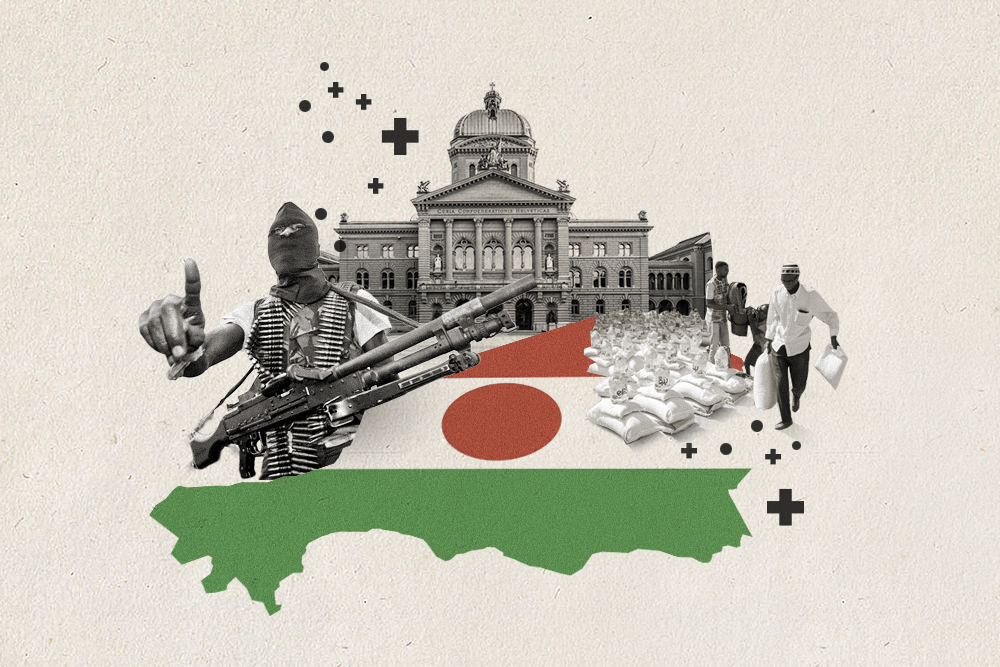
>>Read more about the situation in Niger.
More
Amid people smuggling and terrorism, Swiss tackle root causes in African hotspot
Local voices for peace and solidarity
In Banikoara, not far from the sites of last year’s attacks, the local radio station is committed to combating fear. The editorial team has oriented its programming with a focus on broadcasts that promote peaceful coexistence.
These include, for example, round-table discussions involving religious leaders, local politicians, young people and women. “The aim of all these measures is to raise awareness that peace and security are a shared responsibility of the entire population,” says programme director Dominique Dingui.
The topics covered include dialogue between livestock farmers and agriculturalists, with a focus on non-violent conflict resolution and economic opportunities for young people. “We make it clear to them that you can set up small businesses without needing a school leavers’ certificate,” says Dingui.
Bringing people together, creating opportunities, strengthening solidarity: these are values that the women’s organisation AFVA also holds dear. After working in the fields, the women gather around a tree to turn the nuts into shea butter. It is a labour-intensive process that requires many hands. In the long term, AFVA plans to establish a central production unit.
A tree and its fruit bring hope to thousands of people. Through the women’s cooperatives, a resilient network of relationships is growing, creating alternatives to radicalisation.
Edited by Benjamin von Wyl. Adapted from German by Katherine Price/sb

More
Our newsletter on geopolitics

In compliance with the JTI standards
More: SWI swissinfo.ch certified by the Journalism Trust Initiative

You can find an overview of ongoing debates with our journalists here . Please join us!
If you want to start a conversation about a topic raised in this article or want to report factual errors, email us at english@swissinfo.ch.