








Changing everything, changing nothing: Locarno Festival keeps offbeat at 79

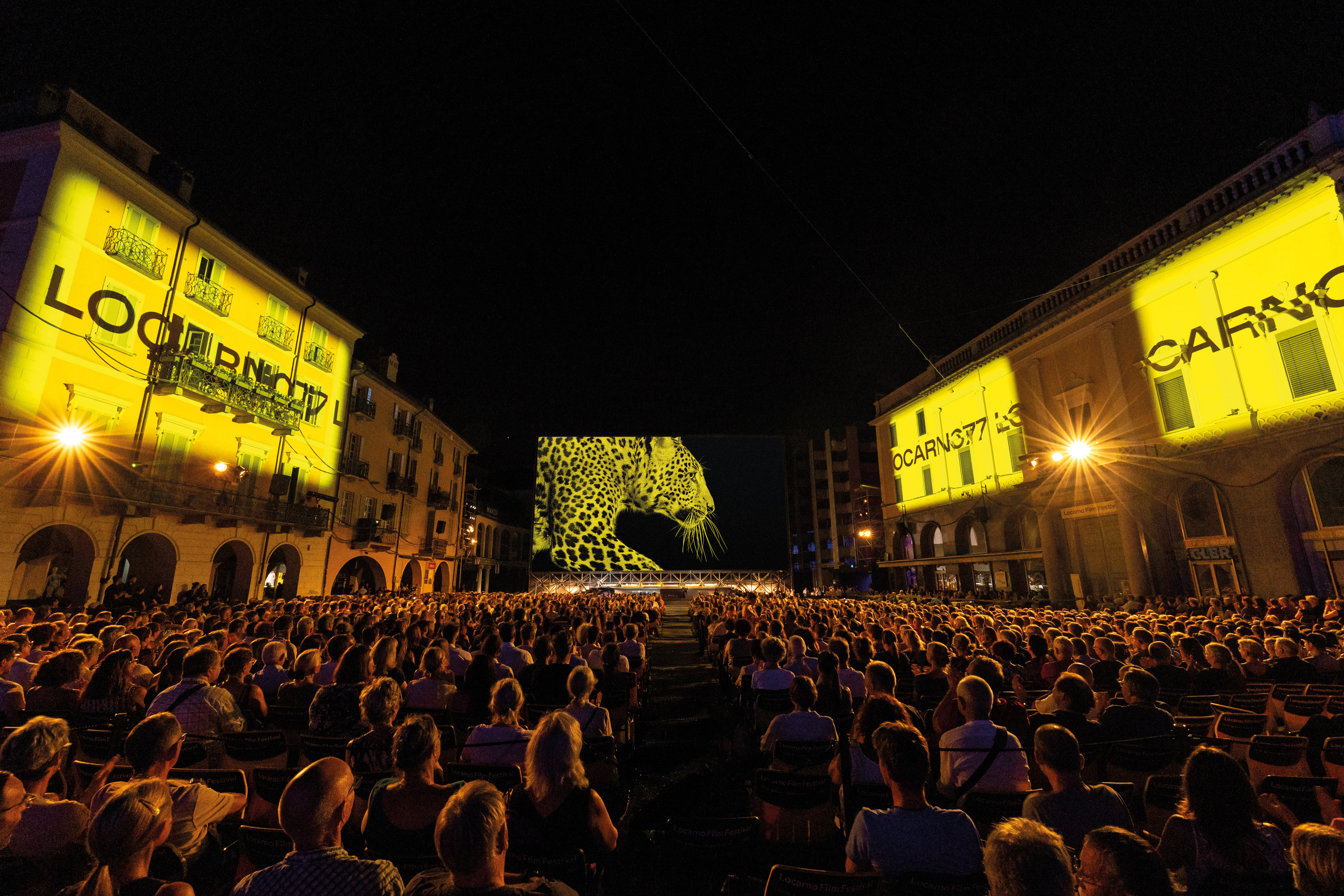
The Locarno Film Festival opens its 79th edition with a strategy that preserves the event’s singular cinephile identity while navigating a rapidly changing film landscape.
Select your language
Generated with artificial intelligence.
Listening:
Changing everything, changing nothing: Locarno Festival keeps offbeat at 79

The death of cinema has been announced every time a technological innovation affects the way people watch films. Streaming services, for example, have already become yesterday’s controversy with the advent of artificial intelligence (AI). Film festivals, meanwhile, attest to the resilience of the traditional cinematic experience, even as they adapt to the changing times in their own ways.
Against this back of constant change, “continuity” is the motto of Locarno’s 79th edition, according to its artistic director Giona A. Nazzaro. Swissinfo met the festival’s director in Zurich in July before the the public announcement of the program.
Asked how one could sum up the new edition, Nazzaro insisted that by “continuity” he means that the structural architecture of the festival, its sections and side-shows, remain unaltered. And that’s a reason to celebrate.

However, the festival has gone through a few subtle changes in the last years. Maybe the most significant was the scrapping of a section devoted to experimental films (“Moving Ahead”). The point, though, was not to drop this filmmaking niche, but to open the other sections of the festival, including the main competition, to edgier works.
“I resist the calls to create sections according to genres”, he said, and this position is very coherent with Nazzaro’s omnivorous film taste. The unabashedly punk-rock fan is at home with the full spectrum of film styles, from the trashiest to the highest-brow, and it reflects in the festival’s choices, reinforcing the Locarno brand as a cinephile mecca.

More
The Grand Hotel Locarno – where it all began
Ch-ch-ch-ch-changes
Some other not so subtle changes came into force when Maja Hoffmann, scion of the pharma giant Roche and influential patron and collector of global contemporary art, was chosen as president of the festival in 2023. She has steered the festival not towards a rebranding, but in raising Locarno’s international profile by reinforcing the festival’s cinephile trademark.

It is maybe too soon to gauge whether Hoffmann’s strategy has been effective or not, but it certainly has reinforced Locarno’s positioning in the European circuit.
The most prestigious festival continues to be Cannes, of course. Over the last decade, it has expanded into a massive, billion-dollar global economic engine. As for Berlin, it has lost much of its luster due to pitiful political controversies that have cost the heads of two directors in as many years. Venice, another focal point in the festival calendar, still keeps its charm and excellence, but one can argue that it caters too much for Hollywood gentry and marketing.
Locarno, on its side, may not be an industry barometer but the presence of film professionals and dealmakers has increased significantly since the pandemics (over 4,000 in 2025). Every year the festival brings a small roster of celebrities, but they are not necessarily the main focus – as Nazzaro once pointed to me, “the main celebrities at Locarno are the films themselves”.

Talking of film aristocracy, the honourable guests this year include director Darren Aronofsky and actresses Isabella Rossellini, Asia Argento and Monica Bellucci. Following the director’s view, though, here is a little sum-up of the real celebrities to be seen:
Concorso internationale, the main competition
Practically all continents are represented in the 17 films in competition – except Africa, but the other sections compensate this miss. From Asia, Korean author Hong Sangsoo, a Locarno regular, brings his Nowhere to Lay My Eyes, and Singaporean Nelson Yeo (who won the Golden Leopard in 2023 with Dreaming & Dying) returns with The House on the Moon.

European productions make the most of the films in competition, but apart from the inevitable French, Italian and German films, the Romanian film scene, spearheaded by the maverick author Radu Jude, has become a fixture of the festival. Unfortunately, there will be no new Radu Jude film this year (his latest, Diary of a Chambermaid, went to Cannes), but the country will be represented by Florin Șerban’s drama You Don’t Belong Here.
Locarno has also been traditionally a springboard for lusophone cinema since Brazilian filmmaker Glauber Rocha won the top prize (then known as the Grand Prix) in 1967 for his film Entranced Earth (Terra em Transe), two years before being awarded in Cannes. More recently, Portuguese author Pedro Costa took the 2019 Golden Leopard for Vitalina Varela, and in 2022, the Brazilian Julia Murat won the top prize with Rule 34.
More
Brazilians celebrate Locarno win with rallying cry for their country’s ailing democracy
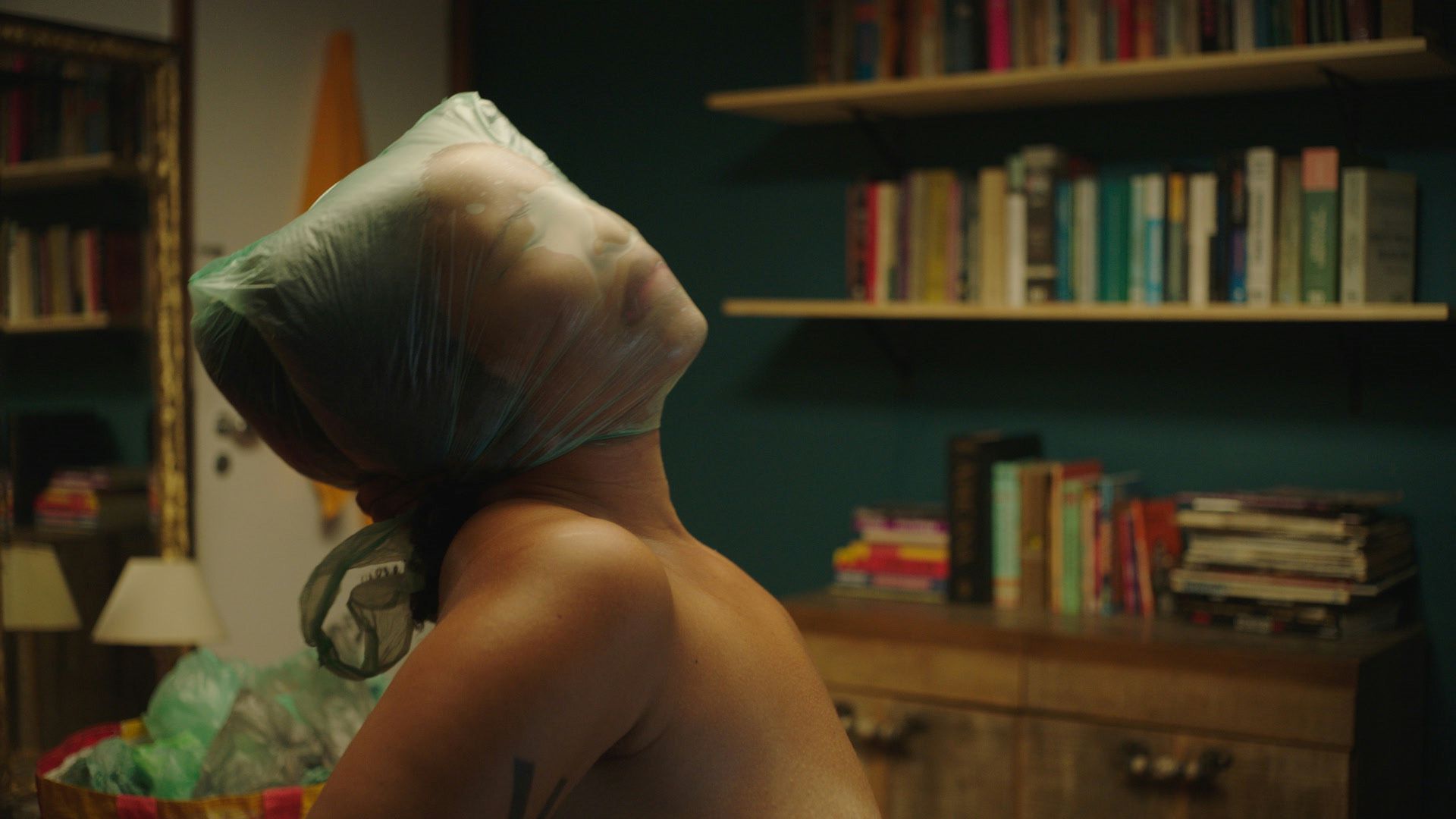
This year, Nazzaro made a bold choice by placing the Brazilian A Margem do Rio (The Riverbank) in the main competition. It is the first film directed by Matheus Farias and Enock Carvalho, and as such it would be more fitting in the Cineasti del Presente section, for authors presenting their first or second feature. However, Nazzaro says that this film “has so many layers and is so difficult, or almost impossible, to categorize, that I decided to place it among the big bets of the festival.”
Both directors have already presented shorts in international festivals, and both have worked closely with Kleber Mendonça Filho, Brazil’s most acclaimed living author. Farias was also the editor of Mendonça Filho’s latest hit, The Secret Agent.

Swiss-Portuguese director Basil da Cunha is also included again in the main competition with O Jacaré (The crocodile), the final part of his trilogy set in the Reboleira suburbs of Lisbon, the Portuguese capital.
The son of Portuguese immigrants in Switzerland, da Cunha studied film, sociology and political science before moving to Lisbon, penniless and with the idea of becoming a filmmaker. He ended up living in the Reboleira district, a peripheral shanty town with a high concentration of Cape-Verdean migrants.

Having built his career outside of the mainstream film circles, da Cunha’s films have the rare virtue of plunging the viewer into the intimacy that the director developed with his characters, who have become his adopted family of friends and lovers.

More
Lisbon’s outcasts take centre stage in groundbreaking Swiss film
Cineasti del Presente: the debutantes
In the section devoted to director’s first and second features, choices are bolder. The Palestinian Revolutionaries Never Die (Mohanad Yaqubi) is an archival dialogue celebrating the creative legacy of the late Lebanese filmmaker Jocelyne Saab, tracing 16 of her films documenting Arab revolutions and struggles between 1973 and 1983. The title is a slogan associated with George Habash, a physician and influential founder of the Popular Front for the Liberation of Palestine (PFLP).
![Jocelyne Saab (30 April 1948 – 7 January 2019[1]) was a Lebanese journalist and film director. She is recognized as one of the pioneers of Lebanese cinema.[2] A reporter, photographer, scriptwriter, producer, director, artist and founder of the Cultural Resistance International Film Festival of Lebanon](https://www.swissinfo.ch/content/wp-content/uploads/sites/13/2026/07/Revolutionaries-Never-Die_1.jpg?crop=628px,0px,6745px,4500px&w=580&ver=b42c80f4)
As the war in Ukraine rages on and Ukrainian cinema has been naturally focused on this existential conflict, Demony, by Natalka Vorozhbyt, bucks the trend by being set in the 1990s. Complicated relations between Russians and Ukrainians, be it in the customs, attitudes or the very usage of the language, are played here in an unusual love story that offers a map of the animosities that led to the current conflict. The Ukrainian contender in the main competition, I Rarely Wake Up Dreaming, is more explicitly focused on the war.
Apart from these, it’s worth taking a look at another Brazilian, Ana Vaz, and her experimental feature Hanabi, the sumptuous Singaporean animation Magic Atlas (directed by Sun Xu), and the Swiss Mateo Ybarra with his doc-fiction Small Talk, set in Villa Pierrefeu, the last finishing school in Switzerland.

The Retrospective
For the cinephile faithful of Locarno, the main attraction is invariably the grand retrospective. It rarely disappoints and this year is more timely than ever. Titled Red & Black – Hollywood Left and the Blacklist, it brings 50 films – fiction, documentaries, newsreels and shorts – from the US, Britain, Spain, Italy, France, Mexico, and Argentina, made by or about filmmakers and creative professionals persecuted or blacklisted in the McCarthy era’s witchhunt.

Carefully curated by London-based Iranian critic Ehsan Khoshbakht (who also prepared the last two Locarno retrospectives), it will certainly strike more than a chord with Trump’s America.
¨Check here other highlights of the 79th Locarno Film Festival:


You can also check the reviews of some of the films selected for the festival’s Swiss Panorama section by our team of international film critics:

More
Swiss-Kenyan filmmaker sets lo-fi love story in hi-tech future

More
Sri Lankan artist challenges Swiss museums over looted heritage

More
Swiss silence, wartime shame, and one girl’s fight against patriarchy

More
Milagros Mumenthaler: a filmmaker crossing currents between Switzerland and Argentina
Edited by Mark Livingston/ds
Errata: The original version of this article erroneously mentioned that Lady Diana Spencer, the late Princess of Wales, attended the Institut Villa Pierrefeu, the last finishing school in Switzerland. This information, provided by the producers of the film Small Talk, is incorrect. Lady Diana attended the Institut Alpin Videmanette (which closed in 1991).

In compliance with the JTI standards
More: SWI swissinfo.ch certified by the Journalism Trust Initiative

You can find an overview of ongoing debates with our journalists here . Please join us!
If you want to start a conversation about a topic raised in this article or want to report factual errors, email us at english@swissinfo.ch.