








September 27 vote: poor start for Swiss neutrality initiative in first poll
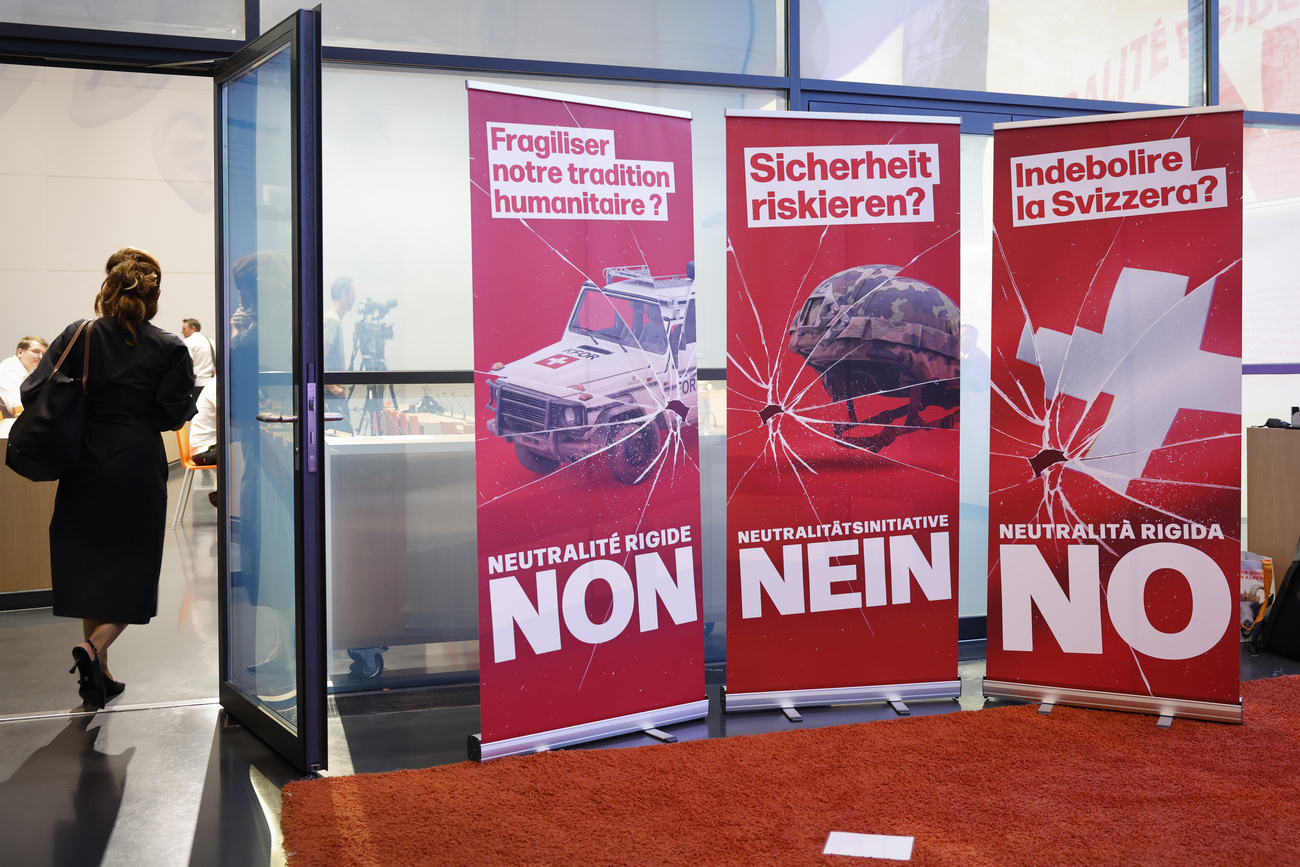
A majority of Swiss citizens would reject the initiative calling for a return to a strict interpretation of neutrality, according to the first survey by the Swiss Broadcasting Corporation (SBC). But voters appear divided over the food security initiative, which is more popular with the Swiss Abroad.
Select your language
Generated with artificial intelligence.
Listening:
September 27 vote: poor start for Swiss neutrality initiative in first poll

The numerous campaign posters put up by the yes camp, promising to preserve peace in Switzerland, do not appear to be convincing the electorate at present.
With just over a month to go before the vote on September 27, 54% of those polled say they intend to reject the neutrality initiativeExternal link launched by the Pro Suisse association, according to the first SBC poll carried out by the gfs.bern institute; 42% of respondents say they are in favour of the initiative and 4% remain undecided. Among Swiss citizens living abroad, the balance of support is almost identical.
External Content
Those surveyed are following their parties’ lines. Only the electorate of the right-wing Swiss People’s Party overwhelmingly supports the initiative, at 86%. The no vote clearly dominates among supporters of all other parties.
The proposal, which seeks to enshrine a stricter interpretation of neutrality in the constitution, also appeals to a majority of those who do not support any party and those who are distrustful of the government.
The divide between urban and rural areas, which had emerged during the vote on the “No to ten million” immigration initiative – rejected by the electorate on June 14 – is once again becoming apparent, according to gfs.bern. Indeed, in towns and cities, 59% are against the initiative, while it secures a narrow majority in rural areas.
While a majority in all age groups are against Pro Suisse’s proposal, those aged over 65 are even more critical of the proposal. “The attitude of this generation is shaped by the fact that they lived through the Cold War,” says Lukas Golder, a political scientist at gfs.bern. At that time, neutrality was interpreted in a relatively flexible manner: Switzerland remained neutral in military and legal terms, while de facto belonging to the Western world.
For the first poll ahead of the votes on September 27, the gfs.bern institute surveyed 17,212 voters between August 3 and 16. The margin of statistical error is between +/-2.8 percentage points.
Two visions of neutrality clash
Opponents of the initiative also have the upper hand when it comes to arguments. Their most effective argument is the idea that Switzerland must retain the ability to adopt sanctions against belligerent states to defend international law and order – something which acceptance of the text would prevent.
Supporters of the initiative are most effective with the argument that enshrining neutrality in the constitution would prevent it from being interpreted differently depending on the situation.
“This is a debate about different conceptions of neutrality,” summarises Golder. Two opposing views are at play: on the one hand, neutrality enshrined in the constitution and seen as a guarantee of security; on the other, a more flexible form of neutrality, compatible with international cooperation and the adoption of sanctions.
As initiatives tend to lose support during the campaign, a rejection of the initiative on September 27 is the most likely scenario, according to gfs.bern.
>> Our explainer on the neutrality initiative:
More
Should Swiss neutrality be stricter? Voters will decide
Close race for the food security initiative – for now
The surprise in this poll comes from the food security initiativeExternal link. The proposal, which calls on the government to encourage the production and consumption of plant-based foods, is not supported by any of the major parties.
Yet the yes and no camps are neck and neck. According to the gfs.bern survey, 49% of those surveyed say they oppose the initiative, while 47% support it. Undecided voters account for 4% of the respondents.
The proposal is clearly more popular among Swiss voters living abroad, 58% of whom say they intend to vote yes. This difference can be explained in particular by the fact that the Swiss Abroad are generally more receptive to environmental issues. “The weaknesses of the text have certainly not yet been debated abroad,” adds Golder.
External Content
Despite the left-wing Green Party’s call for a free vote, their grassroots supporters overwhelmingly back the initiative: 84% of Green voters intend to vote yes. Left-wing Social Democrats and centrist Liberal-Greens are also largely in favour of the proposal, at odds with their parties’ official line.
As with most issues relating to agricultural policy, one might expect a divide between urban and rural areas on this subject. However, this divide is as yet only slight: support stands at 40% in rural areas and 47% in urban areas.
In terms of the arguments put forward, supporters of the initiative currently hold a slight advantage. A very large majority of those surveyed recognise that global warming and pollution are threatening water resources and that action is needed. Opponents of the proposal can, however, draw on another powerful argument: the rejection of the idea that the state should intervene in the population’s dietary choices.
“After a hot, dry summer, the idea of conserving water resources is gaining some support,” observes Golder. In his view, the aim of increasing the country’s self-sufficiency also has the potential to appeal in an unstable geopolitical context. He believes, however, that as the campaign progresses, the initiative’s weaknesses will come more clearly to light and that momentum in favour of a no vote could build. This could lead to the initiative being rejected on September 27.
>> Our explainer on the food security initiative:

More
The Swiss food security initiative: more sustainable agriculture or ‘vegan diktat’?
Edited by Samuel Jaberg. Adapted from French, sub-edited by Anand Chandrasekhar/ts

In compliance with the JTI standards
More: SWI swissinfo.ch certified by the Journalism Trust Initiative

You can find an overview of ongoing debates with our journalists here . Please join us!
If you want to start a conversation about a topic raised in this article or want to report factual errors, email us at english@swissinfo.ch.