








“Easier to attack than defend” against drones: Swiss expert
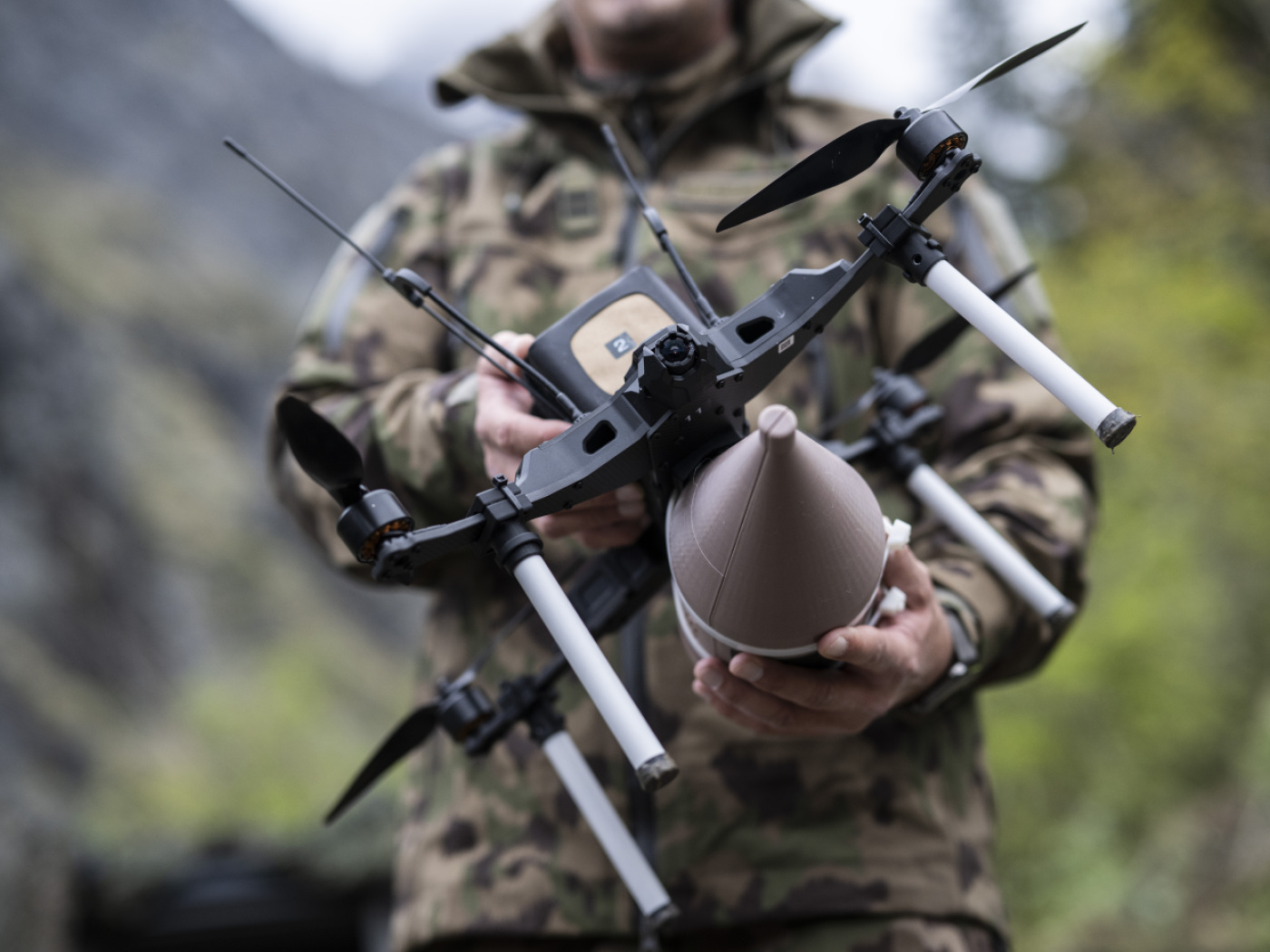
Following the discovery of a drone laden with explosives at Leipzig airport in Germany, Europe is asking itself how to protect infrastructure from increasingly sophisticated aerial threats.
Select your language
Generated with artificial intelligence.
Listening:
“Easier to attack than defend” against drones: Swiss expert
Switzerland, a country at the forefront of drone research, is taking steps to address the issue, but according to expert Roland Siegwart, the gap between attack and defence remains a cause for concern.
“Generally speaking, unfortunately, it has to be said that carrying out attacks with drones is much easier than defending against them, especially in a civilian environment,” says the professor of autonomous systems at the Swiss Federal Institute of Technology in Zurich (ETH) in an interview with Swiss public broadcaster SRF.

More
Inside Geneva: How to cope with killer robots
“You can’t simply fire randomly into the air, because of the risk of collateral damage. This means that there are still no truly reliable systems for shooting down drones with a reasonable expenditure of resources,” he added.
The main difficulty lies in the very nature of the devices. “Firstly, drones are very small and therefore difficult to detect, whether by radar or cameras,” explains the specialist, who works with Armasuisse, the Federal Office for Armament. “Secondly, defence systems are typically designed for aeroplanes: in that case, one can afford to fire ammunition costing half a million francs a round.”
Various defensive options
“With drones, one cannot simply fire cannons at sparrows. Small systems are needed, and it is by no means easy to develop them.”
+ “We have a unique opportunity to regulate autonomous weapons”
Researchers are exploring alternative approaches. “There are various groups around the world working on this issue. We, too, are studying a system to reliably detect drones, combining radar, infrared cameras and optical cameras,” said Siegwart.
“Once detected, they could be brought down with nets, using other drones or, depending on the situation, possibly by firing at them.”
“Switzerland, relative to its size, is in a very good position,” Siegwart said. “I have been in contact with Armasuisse’s German and Austrian counterparts and would say that our colleagues at Armasuisse are much better informed, understand the subject far better and know how to collaborate with universities. We are therefore relatively well positioned.”
The country boasts a favourable ecosystem. “Switzerland is very strong in the drone sector, particularly when it comes to civilian applications in research. There are several start-ups specialising in drone defence.”
“We won’t have a definitive solution within the next five months. But hopefully, sensible, cost-effective and, at the same time, reliable systems will become available fairly quickly,” Siegwart said.

More
Swiss want to better protect military airfields from spying
+ How we produce English news
Translated from Italian, reviewed by an English Department journalist.
External Content

In compliance with the JTI standards
More: SWI swissinfo.ch certified by the Journalism Trust Initiative

You can find an overview of ongoing debates with our journalists here . Please join us!
If you want to start a conversation about a topic raised in this article or want to report factual errors, email us at english@swissinfo.ch.