








Forty years on, Switzerland still sits on Haiti’s Duvalier millions

Switzerland prides itself on returning assets belonging to former dictators. Yet, after 40 years, Bern has still not found a use for $16 million (CHF13.2 million) linked to the late Haitian dictator Jean-Claude Duvalier. This is despite Swiss aid organisations having offered their support as early as 2019.
Select your language
Generated with artificial intelligence.
Listening:
Forty years on, Switzerland still sits on Haiti’s Duvalier millions
Within 18 days in February 1986, the dictatorships in Haiti and the Philippines came to an end. Jean-Claude Duvalier, known as “Baby Doc”, fled from Port-au-Prince to France on February 7. Ferdinand Marcos fled from Manila to the US on February 25. A month later, the Federal Council, Switzerland’s executive body, froze Marcos’s assets held in Switzerland under emergency legislation, marking a turning point in Switzerland’s handling of funds illicitly held by despots.
The Duvalier case was less spectacular in that the asset freeze in mid-April was imposed following the announcement of a Haitian request for mutual legal assistance. What initially appeared to be a routine procedure, however, was to develop into the longest and most complicated case to date of so-called “asset recovery” – the restitution of illegally acquired funds.
In Haiti, criminal proceedings against Duvalier never materialised. The Caribbean state was weakened following the end of the dictatorship and experienced several attempted coups. When, in 2002, it became apparent that mutual legal assistance would fail – and that the Duvalier funds would consequently be released – the Federal Council resorted to emergency legislation after all and ordered a three-year freeze on the funds, which were then estimated at around CHF7.5 million ($4.83 million). The government explained at the time that the aim was to prevent the Swiss financial centre from being misused as a haven for assets derived from dishonest activities.
After the freeze had been extended twice, and with the help of a lawyer funded by Switzerland, Haiti resumed the mutual legal assistance proceedings in May 2008. As the Duvalier family’s account holders were unable to prove the lawful origin of the frozen funds, the Swiss authorities decided in February 2009 to return the funds to Haiti to support development projects.
More
With US in retreat, can Switzerland maintain fight against kleptocracy?
But that was not the end of the matter either. Following two unsuccessful appeals by the Duvalier clan, the Federal Court, on January 12, 2010, overturned the order for the funds to be handed over on the grounds that the statute of limitations had expired and ordered the funds to be releasedExternal link. The judges appeared to have reservations about the ruling. This was indicated by their remark that the strict conditions governing mutual legal assistance needed reform.
Law aims to keep funds from Duvalier clan
On the very day that the Federal Court handed down its judgement, Haiti was struck by a devastating earthquake that claimed over 300,000 lives. “In light of the recent disaster, can we allow the Duvalier clan to keep the proceeds of its exploitation?” asks Swiss Foreign Minister Micheline Calmy-Rey in a newspaper articleExternal link. Her answer: “I don’t think so. For Switzerland, the Duvalier case is a legacy from a time when our financial centre’s defences against assets belonging to despots were still inadequate.”
On February 3, 2010, the day on which the Federal Court published its written judgement, the Federal Council once again pulled the emergency brake and froze the Duvalier funds. Parliament then responded: in October 2010, it passed a lawExternal link on the freezing, confiscation and restitution of dictators’ assets in cases where mutual legal assistance fails due to a lack of state structures in the requesting country.
This “Lex Duvalier” proved successful in that the Federal Council’s order to confiscate the former dictator’s assets became legally binding following a ruling by the Federal Administrative Court in September 2013 – 27 years after the funds were first frozen. The same law later enabled the confiscation of a further €4.2 million (CHF3.9 million), which had been deposited in a Geneva bank by the former Haitian finance minister, Frantz MerceronExternal link, and had remained undetected for a long time.

More
Explainer: Are Swiss banks still home to dirty money, or have they cleaned house?
This cleared the way for the final step in asset recovery: the restitution of the funds to Haiti. According to the law, this was to be achieved through the funding of programmes in the public interest. This was to be done either through an agreement between Switzerland and Haiti, which would regulate the nature of the programmes, the partners involved, and the control and monitoring arrangements; or by the Federal Council itself, should no agreement be reached with Haiti. Cooperation with international or national institutions is also possible in this context.
Foreign ministry cites Haiti’s precarious situation for delay
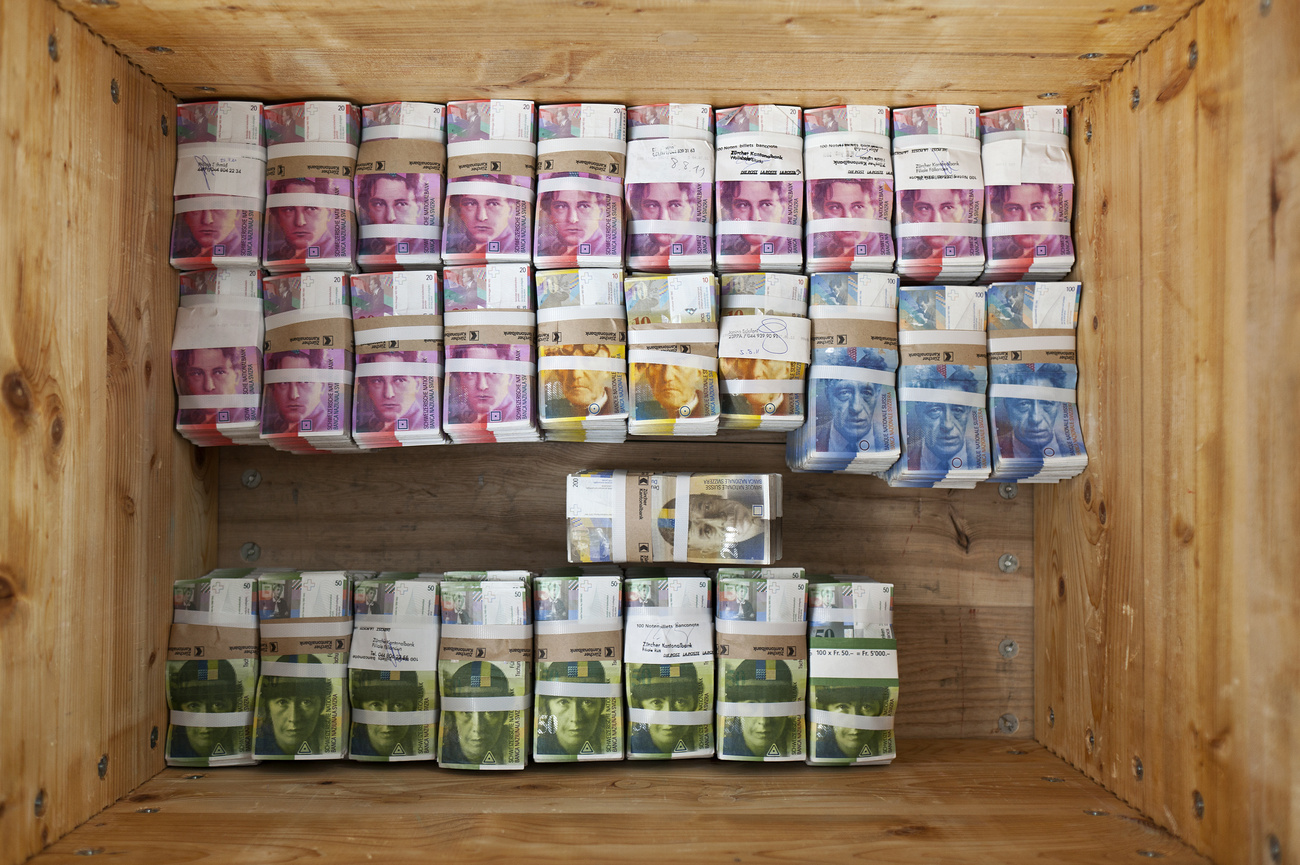
In the case of the Duvalier funds, no agreement has yet been reached with Haiti, nor has the Federal Council determined how the funds are to be used in Haiti. The sum now stands at around $16 million, as the foreign ministry announced in response to an enquiry from SWI swissinfo.ch. The funds are held in federal accounts with the Swiss National Bank and earn interest at market rates.
Explaining the further 13-year delay in the restitution, the foreign ministry stated that it had been examining projects in collaboration with various partners. Natural disasters had further weakened the country’s already fragile institutions. The situation, which remains very precarious, currently makes it impossible to resume negotiations on a restitution agreement. The search continues for programmes that can be implemented in a transparent and efficient manner.

What has not been previously reported is that, in September 2019, three Swiss non-governmental organisations (NGOs) with many years’ experience in Haiti offered Foreign Minister Ignazio Cassis their support in repatriating the Duvalier funds. This was in response to a newspaper report stating that Switzerland was on the verge of reaching an agreement with UNICEF on this matter.
The aid organisations in question are Suisse-Santé-Haiti (SSH)External link, the Swiss Partnership HAS HaitiExternal link (Schweizer Partnerschaft HAS Haiti, SPHASH) and the Swiss Aid Organisation for the Work and Legacy of Albert SchweitzerExternal link (Schweizer Hilfswerk für das Werk und Gedankengut von Albert Schweitzer, SHV). “We are convinced that, thanks to our many years of practical work in Haiti in the field of healthcare – particularly in maternal and child health – we are well placed to provide competent and effective support to the Swiss authorities in achieving their objectives,” states the 2019 letter to the Swiss foreign minister.
Foreign ministry rebuffs aid groups backed by ex-minister
The NGOs requested to be involved in the evaluation of projects and gave assurances that their commitment and field experience would ensure that the funds would benefit the people of Haiti in full. At a meeting with the foreign ministry in Bern in September 2019, the NGOs were accompanied by the former justice and finance minister, Eveline Widmer-Schlumpf. She had previously campaigned against the release of the Duvalier funds.
“I am a lawyer through and through, but I do not simply follow the letter of the law. The law must also be morally justifiable,” Widmer-Schlumpf said in an interview in 2010External link. She added: “Returning the unlawfully acquired funds to the Duvalier clan would not have been justifiable, either morally or in terms of foreign policy.” However, the foreign ministry did not take up the NGOs’ offer. It said it had taken note of their explanations, but that at the time of the meeting it was already pursuing a “concrete programme approach”. But this evidently came to nothing.

More
As aid stalls in Haiti, can attack drones and soldiers end gang violence?
The fact that Switzerland is still holding on to the funds more than four decades after the fall of the Duvalier regime and 12 years after the death of the former dictator shows that the conditions for restitution are among the most difficult aspects of asset recovery. The list of returned dictatorial assetsExternal link – totalling over CHF2 billion ($2.42 billion) – which appears impressive at first glance, masks the fact that the objectives of restitution have not always been achieved. Namely, to improve the living conditions of the population in the country of origin or to strengthen the rule of law there, thereby helping to prevent impunity.
Thus, the successor legislation to the “Lex Duvalier”External link, which came into force in 2016, proved ineffective in the very cases for which it was explicitly designed. This concerned the funds of Zine el-Abidine Ben Ali (Tunisia), Hosni Mubarak (Egypt) and Muammar al-Gaddafi (Libya) – totalling over CHF1 billion ($1.2 billion) – which were frozen in Switzerland during the Arab Spring. An attempt is currently pending before the Federal Administrative Court to return the funds of the ousted Viktor Yanukovych – which have been frozen since 2014 – to the Ukrainian state.
Plans for more efficient asset recovery procedures are in place: in its response to a parliamentary motionExternal link, the Federal Council recently referred to an ongoing revision of the law.

More
Our newsletter on geopolitics
Edited by Benjamin von Wyl. Adapted from German by Patrick Julian Huwyler/ds


See more Swissinfo articles in your Google results. Learn more

In compliance with the JTI standards
More: SWI swissinfo.ch certified by the Journalism Trust Initiative

You can find an overview of ongoing debates with our journalists here . Please join us!
If you want to start a conversation about a topic raised in this article or want to report factual errors, email us at english@swissinfo.ch.