








Swiss voters to decide on stricter rules for conscientious objection
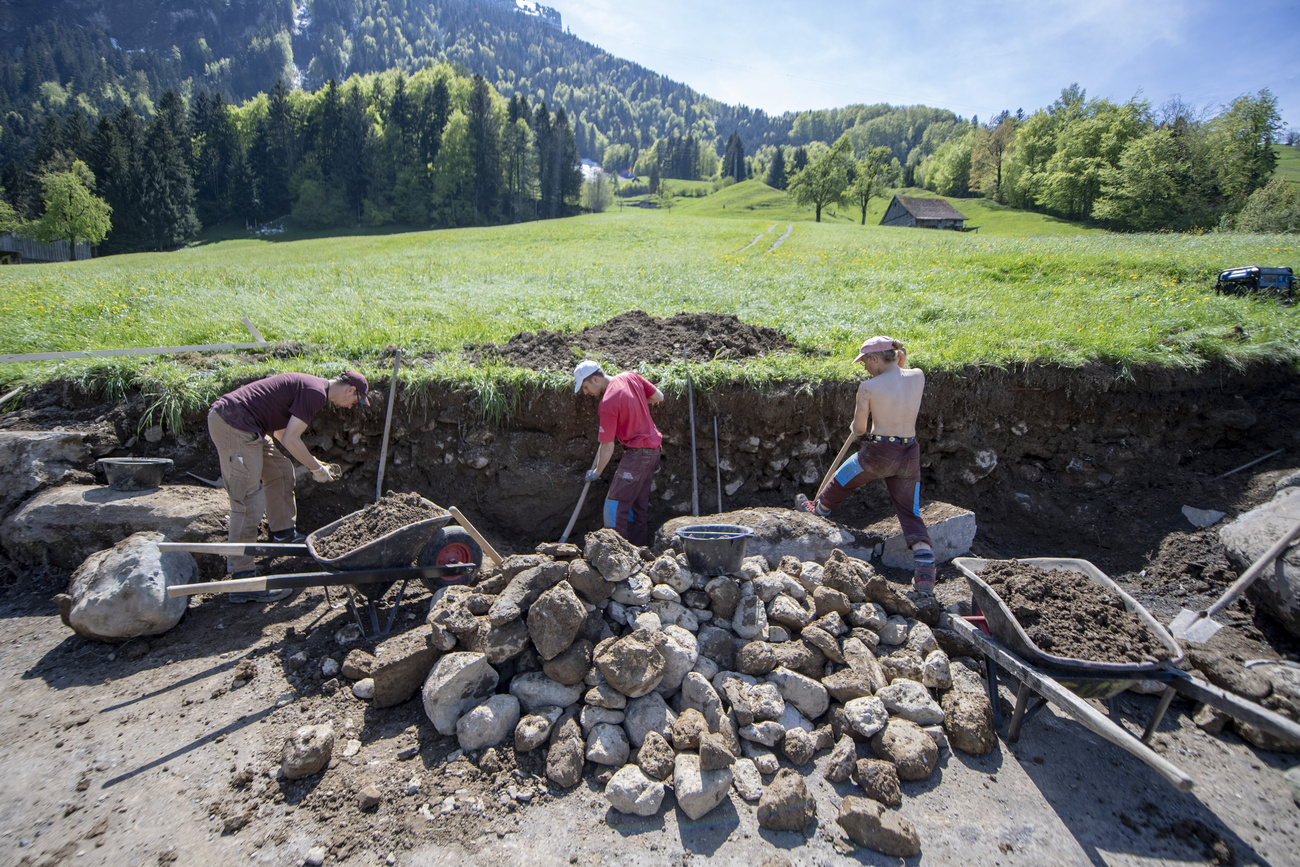
The Swiss parliament wants to make it more difficult to switch from military to civilian service. The goal of the measure, adopted against the backdrop of the war in Ukraine, is to bolster army numbers. The political left is against the reform, fearing it could be a first step towards scrapping civilian service entirely. Voters will decide on June 14.
Select your language
Generated with artificial intelligence.
Listening:
Swiss voters to decide on stricter rules for conscientious objection

What is civilian service and who can do it?
Civilian service is an alternative to military service. In order to be eligible, applicants must meet three criteria. They must be deemed fit for military service; have a conflict of conscience; and be willing to serve for one-and-a-half times longer than they would in the army.
Those performing civilian service are put to work in areas of public interest. Like their military peers, they receive compensation for loss of income during their service. Last year, 50% of civilian service days were carried out in the social sector, 18% in state education, nearly 15% in health care and just under 10% in nature and environmental protection.
External Content
In 2025 a record 7,211 people were accepted for civilian service in Switzerland. A third of applications were submitted after the basic recruit training. The number of service days completed – nearly 1.9 million – was also at its highest level since civilian service was introduced in 1996.
Civilian service should not be confused with civil protection. The latter is performed by those who are unfit for military service but able to carry out other duties to protect the public in the event of disasters or emergencies.
What does the reform entail?
Parliament wants to reduce admissions to civilian service by over 40%, from 7,200 to 4,000 a year. It has therefore tightened the requirements laid out in the Federal Civilian Service ActExternal link.
In future, those doing civilian service will be required to complete a minimum of 150 service days, regardless of how many days of military service they have already done. They will also have less leeway in planning what they do. The requirement that they complete a service period one-and-a-half times longer than standard military service will be extended to officers and non-commissioned officers.
Among the six measures designed to reduce the appeal of civilian service is the introduction of a kind of refresher course, to be completed annually from the year following admission to civilian service. The goal is to bring the conditions closer into line with those imposed on their army peers.
Military personnel who have no service days left to complete will no longer be able to switch to civilian service. This is to prevent them from easily avoiding mandatory shooting practice. Also, civilian service placements requiring medical, dental or veterinary studies will no longer be permitted – this is to make serving in the army more attractive for doctors.
External Content
Why is a vote being held?
In January an alliance of parties and associations submitted a referendum backed by 57,000 signatures against the tightening of the eligibility criteria for civilian service as decided by parliament in September 2025. With the title “Save Civilian Service”, the referendum is supported above all by the left-wing Social Democratic Party, the left-wing Green Party and the Protestant Party.
Arguments for the reform
The Swiss government and a majority in parliament believe that the high number of admissions to civilian service is problematic, particularly as regards military personnel who have completed the basic training, specialists and army officers.
According to a 2024 defence ministry report, 11,000 recruits leave the armed forces each year before the end of their compulsory service. An increasing number are opting for civilian service, while the number of departures for medical reasons has remained stable.
During the parliamentary debates, Economics Minister Guy Parmelin said civilian service had “become a problematic mass phenomenon, contrary to the original objective”. He stressed that civilian service should remain an “exceptional” solution for those experiencing a conflict of conscience.
The proposed measures aim to limit these departures and maintain troop numbers, against a backdrop of geopolitical tension marked by the war in Ukraine, which has been raging for four years on Europe’s doorstep.
Arguments against the reform
The opponents of the reform are convinced that civilian service plays a vital role in society. Civilian service personnel carry out their duties in sectors where staff shortages are the most acute. If their numbers were reduced by 40%, these services would simply not be replaced, critics warn.
Unlike the supporters of the reform, they believe that the army will not benefit from stricter conditions for accessing civilian service. Soldiers who do not wish to serve in the army will still have the option of obtaining a medical discharge.
Moreover, the opponents point out, the army is far from short of soldiers. By law, the armed forces must have 100,000 personnel, with a maximum threshold set at 140,000. Yet current numbers exceed this limit by 5%.
The alliance behind the referendum also condemns what it calls “salami tactics”. It fears that measures to tighten the eligibility criteria could basically undermine civilian service and ultimately lead to its abolition.

What next?
Whatever the outcome, this vote will certainly not be the last on the matter. The government is currently working on reintroducing the conscience test, which was abolished in 2009, following a motion adopted by the House of Representatives. The government also wants to introduce a compulsory information day about the army for women.
In June 2025, the House of Representatives approved a motion aimed at merging civil protection and civilian service to form a new entity called “disaster protection”.
If the Senate supports this proposal, the left is likely once more to gather signatures for a referendum, in a move to stop what it sees as efforts to dismantle civilian service.
Join the debate:
External Content
Edited by Pauline Turuban. Adapted from French by Julia Bassam/ts


See more Swissinfo articles in your Google results. Learn more

In compliance with the JTI standards
More: SWI swissinfo.ch certified by the Journalism Trust Initiative

You can find an overview of ongoing debates with our journalists here . Please join us!
If you want to start a conversation about a topic raised in this article or want to report factual errors, email us at english@swissinfo.ch.