








Will Switzerland cap its population and risk EU ties?

Swiss voters are deciding on whether to impose a population cap that could ultimately force the country to scrap its free movement agreement with the European Union, alongside a reform designed to make civilian service less attractive. Results are due late Sunday.
Select your language
Generated with artificial intelligence.
Listening:
Will Switzerland cap its population and risk EU ties?

The “No to 10 million” immigration initiative aims at limiting the Swiss population to 10 million until 2050. Currently about 9.1 million people live in Switzerland.
If the Swiss population reaches 9.5 million, the initiative would require government and parliament to adopt measures to curb population growth.
The free movement of people agreement with the EU is at stake
The initiative would oblige Swiss authorities to introduce measures to reduce net immigration. In the asylum sector, for example, this could mean that provisionally admitted people would no longer be granted permanent residence permits. In a second stage Switzerland could re-negotiate international agreements that contribute to population growth. Because most immigration comes from EU and EFTA countries, Switzerland could be ultimately required to terminates its free movement of people agreement with the European Union.
The right-wing Swiss People’s Party, who launched the initiative, argues that immigration is putting a strain on Switzerland, referring to it as “pressure from population density”. It calls for “sustainable population development”, which is why it also refers to the proposal as the “sustainability initiative”.
The government and parliament both reject the initiative, and none of the Swiss governing parties except of the People’s Party backs it. The opponents argue that the initiative undermines the bilateral approach with the EU and endangers Switzerland’s wealth. This is because the country depends on immigration to recruit enough skilled workers and maintain the social security system.
>> Learn more about the ‘No to 10 million’ immigration initiative.

More
‘No to ten million’ vote – should Switzerland cap its population?
According to the latest poll commissioned by the Swiss Broadcasting Corporation (SBC) and conducted by gfs.bern Swiss voters would have declined the initiative in late May: 45% of the respondents were in favour of it, while 52% were against it; 3% said they had not made up their mind yet.
>> What do you think: Should Switzerland cap it’s population?
More

Immigration has boosted Switzerland’s economy but repeatedly challenged its political system. This initiative is the latest attempt in a series of initiatives on the topic.
Civilian service reform under scrutiny
Separately, the Swiss vote on a reform of the civilian service. Parliament has decided on a reform of the Federal Civilian Service Act to make it harder to opt out of compulsory military service in favour of civilian service. The government and a parliamentary majority argue that the reform is necessary to maintain troop levels, which they see as increasingly important amid heightened geopolitical tensions.
Swiss voters have a say because an alliance of parties and associations submitted a referendum against the reform backed by 57,000 signatures. With the title “Save Civilian Service”, the referendum is supported above all by the left-wing Social Democratic Party, the left-wing Green Party and the Protestant Party.
Reform opponents argue that the army is not short of personnel and reject the claim that stricter rules for civilian service will strengthen military numbers. In their view, soldiers who do not wish to serve in the army will still have the option of obtaining a medical discharge.
>> Read more about the referendum against the civilian service reform.
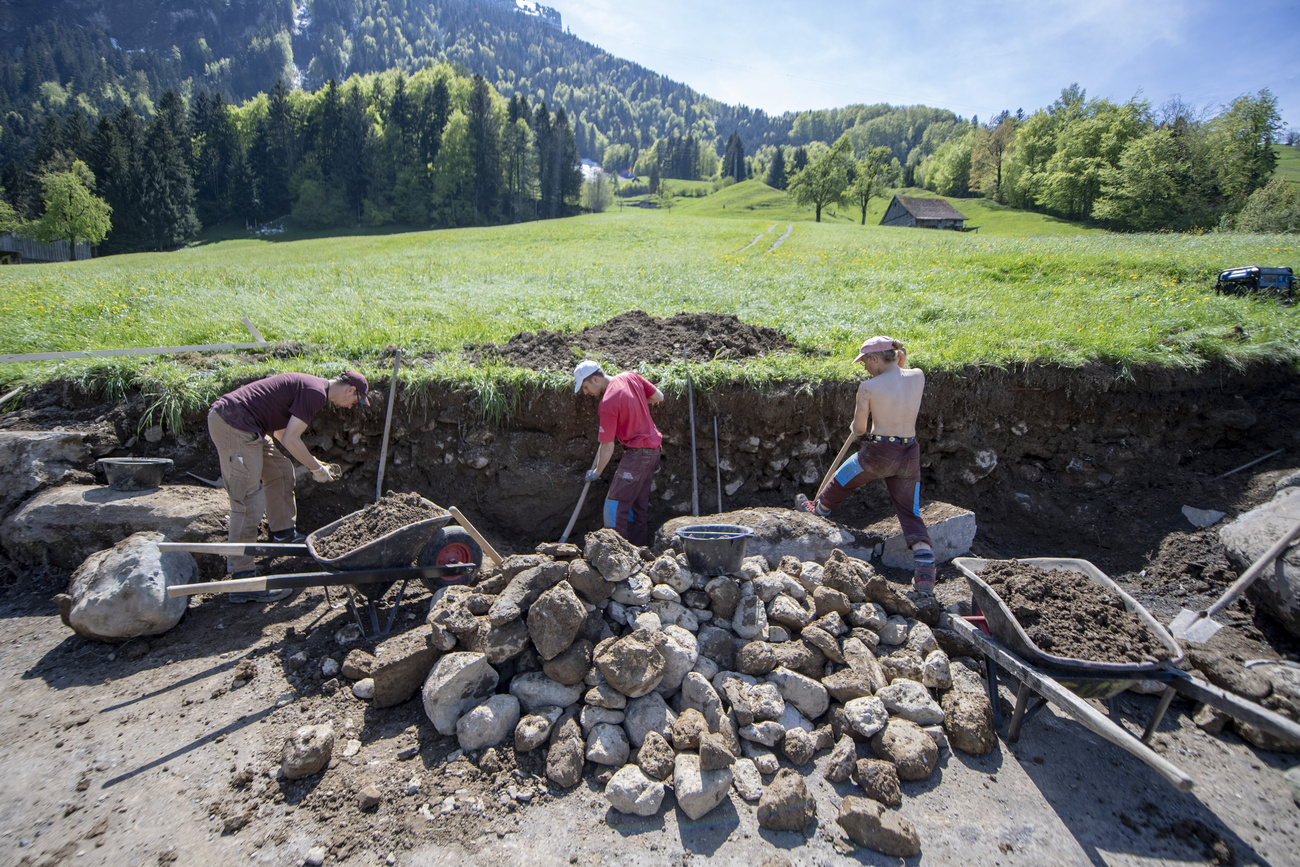
More
Swiss voters to decide on stricter rules for conscientious objection
If the voters had gone to the poll in late May, the outcome of the vote would have been a close call. According to the SBC poll (embed link) 48% of the respondents were in favour of the civilian service reform, while 46% would have supported the referendum. 6% were still undecided.
Swiss citizens go to the polls up to four times a year, but not everyone living in Switzerland can vote on June 14. Only Swiss citizens over the age of 18 and not under guardianship are eligible to vote on national issues. Voters can have their say either by postal ballot or in person at the ballot box. Those living abroad must register. A total of around 5.6 million people can vote – just under two-thirds of the country’s population of around nine million.
People living in Switzerland who do not have Swiss nationality cannot vote, despite making up about a quarter of the population.
Around half of eligible voters usually cast ballots. Over the past ten years, the annual average voter turnout has been between 41% and 57%, according to the Federal Statistical Office. In practice, this means it takes less than 1.5 million votes to win.
Regional votes on minimum wage and religious symbols
Votes are also being held in many cantons. In the canton of Vaud, for example, voters are deciding whether to enshrine a minimum wage of CHF23 ($29.40) gross per hour in the cantonal constitution. Five cantons in Switzerland have already introduced a minimum wage: Neuchâtel, Jura, Geneva, Ticino and Basel City (amounts between CHF18.75 and CHF24).
In Geneva, voters decide if visible religious symbols should be banned in parliament. A respective regulation was introduced in 2019 but was later overturned by the courts. Parliament has now decided to reintroduce it, which triggers a mandatory referendum. Supporters as the People’s Party, the Radical-Liberals or the Center Party invoke institutional neutrality, whilst opponents see a ban as a disproportionate infringement of fundamental rights.
Edited by Samuel Jaberg/ds

In compliance with the JTI standards
More: SWI swissinfo.ch certified by the Journalism Trust Initiative

You can find an overview of ongoing debates with our journalists here . Please join us!
If you want to start a conversation about a topic raised in this article or want to report factual errors, email us at english@swissinfo.ch.