








Sherlock Holmes and the mystery of his endless afterlife

It is a bright May morning in the Swiss Alps, the occasional fluffy cloud setting off the clear blue sky. The sun is shining, but the air is cool. Perfect weather, we agree, for murder.
Select your language
Generated with artificial intelligence.
Listening:
Sherlock Holmes and the mystery of his endless afterlife
The killing in which we are to participate will be violent, but it won’t be a spontaneous moment of fury. On the contrary, it is long-planned. For months we have been receiving instructions for our rendezvous, which urge us to adopt aliases and wear disguises. Later, I will discover that branches of both the Swiss and British governments have been involved. Just how high does this thing go?
External Content

One answer to that turns out to be 2,700ft: the altitude of the narrow path on which I’m now waiting, next to a waterfall. Above us, the water gushes through a hole in the rock before falling hundreds of feet to a pool below. A slip would be deadly. In front of us are two men. One is dressed for the opera – or he would be if we were in the 19th century – with a dinner suit, top hat and black cloak. The other is wearing a tweed cape and a deerstalker. With a cry, the man in the top hat charges, and the pair wrestle, each trying to push the other over the edge.
Then, just as it seems that the man in the deerstalker has won, they pause, adjust their clothing and do it all again, so that the TV news crews can get a better angle. The Sherlock Holmes Society of London, for that is who we are, is on its once-a-decade pilgrimage to the Reichenbach Falls.
It was here that, in 1891, our hero was thought to have plunged to his death, locked in the arms of his nemesis, Professor James Moriarty, “the Napoleon of crime”. To mark the occasion, nearly 60 of us have spent three days touring Switzerland dressed as Victorians. There is a part of me that is aware that this is all very silly. After all, I say to myself, as I sweat under my own top hat and frock coat, I’m not that into Sherlock Holmes.
I’m here, I keep telling people, because I’m interested in the huge cultural footprint that has been left by Sir Arthur Conan Doyle’s creation. “I hear of Sherlock everywhere,” notes the detective’s brother Mycroft, predicting the future better than anyone could have guessed, in the 1893 story The Adventure of the Greek Interpreter.
Holmes is regularly high on the lists of fictional characters most portrayed on screen, up there with Father Christmas and Dracula. Even if you’ve never read one of the stories, you know who he is. And you’re only going to see more of him, because Conan Doyle’s works are now out of copyright, so the character is anyone’s to play with.
Right now, you can watch Watson, a modern-day series that follows Holmes’s sidekick as he returns to medicine, and Young Sherlock, a Guy Ritchie interpretation best described as “very Guy Ritchie”. Next year we’ll see Rafe Spall in The Death of Sherlock Holmes. That’s just television. Adrian Braddy, editor of Sherlock Holmes Magazine, says it publishes more than 80 reviews of new spin-off books a year. And The Regent’s Park Open Air Theatre in London, round the corner from Baker Street, has just put on a new play, Sherlock Holmes.
This is all before we get to the character’s real-world footprint. It is not simply that the walls of Baker Street underground station are tiled with his instantly recognisable profile. The statue of Holmes outside the station is one of at least five around the world. In the past month, I’ve visited three museums dedicated to him. Last year he got a Lego set.
More
Sherlock Holmes
But what most interests me about Holmes is another facet of his strange life: people write to him. The first recorded letter to the detective arrived in 1890, when a Philadelphia tobacconist requested a copy of his monograph on tobacco ash (Holmes claimed to be able to identify 140 types). For a long time, people wrote to him care of Conan Doyle: although he gave his character the address of 221B Baker Street, the numbers in the road didn’t go that high. But in the early 1930s, two things happened. First, the council declared all the bits of road in line with Baker Street to be part of the same thoroughfare, adding, at the northern end, numbers above 200. The second was that the Abbey Road Building Society built its new headquarters from 219-229 Baker Street, a block that effectively included 221B. In 1935, the first letter arrived.
The bank decided that letters to Holmes should get replies and, in a light-hearted decision that would have long-lasting consequences, opted to play along. A correspondence secretary would explain to writers that, as explained in the books, Mr Holmes had retired to Sussex. The letters began to flood in and continued for decades. There were invitations to speak, requests for signatures and, of course, pleas for help in solving crimes. They continue to this day, though since the Abbey became part of Santander, they go to the Sherlock Holmes Museum up the street.
This is where I should declare an interest. My upcoming series of novels is about a present-day correspondence secretary to Holmes who decides to solve one of the crimes in the letters, using the tools of his hero, only to discover that this isn’t quite as straightforward as it looks in the books.
In my research, I quickly learnt that the Abbey hadn’t been the only people playing with Holmes. In the 1930s, a group of distinguished authors were inventing what has become known as “The Game”. The premise is simple: imagine that Holmes is a real person, and try to assemble the facts of his life from the stories.
The Game started as an attempt at satirical theology. Ronald Knox, a Catholic priest and writer of detective fiction, wanted to mock biblical scholars who argue that inconsistencies in the gospels prove they were written by other authors. Knox published his own essay on the contradictions in the Holmes stories. Conan Doyle wrote with tremendous speed, and wasn’t good at checking the details of his own past work. At different points Watson is single, married or widowed. He has a war wound that changes in character and location over the years. Knox argued that all these showed the Holmes stories couldn’t possibly have been written by the same man, and proposed that there were, in fact, two authors.
Whatever Knox’s intention, his idea caught on. The Sherlock Holmes Society was formed in Britain to discuss these subjects. “The thing has become a hobby among a select set of jesters here and in America,” wrote one enthusiast, the crime writer Dorothy L Sayers. “The rule of the game is that it must be played as solemnly as a county cricket match at Lord’s: the slightest touch of extravagance or burlesque ruins the atmosphere.”

More
Sherlock Holmes creator’s Swiss skiing legacy: fact or fiction?
‘Fearful place’
This is the spirit in which we are touring Switzerland. Each of us has been instructed to select a character from the books (also known as The Canon) who we will play. We are to dress as them throughout. When I learn this, I am reluctant. However, I tell myself that this will be a fantastic opportunity to do research for the book series. My hero is supposed to be a Sherlock obsessive.
After a second inquiry about who I will be playing, I realise it can’t be put off. A search of the books reveals that Colonel Valentine Walter, a villain in “The Bruce-Partington Plans”, is described as a “very tall, handsome, light-bearded man of 50”. I can, I think, pull off three of those without effort.
We are assembling in Lausanne and, like Holmes, I travel to Switzerland by train. He was trying to throw off the pursuit of the villainous Moriarty. My suitcase is larger than I would usually take for a five-day trip, but I don’t usually pack a frock coat. In my hotel room, I put on my costume and consider the result in the mirror. On the one hand, I think I look quite dapper. On the other hand, I fear this is ridiculous. I have interviewed three prime ministers and once rode a Chinook into Kabul. I demand to be taken seriously.
At least it isn’t hard to find my group in the hotel lobby. The women are in huge dresses and the men are turned out for Ascot, except for one dressed as a Cambridge university rugby player – a character, as you’ll of course have guessed, from The Missing Three-Quarter. I immediately warm to them, as I do these days to any group where I’m among the youngest members. Still, I lean against a pillar, trying to keep my distance, telling myself that I’m not really one of them. And then I catch a glimpse of my reflection and realise that ironic detachment is harder to pull off when you’re wearing a top hat.
A woman bounds up to me: “We’re beyond excited! Which character are you?” I’m so taken aback by the enthusiasm that I can’t remember the answer. “Once you’ve purloined a role, you tend to keep it,” the man playing Moriarty tells me. He is admirably sinister, although I learn later that when he’s not doing this, he’s a barrister.
Moriarty is almost as famous as Holmes, but he appears directly in only two stories. Conan Doyle invented him for The Final Problem, a super-villain to match the super-detective. By 1893, having written two Holmes novels and two collections of short stories, the author was tired of his detective. He felt the stories were overshadowing the historical novels that he regarded as his great works.
Conan Doyle was searching for a way to kill Holmes when he toured Switzerland and visited the Reichenbach Falls. It was “a fearful place” where the water “plunges into a tremendous abyss” – the ideal spot for Holmes to die in a final heroic sacrifice, wrestling with his arch-enemy.

These days, the waters are rather less thunderous, because most of them are diverted into a hydroelectric generator. That there is any water at all is rumoured to be because the local authorities were persuaded to turn it back on, as it were, for our visit. We’ve also been joined by an observer from the British embassy, possibly in case someone takes things too literally and follows Holmes and Moriarty down into the abyss.
By now, I’m used to dressing up. Indeed, on the second day of the trip I make time to go back to the hotel to change into my dinner suit for the evening – it’s white tie, Moriarty informs me. The people on the trip are mainly male, but not exclusively. Heather Owen is playing Mrs Turner, an editing mistake: Conan Doyle forgot, when writing A Scandal in Bohemia, that Holmes’s landlady was called Mrs Hudson. Owen is a longtime member of the society. “It’s a game we play together,” she says. The appeal for her is the chance to explore late Victorian life. “It’s a picture of an age.”
More
How Queen Victoria transformed the Swiss tourism industry
Other women admit they’ve come along at the request of their husbands. Joan Blanksteen, who has travelled to join us from America, indicates her Victorian outfit. “If we ever get divorced, I’ll be able to show the judge what I had to put up with,” she says. Her husband Charles is giving a detailed explanation of the types of airgun that might have been available to his character, Colonel Sebastian Moran, who tries to kill Holmes in The Empty House. He has kept The Canon by his bed since childhood.
That was the story, published in 1903, in which Conan Doyle gave in to public clamour and brought Holmes back to life. It was a defeat for the author, an admission that these were the books people really wanted from him. But perhaps he’d always had it in mind: it was notable that, in The Final Problem, Holmes’s body was never found, leaving a way back for the character.
First superhero
The reaction to Holmes’s death had been extraordinary. It was reported that people in London were wearing black crepe. Conan Doyle received abusive letters. If you thought that parasocial relationships – where teenagers feel they really know Taylor Swift or Harry Styles – were a modern phenomenon, think again.
The very existence of the society, re-established in 1951 after the original fell into abeyance during the Second World War, is testament to this. Most literary societies are dedicated to authors, not characters.

I ask everyone I speak to why Holmes appeals. “I love how flawed he is,” says Laura Sparks, who has travelled from Canada. To others, he’s the first superhero, whose powers are observation and deduction. Holmes was a man of his moment. The stories are suffused with a late-Victorian optimism about technology and the future. The detective’s own scientific approach spoke to a belief that the world could be known, understood and mastered.
And then there is the storytelling itself. The Hound of the Baskervilles, written and published in just seven weeks, is a model of propulsive thriller writing, with a three-act structure that might have been mapped in a modern Hollywood studio. The tale is not a “whodunnit” – we’re told the name of the villain two-thirds of the way through – but a “howdunnit”: what is the mysterious beast that stalks the moor? Bonnie MacBird, a former Hollywood screenwriter who has written six bestselling Holmes adventures, says that “Conan Doyle’s style is, oddly, almost cinematic. Unlike his contemporaries, he uses dialogue extensively, but his descriptions are succinct and memorable. He sets the scene quickly and launches into the action with all the narrative drive of a film.”
But mostly fans love Holmes’s relationship with Watson. This is one of the great literary buddy stories: an odd couple who can’t be parted. Wives, perhaps as many as five, come and go unnamed from Watson’s life, but Sherlock remains constant.
“Holmes is so fully formed that it’s really just a pleasure to write into the character,” says Joel Horwood, who wrote the Regent’s Park production. “It’s like getting to play with Conan Doyle’s toys. The hardest thing is that he belongs so entirely and rightfully to the audiences. In Holmes, Conan Doyle had created a character so beloved that even he couldn’t kill him off.”
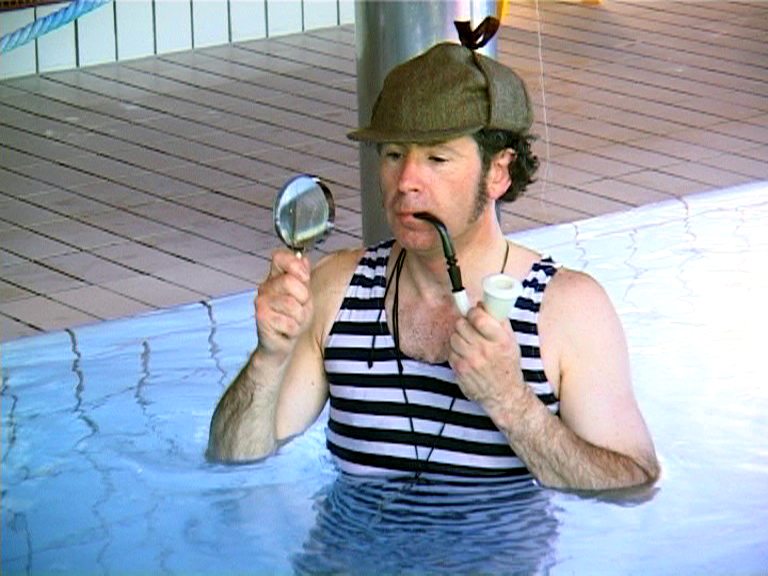
Even within Conan Doyle’s lifetime, the character was out of his control. Think of that silhouette: its distinctive parts are the inventions of other people. It was Sidney Paget, an illustrator with The Strand magazine, who gave Holmes his deerstalker, and the actor William Gillette, who took Holmes on stage, who put the curved pipe in his mouth.
For Sherlockians, screen adaptations are a mixed blessing. The BBC modernisation, starring Benedict Cumberbatch, was written partly with fans in mind, and contains treats for them: in the first episode, there’s a plotline about Watson’s wound moving. Views about Young Sherlock at society meetings could politely be called “mixed”. But adaptors can claim they have the author’s permission. When Gillette asked if he could marry Holmes off in the play, Conan Doyle replied: “You may marry him, or murder him, or do what you like with him.”
As we discuss these questions late into the night in the hotel bar, I realise that my claim to be a disinterested observer is self-deception. There is a reason why my wife gave me the classic Granada TV series on DVD 20 years ago, why the Holmes books are the first things I download to a new phone, why there is a photo of me reading A Scandal in Bohemia to my son on the day he was born. And there are many of us. As we stand on the Reichenbach Falls, watching Holmes and Moriarty wrestle for the cameras, a young Chinese woman walks round the corner, wearing a deerstalker. A student at Manchester University, she’d chosen that weekend to make her own private pilgrimage to the spot where her hero died. Seeing him made flesh before her, she was speechless. More than a century after his creator tried to kill him off, Sherlock Holmes still has that effect on people.
Copyright The Financial Times Limited 2026

In compliance with the JTI standards
More: SWI swissinfo.ch certified by the Journalism Trust Initiative

You can find an overview of ongoing debates with our journalists here . Please join us!
If you want to start a conversation about a topic raised in this article or want to report factual errors, email us at english@swissinfo.ch.