








How conscientious objectors’ activism led to the introduction of civilian service
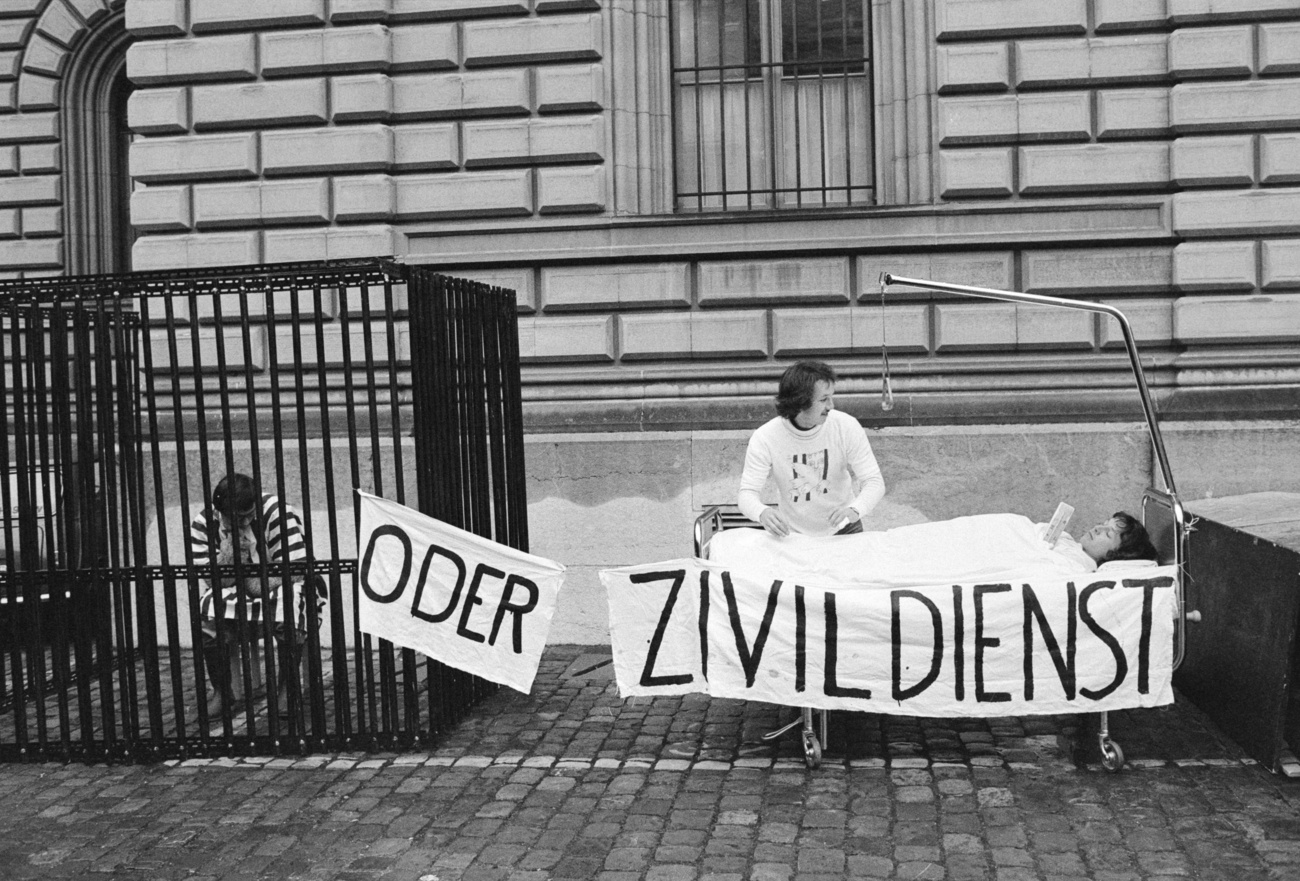
Conscientious objectors were for a long time a small minority in western Europe. In the 1960s, their numbers began to grow rapidly. A book by historian Niels Rebetez sheds light on the long struggle endured by those who refused to serve.
Select your language
Generated with artificial intelligence.
Listening:
How conscientious objectors’ activism led to the introduction of civilian service


For decades, refusing military service in Switzerland was not a legally recognised choice. Conscientious objectors were marginalised, prosecuted and sometimes dismissed by military courts as “deficient” or “selfish”. From the 1960s onwards, however, their numbers grew rapidly amid wider social and political protest movements.
In a bookExternal link published in May, Niels Rebetez traces the long struggle that ultimately led to the introduction of civilian service in 1996. His research is particularly topical given that Swiss voters decided on June 14 to restrict access to civilian service. Swissinfo spoke to him shortly before that referendum.
Swissinfo: Why did increasing numbers of men refuse compulsory military service from the 1960s onwards?
Niels Rebetez: The profile of conscientious objectors changed. Until then, most objectors justified their refusal on religious grounds, particularly Jehovah’s Witnesses. From the 1960s onwards, motivations became much more diverse. Political objection, in particular, grew alongside the emergence of organised activism in support of conscientious objectors.
Broader social changes also played a role. The protest movements of the 1960s challenged the traditional family model and conservative values. Those ideals were fundamentally at odds with the military’s emphasis on discipline, sacrifice and unquestioning obedience. At the same time, after the Second World War, young people spent longer in compulsory education, higher education or vocational training. That increasingly came into conflict with military service.
Niels Rebetez holds a PhD in contemporary history from the University of Fribourg. His book is based on his doctoral thesis, completed in 2023.
A specialist in oral and social history, he has also researched the history of the anti-psychiatry movement in French-speaking Switzerland. He has worked for several years as a scientific adviser, first for the Swiss parliament and later at the health ministry. He is currently head of LGBTIQ affairs at the Federal Office for Gender Equality.
SWI: Was the Swiss movement unique, or part of a wider international trend?
N.R.: It was part of a much broader phenomenon that extended beyond conscientious objection itself. Across western Europe, all forms of military service avoidance became more common, including desertion and unauthorised absences.
Switzerland nevertheless stands out in one important respect. It was one of the last countries in western Europe to introduce civilian service. Most neighbouring countries had already created a legal status for conscientious objectors.
Switzerland also remained more strongly attached to its military than many other countries, partly because it had not fought in the Second World War. The model of national defence based on conscription was therefore never fundamentally challenged and survived long after compulsory military service had begun disappearing elsewhere.

More
Why the Swiss civilian service model is an exception
SWI: Military service carried considerable social importance at the time, and refusing to serve could lead to criminal sanctions. Who were the men willing to take that risk?
N.R.: There was no single profile, but certain patterns emerge. They were often students or men working in the service sector. They also tended to come from urban areas. French-speaking Switzerland was also overrepresented compared with the German-speaking part of the country.
My research also identified another, previously overlooked group of very different people. These were men living in precarious circumstances, often from disadvantaged backgrounds. Many had no vocational qualifications, moved from one low-skilled job to another and faced multiple personal difficulties. For them, military service was simply one more burden in lives already marked by hardship.
SWI: What consequences did conscientious objectors face?
N.R.: The first consequence was imprisonment. Sentences ranged from a few days to more than a year. From the late 1960s onwards, however, the authorities acknowledged objectors whose motives were considered “honourable” and based on a serious conflict of conscience. They could receive a more lenient form of detention. They were imprisoned at night and on weekends but worked outside prison during the day, for example in hospitals. Those who did not receive this recognition served ordinary prison sentences alongside other convicted offenders.
SWI: What was prison like?
N.R.: It was a far from trivial experience. Objectors were exposed to the same prison conditions as everyone else: the risk of sex abuse, violence and arbitrary treatment.
For some, the consequences were devastating. During my research I identified three conscientious objectors who died in prison: two by suicide at Bellechasse prison and another who most likely died from a drug overdose.
More broadly, imprisonment often left lasting scars. Many former prisoners described the experience as deeply distressing, even traumatic. Some struggled for years to get over it.
SWI: In your book, you also describe longer-term consequences beyond prison.
N.R.: Yes, especially in people’s professional lives. In the private sector, some conscientious objectors lost their jobs or found it difficult to find new employment, although these cases are difficult to document. The effects are clearer in the public sector. Teachers and youth workers were particularly affected because the authorities feared they might exert a negative influence on young men.
There was also a question of principle. From the state’s perspective, it was difficult to accept that someone could work for the state while refusing to fulfil a constitutional obligation such as military service.
More
Swiss voters to decide on stricter rules for conscientious objection
SWI: You also examined how military courts treated conscientious objectors. How were they viewed?
N.R.: Military justice sought above all to explain what appeared, especially during the Cold War, to be an incomprehensible refusal to serve. Judges and court-appointed psychiatrists often struggled to understand such behaviour. Rather than taking objectors’ own explanations seriously, they looked for explanations in the individuals themselves.
Two interpretations recurred repeatedly. The first was that conscientious objectors were somehow deficient or suffered from “incomplete mental development”. This interpretation made it possible to explain behaviour considered irrational without questioning the military institution itself.
When that explanation did not fit, a second interpretation emerged: selfishness. Objectors were portrayed as people unwilling to accept any civic duty. The language became much harsher and could result in more severe sentences. In both cases, their motives were largely stripped of their political meaning and legitimacy.
SWI: What role did conscientious objectors play in the creation of civilian service?
N.R.: Their activism helped, over the long term, to prepare the ground and gradually make the idea of civilian service politically conceivable. Even so, the first two popular initiatives proposing civilian service, in 1977 and 1984, were decisively rejected by voters.
Voters finally approved its introduction in 1992. The end of the Cold War played a crucial role by making it acceptable to a majority of Swiss voters that some people should be allowed to perform an alternative form of national service on grounds of conscience.
Edited by Samuel Jaberg. Adapted from French by Catherine Hickley/gw

In compliance with the JTI standards
More: SWI swissinfo.ch certified by the Journalism Trust Initiative

You can find an overview of ongoing debates with our journalists here . Please join us!
If you want to start a conversation about a topic raised in this article or want to report factual errors, email us at english@swissinfo.ch.