








Why the Swiss civilian service model is an exception

Many of the 68 countries worldwide that impose compulsory military service offer a civilian alternative for conscientious objectors. While some such programmes bear similarities to the Swiss model, they are usually more restrictive and less accessible.
Select your language
Generated with artificial intelligence.

Listening:
Why the Swiss civilian service model is an exception

On June 14, Switzerland will vote on tightening the conditions for access to civilian service. Although other countries have comparable systems, in most cases there are significant differences.
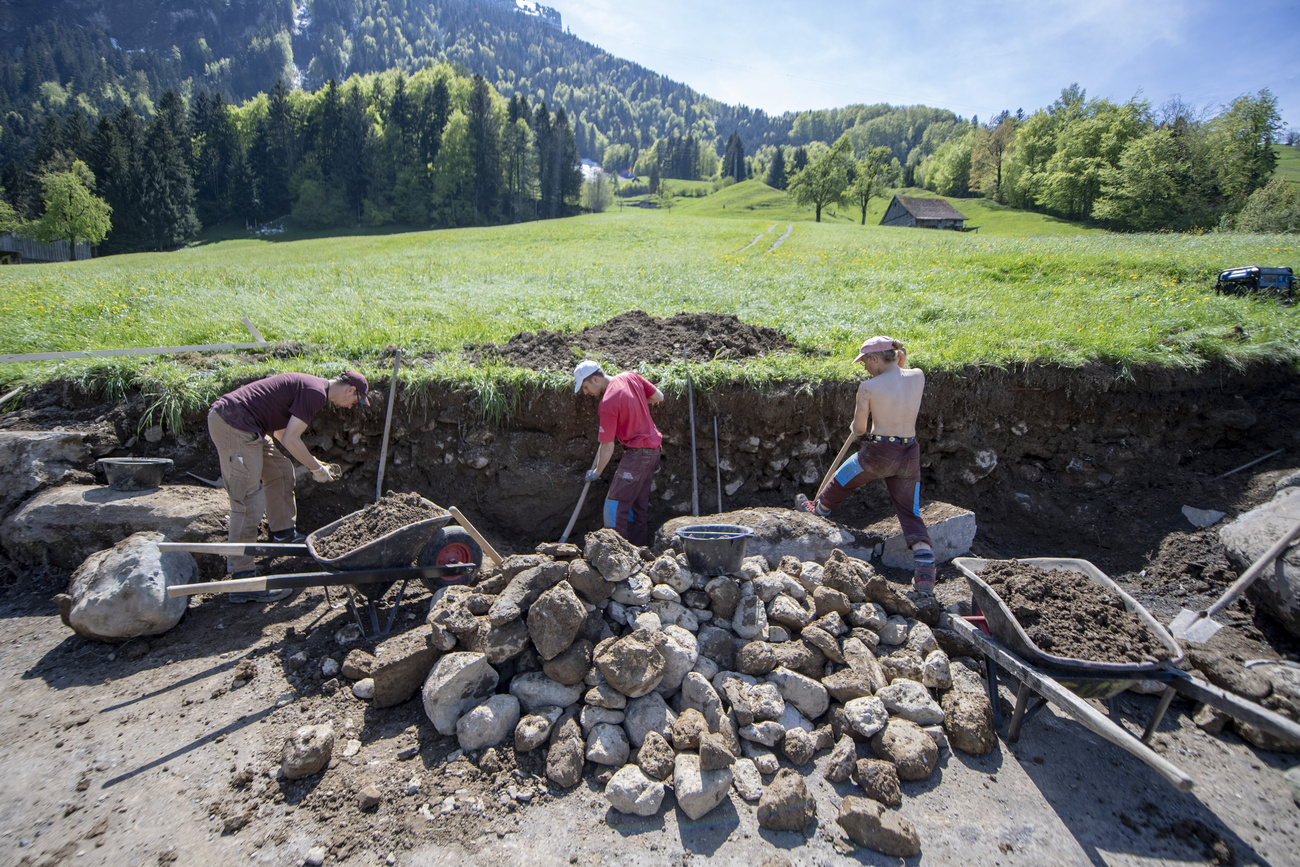
Civilian service is closely linked to the existence of conscription: it provides a non-military alternative for conscientious objectors; that is, for those fit enough for military service but unwilling to perform it due to their convictions.
More
Swiss voters to decide on stricter rules for conscientious objection
The right to conscientious objection is recognised by international human rights instruments (Article 9 of the European Convention on Human Rights and Article 18 of the UN International Covenant on Civil and Political Rights). It implies the existence of a civilian alternative that must, however, be non-punitive, accessible and independent of the military authorities. These conditions remain only partially met in some countries.
According to the World Population ReviewExternal link platform, 68 countries currently impose some form of compulsory service on at least part of their population.
Many European countries had abandoned conscription, but the Russian threat and a shortage of professional soldiers have reignited the debate on the need to reintroduce it. Lithuania, Sweden, Latvia and Croatia have decided to reinstate compulsory military service. Others, had never abolished it: they include Switzerland, Austria, Denmark, Finland, Norway, Estonia, Greece and Cyprus.

Austrian civilian service is closest to the Swiss model
Austria, which like Switzerland is a neutral country, is the only neighbouring state to maintain a general obligation to serve for male citizens aged 17 to 50. Its civilian service model is also the one that most closely resembles Switzerland’s. As in Switzerland, it is an alternative to military service for conscientious objectors, based on a contribution to the public good.
The Austrian system does, however, have several significant differences. Civilian service there lasts nine months and is carried out continuously. To be eligible, conscripts must submit a formal declaration within a specified timeframe.
Civilian service personnel are mainly assigned to the social and healthcare sectors: hospitals, care homes or emergency medical services. Assignments are allocated by an agency attached to the federal chancellery according to needs, profiles and available places.
In Switzerland, civilian service is generally longer and spans several years. It can be requested at any time, regardless of the stage of military service a conscript is at. Its duration is one and a half times that of the military service not yet completed: 368 days for those who have not yet attended recruit school.
Another major difference is that Swiss civilian service personnel organise their own placements. These cover a wider range of activities, such as the environment, agriculture and civil defence.
Finland has a similar system with an alternative civilian service for conscientious objectors. As in Switzerland, those entering civilian service must undergo preliminary training before their placement and find a position themselves with a recognised organisation. The Finnish system differs, however, in that men may also choose to perform unarmed military service.

In the Baltic states: defence-related alternatives
In the Baltics, Estonia and Latvia also offer alternatives to military service, but these differ significantly from the Swiss model. In Estonia, men subject to compulsory military service may opt for alternative service if they have a conflict of conscience. However, only a few dozen conscripts a year choose this option, which is also closely linked to national defence.
In Latvia, where conscription was reintroduced in 2024, the civilian alternative remains largely governed by military structures, to the extent that it does not constitute a truly separate option.
Lithuanian, Greek and Cypriot systems face criticism
In Lithuania, Greece and Cyprus, civilian service exists in theory, but it has been criticised for failing to comply with fundamental rights. In 2022, Lithuania was condemned by the European Court of Human Rights (ECHR) for violating freedom of conscience. The court ruled that alternative service under military control rendered it incompatible with genuine conscientious objection. Subsequently, the country amended its conscription law to meet international standardsExternal link.
Greece and Cyprus are regularly singled out for persistent violations of fundamental rights. In particular, they are criticised for the fact that decisions on eligibility are made by bodies linked to the military rather than by fully civilian authorities. Furthermore, applications based on religious beliefs are reportedly given greater consideration than those made on other grounds.
In South Korea, an alternative to imprisonment
Outside Europe, the case of South Korea is particularly notable and is often cited as a counter-example of civilian service. Until 2020, there was no alternative to compulsory military service in that country. Every year, hundreds of young South Korean men were sentenced to prison terms of around 18 months for refusing to perform military service on conscience grounds. These convictions meant they had criminal records, with lasting economic and social repercussions extending well beyond the period of imprisonment.

Since 2020, conscientious objectors have been able to perform alternative service. However, this scheme remains highly criticised: lasting 36 months, almost twice as long as standard military service, it can only be carried out in prisons. It is therefore often seen as an alternative form of imprisonment.
Repressive systems in Turkey and Eritrea
At the most restrictive end of the spectrum are systems where the right to conscientious objection is absent or widely violated. Turkey is one such country: despite several international condemnations, those refusing to serve face repeated criminal prosecution.

In Eritrea, the system goes even further. National service, compulsory for both men and women, is officially limited to 18 months, but in practice it is of indefinite duration and can last for several years or even decades. Refusal to comply exposes individuals to prison sentences as well as other forms of persecution.
In addition, conscripts are not only assigned to military duties, but also to civilian tasks, under forced conditions and for low pay. This situation has led some observers to describe the system as forced labour, or even comparable to slavery. In this context, national service is often portrayed as a tool for controlling the population, and sits at the core of the human rights violations regularly criticised in the country.
Edited by Samuel Jaberg. Adapted from French by Catherine Hickley/gw
External Content
Texte relu et vérifié par Samuel Jaberg

In compliance with the JTI standards
More: SWI swissinfo.ch certified by the Journalism Trust Initiative

You can find an overview of ongoing debates with our journalists here . Please join us!
If you want to start a conversation about a topic raised in this article or want to report factual errors, email us at english@swissinfo.ch.